
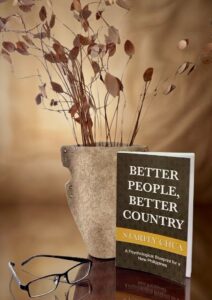
Better People, Better Country
A Psychological Blueprint for a New Philippines
by Starfly Chua
Better People, Better Country is a reflective and thought-provoking book that challenges the common belief that national progress begins with moral improvement. Drawing from personal experience, counseling practice, and contextual behavioral science, Nathaniel Chua explores why many well-intentioned efforts to change behavior—whether in individual lives, relationships, institutions, or society as a whole—often fail.
Rather than offering another set of moral prescriptions, the book invites readers to question the deeper assumptions behind how we think change happens. It argues that the real barrier to progress is not a lack of values, but a widespread pattern of anti-intellectual thinking—where rules, labels, and moral certainty replace careful observation, context, and functional understanding.
Bridging psychology, philosophy, and Philippine social realities, the book offers a different lens: one that shifts from judging people to understanding behavior, from enforcing rules to shaping environments, and from moral certainty to more flexible, evidence-based thinking. It is both a personal journey and a broader call for a more thoughtful, compassionate, and workable approach to change—within ourselves and as a nation.
Better People, Better Country is now available through selected Fully Booked branches in Metro Manila.
Also available worldwide through Amazon
Buy on Amazon (International Orders)
Why do well-intentioned reforms often fail to produce real change?
Why do corruption, mistrust, and division persist even when people sincerely want a better country?
In Better People, Better Country, Starfly Chua explores these questions through the lens of psychology, behavioral science, and social cooperation. The book argues that lasting national change does not come from moral appeals or policy reforms alone—it emerges from understanding how human behavior is shaped by context, incentives, and shared culture.
Part personal journey and part intellectual exploration, this book brings together ideas from modern psychology, governance research, and real-world experience to offer a new way of thinking about change—both in ourselves and in society.
Rather than asking “What’s wrong with people?”, the book asks a deeper question:
“What kind of environments help people become their best selves?”
Here are what some practitioners say about the book:
This book is a fascinating personal exploration and cultural adaptation of contextual behavioral science applied to psychotherapy. It takes you, with great clarity and humility, from the philosophical foundations of functional contextualism all the way to its practical applications in Acceptance and Commitment Therapy. The way it addresses the challenges of psychological well-being in the Philippines makes it a particularly valuable contribution.
Dr. Matthieu Villatte, PhD, Co-author of Mastering the Clinical Conversation: Language as Intervention
Better People, Better Country offers a transformative shift in perspective, moving from rigid cultural rules that invite moral shaming toward one of contextual understanding. Both deeply personal and extensively practical, Starfly Chua provides a psychosocial blueprint for change and progress at multiple levels of human existence. This book is an invaluable resource for the people of the Philippines because it moves beyond the exhausted cycle of demanding ‘better people’ and instead provides the tools to build ‘better contexts’ — systems that naturally support prosocial values that benefit citizens and country alike.
Lou Lasprugato, MFT
Peer-Reviewed ACT Trainer
For far too long, theories of human behavior and psychology have been relegated to the therapy room, used in private, and often at the individual level. We now have advanced psychological theories that can explain and help foster change at the societal level.
Chua reaches for the same shining star that famed behavior analyst B.F. Skinner once reached for, applying cutting edge behavior change technology to the community at large—not just for the purposes of greater mental health—but for more workable societies. Chua doesn’t just reach for this star, he grasps it firmly. Laid out in this book is a set of common sense reforms that could revolutionize the Philippines and the world at an achievable cost: our own willingness.
Jacob Martinez
Practicing Counselor
Wisconsin, USA
Where to Buy
You can purchase the book through Amazon or directly from the author.
Order from Amazon
The book is available internationally through Amazon.
This option is recommended for readers outside the Philippines.
👉 Order on Amazon: https://a.co/d/09yUutUq
Amazon handles printing, payment, and delivery.
Order Directly from the Author (Philippines)
Readers in the Philippines may also order a copy directly from the author.
Benefits of ordering directly:
• Possible signed copy
• Personal dedication available upon request
• Easier local delivery for Philippine readers
Price: ₱899.00 per copy
(Shipping not included)
To order, please send a message including:
• Your name
• Delivery address
• Number of copies
• Whether you would like the book signed or dedicated
You may order through:
📩 Email: [your email] or through our Facebook page.
I will reply with payment and delivery instructions.
About the Author
Nathaniel Chua is a counselor and writer based in the Philippines. He holds a Master of Arts in Counseling and works with individuals and couples through One Life Only Counseling Services.
His work draws from contextual behavioral science, psychology, and social research to explore how people and societies can build more cooperative, humane, and sustainable ways of living.
Better People, Better Country is his first book.
If you are interested in learning more about the ideas behind the book, you may also explore the vlogs and reflections on this website and Facebook page.
The Journey:
Better People, Better Country began as a personal belief: that improving individuals—becoming more disciplined, more moral, more authentic—was the key to solving life’s problems.
This idea shaped the author’s early work in counseling and his website, created in 2009. It reflected a widely held assumption: that personal change begins within the individual.
But over time, this belief gave way to a deeper inquiry.
This book traces the author’s journey in searching for a more precise explanation of human problems and societal inequality.
What emerged was not a new technique, but a different way of understanding behavior itself.
Drawing from Contextual Behavioral Science—including Acceptance and Commitment Therapy and Relational Frame Theory—this work reflects a shift not only in therapeutic approach, but in epistemology: how we think, how we explain, and how we define problems.
It does not deny the role of biology, personality, or individual differences. Rather, it argues that these factors alone are often insufficient to explain behavior in context. Human action is also shaped by learning histories, social environments, cultural norms, and systems of consequence.
From this perspective, many persistent personal and societal difficulties—including patterns of inequality—are maintained not only by behavior itself, but by unexamined assumptions about behavior—including essentialist labels, moral judgments, and rule-based ways of thinking that can limit flexibility and obscure context.
In the Philippine setting, these patterns can be understood within a broader historical and cultural context—including colonial influences and institutional traditions that have, at times, emphasized authority, compliance, and moral framing over open inquiry and contextual analysis.
The result is not flawed individuals, but often constrained ways of thinking about human behavior.
This book proposes a shift:
From asking “What is wrong with people?”
To asking “How are we understanding this behavior—and what does that understanding produce?”
This is both an epistemic and practical shift:
From essential explanations to contextual analysis
From moral judgment to functional understanding
From focusing solely on individuals to examining systems and environments
The title remains—but its meaning changes.
“Better people” does not refer to moral superiority or fixed traits. It refers to greater awareness of how we think about behavior, and the ability to question, refine, and choose more workable ways of understanding it.
Because when our understanding becomes more flexible, the possibilities for action expand.
At its core, this book is not about fixing people.
It is about improving how we make sense of people—and how that shift can lead to more effective, humane, and cooperative outcomes in individuals, relationships, and society.