When Your Faith Becomes a Mental Trap

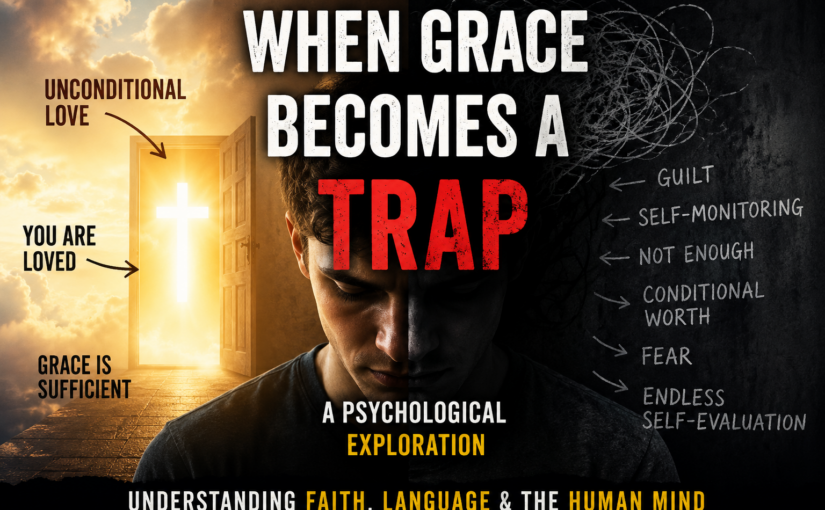
Have you ever listened to a sermon that says:

“You are loved unconditionally”…

but minutes later you begin wondering whether you are truly righteous enough, faithful enough, or transformed enough?

You leave inspired — but also anxious, guilty, and psychologically trapped.

This video explores how certain forms of religious language can unintentionally create chronic self-monitoring, fear, guilt, and endless spiritual self-evaluation.

This is not an attack on Christianity or faith.

It is an exploration of how language functions psychologically.

Drawing from contextual behavioral science, ACT (Acceptance and Commitment Therapy), and functional contextualism, I discuss:

rule-governed behavior
guilt as behavioral control
coherence traps
fusion with moral narratives
chronic spiritual self-monitoring
and why some people become experts at monitoring themselves spiritually instead of actually living

I also speak from personal experience as someone who once deeply preached and believed these systems myself.

The issue is not whether faith is “true” or “false.”
The issue is whether certain psychological patterns increase rigidity, fear, and suffering — or create greater flexibility, compassion, and humanity.

Many people today silently struggle with:

religious guilt
scrupulosity
fear of not being “saved enough”
compulsive self-monitoring
or the exhausting pressure to appear spiritually transformed at all times
These struggles are rarely discussed openly because they are often mistaken for spiritual weakness rather than understandable psychological processes.

My hope is that this conversation creates space for deeper reflection, honesty, compassion, and psychological freedom.
📌 Watch the full video below.

#Faith #Psychology #ACT #MentalHealth #Christianity #ReligiousTrauma #Spirituality #ContextualBehavioralScience #AcceptanceAndCommitmentTherapy #PsychologicalFlexibility #OneLifeOnlyCounseling

If you are looking for counseling or psychotherapy services in Quezon City, Manila, or elsewhere in the Philippines, you may message us at

0917 886 LIFE (5433)!

https://open.spotify.com/episode/4Jm0KWZ2aor0gKo2PDj3lj?si=c5cUF3LTScak30g9qIR-dQ

Panel Discussion on Scaling Up Contextual Behavioral Science from Individuals to Societies

​This video features a discussion hosted by Nathan Chua (One Life Only Counseling) with guests Eugene (an ACT practitioner and psychiatrist from Malaysia) and Jacob (a licensed counselor from Wisconsin).

Panel Discussion on Scaling Up Contextual Behavioral Science from Individuals to Societies

In this session, the panel explores how the principles of Contextual Behavioral Science (CBS) and Acceptance and Commitment Therapy (ACT) can be transitioned from individual clinical work to addressing broader societal issues. The discussion covers personal journeys into CBS, the role of language (Relational Frame Theory), and how system design can promote natural cooperation. ​

Key Topics & Timestamps:

​[00:00] – Introductions and the personal journeys of Nathan, Eugene, and Jacob into ACT and CBS.

​[18:01] – Scaling CBS: What changes when we move from helping individuals to influencing societies?

​[22:42] – The different “spheres” of society: Cultural, technological, and political dynamics.

​[24:21] – Marketing and RFT: How advertisers use behavioral science (often unconsciously) for capitalistic aims. ​

[30:58] – Human evolution and the challenge of cooperating in large populations vs. small groups.

​[35:45] – System Design: Creating contexts where cooperation feels natural rather than coerced.

​[41:59] – Observations from Malaysia: How “thought speak” and undercurrents of language influence racial dynamics and policy.

​[52:44] – The decline of trust in modern societies and how RFT explains the shifting function of government. ​

[01:05:07] – Dreaming of Change: Practical ideas for reform in transportation, education, and academia using a CBS lens. ​

Panelists: ​

Nathan Chua: Author and Counselor based in Metro Manila, Philippines. ​

Eugene Koh: Psychiatrist and ACT practitioner from Malaysia.

​Jacob Martinez: Licensed Professional Counselor from Wisconsin, USA.

​Resources Mentioned: ​

The Happiness Trap by Russ Harris

​Stumbling on Happiness by Dan Gilbert ​

ProSocial by Paul Atkins, David Sloan Wilson, and Steven C. Hayes ​

Bowling Alone by Robert Putnam ​

1984 by George Orwell (regarding “Newspeak”) ​

Better People, Better Country by Nathaniel/Starfly Chua

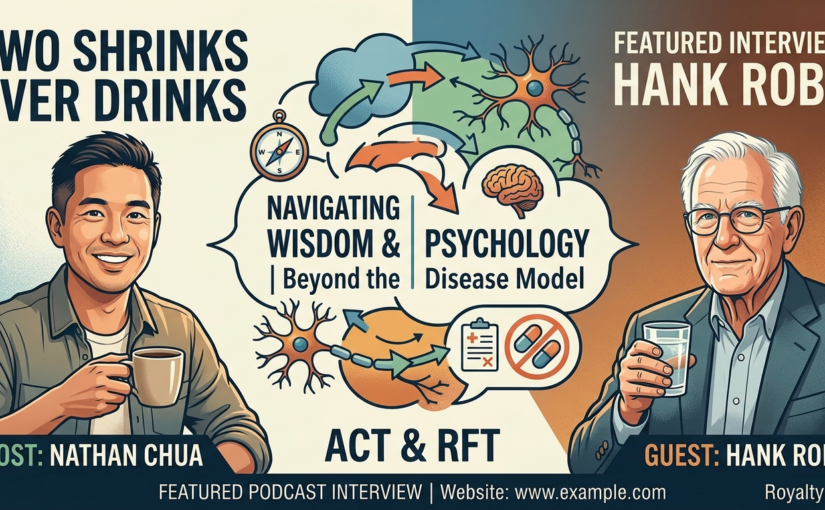
Two Shrinks Over Drinks: ​Navigating Wisdom & Psychology: A Conversation with Hank Robb

​How can we move beyond just being “healthy” to living wisely?

​In this episode of “Two Shrinks Over Drinks,” Nathan Chua sits down with Dr. Hank Robb, a seasoned psychotherapist from Portland, Oregon, and a prominent voice in Acceptance and Commitment Therapy (ACT) and Relational Frame Theory (RFT). ​

Together, they dive deep into the philosophy of behaviorism, the limitations of the DSM “disease model,” and how small groups can drive large-scale societal change. Hank shares his unique perspective on making complex psychological concepts simple, digestible, and—most importantly—actionable for everyday life.

​Key Topics Discussed: ​

[05:13] Technical Eclecticism: Why it’s okay to use diverse techniques but vital to stay grounded in a consistent theory.

​[13:00] The Power of “We”: Moving from joint attention to joint intention in therapy and relationships. ​

[16:14] Creative Hopelessness: Understanding the transformation of stimulus functions—when letting go of a failing strategy opens the door to new opportunities.

​[30:08] Misunderstandings of B.F. Skinner: A look at Skinner’s naturalism and why his denial of “supernaturalism” made him a controversial figure. ​

[53:30] Errors vs. Illness: Why focusing on “wisdom” and “wise choices” is often more helpful than traditional diagnostic labeling (DSM).

​[01:03:00] Scaling Change: How principles from Eleanor Ostrom and small, value-driven groups can influence communities and even entire countries. ​

About Hank Robb: Hank Robb, Ph.D., ABPP, is the author of Willingly ACT for Spiritual Development. He is known for his ability to translate the dense language of RFT into practical metaphors that help clients “willingly acknowledge, willingly choose, and willingly teach.”

​About the Host: Nathan Chua is a counselor based in Quezon City, Philippines, and the author of Better People, Better Country. ​

Connect with us:

www.onelifeonly.net

https://onelifeonly.net/order-the-book/ ​#ACT #Psychology #BehavioralScience

#MentalHealth #Wisdom #HankRobb #RelationalFrameTheory #Counseling #TwoShrinksOverDrinks

https://open.spotify.com/episode/7vnTD2k876ZMhfRi9A8VPn?si=SqFBTbaKSdek3pnVqSVrng

Could Suicide Be Predicted?

Why Suicide Risk Is Harder to Predict Than People Think

Most people assume therapists can predict suicide the way meteorologists predict storms. But modern psychological research tells a much more complicated story.

In this video, I discuss why risk factors are not the same as reliable prediction, how human behavior is deeply context-sensitive, and why many contextual behavioral scientists are becoming more cautious about the illusion of certainty in prediction.

This is also why therapy is not only about risk management and control, but about understanding suffering in real time, reducing isolation, building psychological flexibility, and helping people reconnect with workable ways of living.

A contextual behavioral science perspective on therapy, compassion, and human behavior.

#MentalHealth #Psychology #ACT #ContextualBehavioralScience #Therapy #Counseling #PsychologicalFlexibility

https://open.spotify.com/episode/0HIr9VTrEIiasV5Wzs9BPu?si=hyGwIDxxTd2aiedX81XZ4A


Why Avoiding Toxic People Doesn’t Always Work

Most advice says: “Just avoid toxic people.”

But what if you can’t?

What if that person is your boss, your spouse, your parent, or someone you can’t simply walk away from?

This is where most advice breaks down.

And this is where people start to feel stuck, confused, or even guilty.

If this is your situation, you don’t have to figure it out alone.

👉 Book a confidential session here.

We offer counseling sessions focused on helping you respond more effectively to complex relationship situations — without pressure, judgment, or one-size-fits-all advice.

The Problem with Oversimplified Advice

Advice like “avoid toxic people” works well on social media because it’s clear, direct, and emotionally satisfying. But it can also create guilt and confusion when people find that they can’t actually follow it.

You might start asking yourself:

“What’s wrong with me?”
“Why can’t I just walk away?”
“Am I weak for staying?”

In many cases, the issue is not weakness — it’s context.

A More Workable Question

Instead of asking:

“Should I avoid this person?”

A more helpful question is:

“What is workable in this situation?”

This shifts the focus from rigid rules to practical, real-life solutions.

What You Can Do Instead

Depending on your situation, more workable options may include:

Setting clear but realistic boundaries
Limiting exposure rather than cutting off completely
Changing how you respond in difficult interactions
Building support systems outside the relationship
Gradually creating options if leaving is your long-term goal

Avoidance is sometimes the right choice — but it’s not the only choice.

A More Flexible Way to Think About Relationships

From a contextual behavioral perspective, the goal is not to follow rules perfectly, but to respond in ways that actually improve your life over time.

Some relationships require distance.
Some require boundaries.
Some require patience and strategy.

And some, eventually, may require letting go.

But the key is this:

The best choice is the one that is workable in your real-life context — not just what sounds good in theory.

Watch the Full Video

Watch the full discussion above to explore this idea in more detail and learn how to apply it to your own relationships.

If this is something you’re going through, you’re not alone.

👉👉 Book a session here to talk this through

From Participant to Contributor: A Guest Segment for a PESI ACT Training

I was recently invited by Jacob Martinez, a licensed professional counselor from Wisconsin, to contribute to an international ACT training series in collaboration with PESI.

For many years, I’ve been on the other side of these trainings—as a participant, learning from international clinicians and trying to make sense of how these ideas apply in real-world settings.

This invitation marks a meaningful shift for me: from learning within that space to contributing to it.

In this 45-minute segment, I discuss a core distinction in contextual behavioral science:

Functional coherence vs essential coherence.

In simple terms:

Essential coherence asks: “Is this true? What is this really?”
Functional coherence asks: “Does this work? What does this lead to?”

Most of us—including many clinicians—are trained to think in essential terms: labels, traits, diagnoses, and fixed explanations about “what a person is.”

ACT takes a different approach.

Instead of focusing on what thoughts or emotions are, it focuses on what they do—how they function in context, and whether they help a person move toward a meaningful and workable life.

This shift may seem subtle, but it has wide implications—not just for therapy, but for how we understand relationships, culture, and social issues.

I’m sharing this here in the hope of making these ideas more accessible, especially within the Filipino context, where moral and label-based thinking are often emphasized.

Because the real shift is not just learning new techniques.

It’s learning to see behavior differently.

▶️ Watch the full 45-minute training here:

https://spotifycreators-web.app.link/e/bZHvvPXmV1b


Why Good People Break: A Psychological View of Les Miserables

If you feel stuck, overwhelmed, or constantly misunderstood…you don’t have to go through it alone.

In Les Misérables, Jean Valjean transforms after an act of compassion… while Inspector Javert cannot — even when shown mercy.

Many struggles in relationships, anger, anxiety, or burnout are not signs of weakness…
but understandable responses to painful life experiences.

Clarity and support can make a powerful difference.

If you or someone you care about is going through a difficult time, professional counseling can help you move forward with greater understanding, strength, and compassion.

Send a private message at +63 917 886 5433 to inquire or book a session.
Confidential and judgment-free.
Online sessions available.

This vlog explores powerful lessons from film and real life.

You don’t have to wait until things feel overwhelming to seek support.

#CounselingPH #MentalHealthPH #RelationshipHelp
#CouplesTherapy #OneLifeOnly

Being In Love or Being Loving? A Behavioral Look at Love – A Valentine’s Reflection

As Valentine’s Day approaches, we often ask: Are we still in love?
But psychology invites a quieter, more helpful question:
Are we being loving?

In this vlog, I explore the difference between being in love and being loving—not as a moral judgment, but as a practical way of understanding relationships.

Travel, dates, and special moments can make love feel easy.
But everyday life—stress, conflict, responsibility—creates a very different context.

This video looks at:

Why love often feels effortless in pleasant situations
Why relationships struggle in the day-to-day grind
How your relationship itself is a context, not just a feeling
Why being loving can serve as a compass when emotions fluctuate

This is not relationship advice or a checklist for couples.
It’s an invitation to look at love through a behavioral and humane lens—one that helps relationships hold up not just during the highs, but through the vicissitudes of life.

@onelifeonlycounseling

Being in love is a feeling. Being loving is a practice. Travel, dates, and special moments make love feel easy. Daily life—stress, conflict, responsibility—tests whether a relationship can hold. This reflection looks at love not as emotion alone, but as something we do, especially when it’s hard. A Valentine’s reminder: your feelings may change, but your compass doesn’t have to. 🔗 onelifeonly.net BeingLoving Relationships ValentinesDay LoveTalk Couples HealthyRelationships Psychology

♬ original sound – One Life Only Counseling – One Life Only Counseling

The Dog Whistle We Don’t Hear in Motivational Speaking

@onelifeonlycounseling

The kind of advice we don’t question. Ever notice how some motivational advice feels inspiring at first… then oddly heavy later? This video looks at a subtle pattern most of us feel, but rarely name. ▶️ Watch till the end. Motivation PsychologyTok MentalHealthPH SelfHelp #ThinkDeeper LifeAdvice PersonalGrowth FilipinoTikTok

♬ original sound – One Life Only Counseling – One Life Only Counseling