by Nathan Chua
This is part of a series on
BETTER EXPLANATIONS. BETTER SOLUTIONS.
A Contextual Conversation with Nathaniel Chua
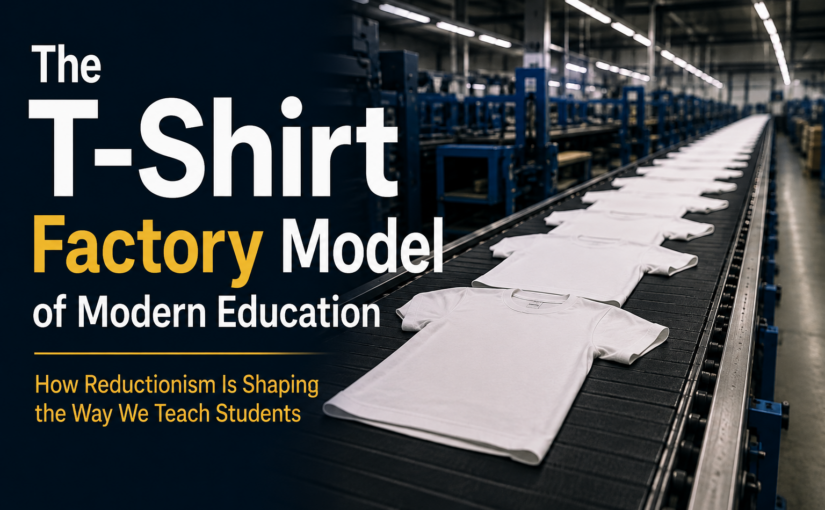
What if I told you that one of the biggest problems in modern education is that we’ve been treating students like T-shirts?
Think about how T-shirts are made.
Small.
Medium.
Large.
Every shirt follows the same pattern. The same measurements. The same production line. The same quality control process.
Factories are wonderful at producing identical products.
But now imagine applying that same logic to human beings.
Everyone starts school at roughly the same age.
Everyone studies almost the same subjects.
Everyone takes the same examinations or completes the same term papers.
Everyone is expected to graduate after roughly the same number of years.
And those who don’t fit the standard timetable are often seen as falling behind.
The problem isn’t that factories exist.
The problem begins when we borrow the factory’s way of thinking and apply it to people.
This way of thinking has a name.
It’s called reductionism.
Reductionism is the habit of treating something wonderfully complex as though it were much simpler than it really is.
Instead of seeing a developing human being with a unique history, family background, culture, strengths, struggles, interests, and opportunities, we reduce that person to a few measurable numbers.
Grades.
Test scores.
Class rankings.
Academic performance.
Now, don’t misunderstand me.
Schools need standards.
Assessment isn’t the problem.
The problem begins when standardization becomes our model of what a human being is.
Human beings are not products rolling off an assembly line.
They are developing, changing, adapting, and responding to the circumstances around them throughout their lives.
Some flourish early.
Others flourish much later.
Some learn best by reading.
Others by doing.
Some struggle because of trauma.
Others because of poverty.
Others because they’re simply developing at a different pace.
When we ignore these contexts, we begin asking the wrong question.
Instead of asking,
“How do we help this student flourish?”
we ask,
“Why doesn’t this student fit the system?”
A contextual approach turns that question around.
It asks,
“What conditions would allow this particular student to flourish?”
That is a very different way of thinking.
It doesn’t mean lowering standards.
It means recognizing that different people may need different pathways to reach meaningful goals.
So why has reductionism become so common?
Not because educators don’t care.
And not because schools are trying to harm students.
Reductionism is attractive because simplicity is efficient.
Standardized tests are easier to administer.
Uniform curricula are easier to manage.
Fixed timelines are easier to measure.
These systems help us organize education on a large scale.
But what’s easier for the system isn’t always what’s best for the student.
The irony is that education exists to develop human potential.
Yet when we become overly reductionistic, we sometimes begin treating students more like products than people.
And I don’t think this problem is limited to education.
We reduce students to grades.
Have you ever wondered what your report card didn’t measure?”
Then continue:
Your kindness.
Your resilience.
Your curiosity.
Your courage to keep trying after repeated failure.
Your ability to encourage another student.
Your capacity to love.
We reduce employees to productivity.
We reduce couples to personality types.
We reduce citizens to political labels.
We reduce entire generations to stereotypes.
We reduce people to diagnoses.
And then we wonder why so many people feel unseen.
Reductionism is the broader habit of oversimplifying complex human realities.
Essentialism is one form of reductionism.
When we reduce students to grades, people to labels, or partners to personality types, we stop seeing the living, changing processes that make them human.
Perhaps the challenge isn’t simply to improve education.
Perhaps it’s to change the way we think about human beings.
Not as products to manufacture.
Not as labels to categorize.
But as people continually developing within contexts.
Because better explanations create better solutions.
Human beings are not T-shirts.
They are not products.
They are not labels.
They are living processes.
And education should never forget that.
https://open.spotify.com/episode/7tPXIvKybGuonsx26xV7f5?si=91IUekR_Thi22AGtxoW_rw
@onelifeonlycounseling The T-Shirt Factory Model of Modern Education: How Reductionism Is Shaping the Way We Teach Students What if modern education sometimes treats students like T-shirts coming off a factory line? Same process. Same standards. Same expected outcome. But human beings are not standardized products. Grades and test scores can tell us something — but never everything. Maybe the better question is not: “Does this student fit the system?” but: “Does the system help this student flourish?” People are not T-shirts. Education Psychology Students Learning HumanPotential OneLifeOnly
♬ original sound – One Life Only Counseling – One Life Only Counseling