Life is about doing life.
Relationships are about doing relationships.
And love is about doing love.
Life is about doing life.
Relationships are about doing relationships.
And love is about doing love.
By Nathan Chua
We’ve often heard people say:
“I’ve learned so much from my past relationships. Now I know what to look for.”
But here’s a question worth asking.
What exactly did they learn?
Did they learn how to sustain a relationship? Or did they simply learn how to avoid another painful one?
Because breaking up doesn’t necessarily teach us how to stay together.
Sometimes, it simply teaches us how to break up better.
Think about it.
After a painful breakup, we often develop a list of things to avoid.
“I’ll never date someone like that again.”
“I won’t tolerate that kind of behavior anymore.”
“The moment I see a red flag, I’m out.”
And we call that learning from experience.
But what if some of those lessons actually make it more difficult for us to sustain our next relationship?
Let me explain.
When a relationship ends painfully, leaving can bring tremendous relief.
The arguments stop. The disappointments end. The anxiety subsides.
And naturally, we learn something from that experience.
We learn that leaving can make the pain go away.
Now, there’s nothing necessarily wrong with leaving. Sometimes, especially in harmful or abusive relationships, leaving is precisely what we need to do.
But here’s the interesting part.
What brings us relief isn’t necessarily what teaches us how to build something better.
If every disagreement reminds us of a previous painful relationship, we might become quicker to withdraw.
If we were betrayed before, we might become increasingly suspicious.
If our previous partner disappointed us, we might develop stricter expectations of the next one.
Without realizing it, we may become very good at protecting ourselves from relationships, rather than learning how to participate in them.
And there’s a difference.
You see, sustaining a relationship requires skills that breaking up doesn’t necessarily teach us.
It requires learning how to navigate differences.
How to have difficult conversations.
How to respond when our partner disappoints us.
How to recognize that the person we love will sometimes behave in ways we don’t particularly like.
And perhaps most importantly, how to distinguish between difficulties we can work through and situations we genuinely need to leave.
Unfortunately, we sometimes approach new relationships with old rules.
“If someone really loves me, they should know what I need.”
“If we argue too much, we’re probably incompatible.”
“If I feel unhappy, maybe I’m with the wrong person.”
But are these rules helping us build the relationship we want?
Or are they simply helping us avoid the pain we’ve experienced before?
Here’s something else to consider.
When we evaluate a potential partner, we often ask:
“Is this person right for me?”
But perhaps we should also ask:
“Am I learning how to become a better partner in this relationship?”
Because relationships aren’t sustained simply by finding someone who meets our expectations.
They’re also sustained by what two people learn to do together, especially when things become difficult.
Of course, not every relationship should be saved.
And staying together isn’t necessarily a measure of success.
Sometimes, ending a relationship is the most sensible and compassionate decision.
But leaving and staying require different skills.
And learning one doesn’t automatically teach us the other.
So the next time someone says they’ve learned a lot from their previous relationships, perhaps there’s another question worth asking.
Did those experiences teach you how to love better?
Or did they simply teach you how to leave sooner?
Because the real lesson from a breakup may not be about finding someone who will never disappoint us.
It may be about learning how to respond differently when disappointment inevitably comes.
And perhaps that’s where learning how to love actually begins.
Have you ever looked at your friends and wondered, “What happened to me?”
Maybe they’re earning more than you.
They have better jobs.
Bigger houses.
More impressive titles.
And you start thinking, “I’m already this old. I should have accomplished more by now.”
Our minds are very good at doing this.
They compare.
They rank.
They turn life into a scoreboard.
But here’s something I learned from Steven Hayes, one of the founders of Acceptance and Commitment Therapy.
Think about Abraham Lincoln.
Do you know how much money he had in his bank account when he died?
Probably not.
Do you know what awards or accolades he received?
Most of us don’t.
And here’s something even more interesting.
We don’t really remember Abraham Lincoln simply because he once became President of the United States.
There have been many presidents.
We remember Lincoln because of what he did while he was here.
We remember what he stood for.
We remember the choices he made when those choices mattered.
And maybe that’s something worth remembering when our minds start comparing our lives with other people’s lives.
Your job title is not your life.
Your salary is not your life.
Your awards are not your life.
Even your achievements are not your life.
They are things that happened in your life.
Your life is what you are doing with the moments you have.
So instead of asking:
“How successful am I compared with everyone else?”
Maybe we can ask a different question:
“What do I want to do with the life that’s in front of me?”
Maybe you want to be a loving parent.
A dependable friend.
Someone who shows kindness when kindness is difficult.
Someone who creates something worthwhile.
Someone who helps another human being.
Someone who keeps learning.
Someone who gets knocked down and chooses to stand up again.
Those things don’t require a prestigious title.
You can start doing them today.
Because perhaps we’ve been asking the wrong question.
It’s not:
“What have I achieved?”
It’s:
“What am I doing with the life I have?”
A meaningful life isn’t an award waiting for you at the finish line.
It’s something you do.
One choice.
One action.
One moment at a time.
And eventually, all those moments become the life you lived.
https://spotifycreators-web.app.link/e/B8x97A2uc7b
You may have heard the old saying that sometimes we become human doings rather than human beings.
But perhaps we miss something in that distinction. Being is also doing. Being human is something we do—moment by moment, choice by choice—as we create a life of meaning and purpose.
The human doing the old saying warns us about is the life spent chasing one achievement after another, as though a life could be measured by everything we manage to accomplish.
But living well is a different kind of doing. A worthwhile life is built much like a house: not all at once, but one brick at a time. So is a worthwhile relationship. We build it in the small things we do today, and then again tomorrow—the conversation we choose to have, the kindness we offer, the moment we stay when it would be easier to turn away.
There is no final brick called a meaningful life. The building is the living. Being human is this continuing process of choosing, moment by moment, what we want each moment to stand for. Each life is built from all those moments you showed up for.
The science of behavior offers us a different way of understanding our life choices, big or small. Human behavior can be better understood through the contexts that surround it rather than through some mysterious inner entity or parts within us that divide people into the good and the bad, the extolled and the condemned.
I’m pleased to share that the
Revised Edition of
Better People, Better Country:
A Psychological Blueprint for a New Philippines
is now available on Amazon!
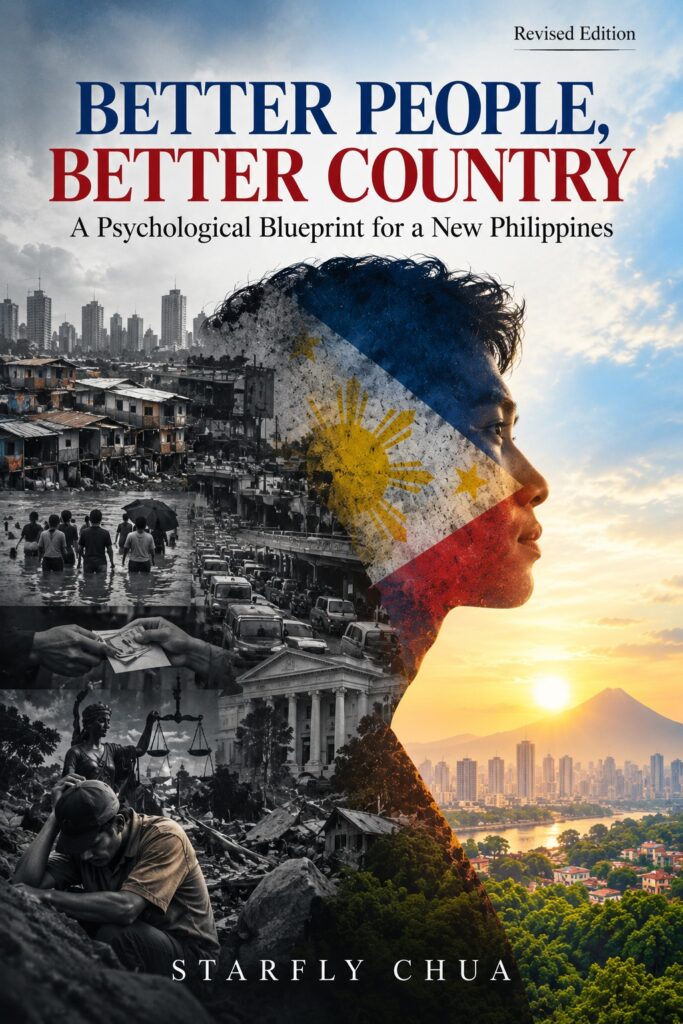
This revised edition gave me an opportunity to revisit the book, refine several arguments, update references, and clarify some of the ideas at the heart of it.
Better People, Better Country challenges a familiar assumption: that if we want a better country, we simply need to produce better people.
The book takes a different view.
Rather than asking what is wrong with Filipinos, it asks what happens when people encounter particular systems, institutions, incentives, rules, and social environments. It argues that many of the behaviors we readily attribute to character may be better understood by examining the contexts in which those behaviors develop and persist.
This is neither an argument for moralism nor for structuralism. People matter, and structures matter—but neither can be adequately understood in isolation from the contexts in which they interact.
At its heart is a hopeful proposition: we do not have to wait for people to somehow become better before we can build a better country. We can create conditions that make better ways of living and working together more possible.
The Revised Edition is now available in Kindle and paperback editions on Amazon.
— Starfly Chua
by Nathan Chua
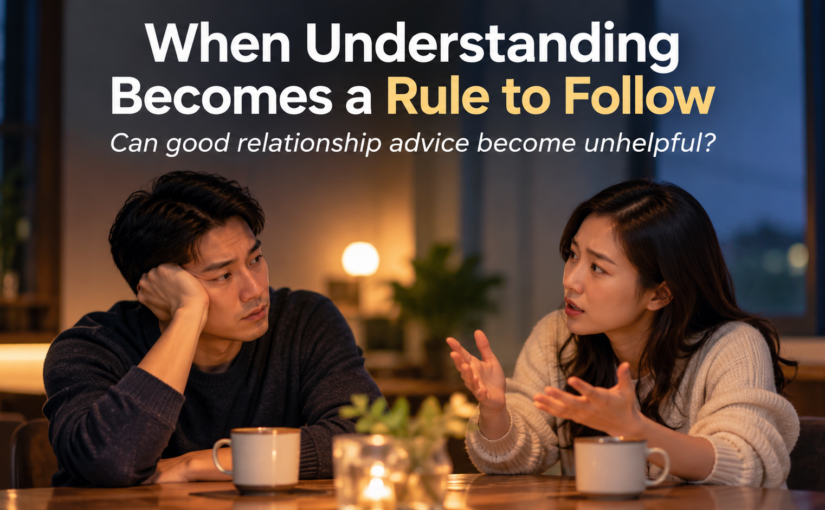
We often hear that the key to a good relationship is understanding your partner.
And of course, understanding can help.
But what if understanding itself becomes a rule that both must follow?
What if we start believing that every disagreement has to be explored, explained, processed, and fully understood before we can move on?
Imagine you’re having dinner with your partner.
The service is bad.
You want to complain. Your partner says, “Forget it. Let’s just enjoy dinner.”
Now you could spend the next twenty minutes trying to understand each other.
“Why does bad service bother you so much?”
“Why don’t you speak up when something is wrong?”
Maybe you discover that one of you is particularly sensitive to being treated unfairly. Maybe the other hates confrontation. Maybe you even understand exactly where those differences came from.
That’s useful.
But then what?
Because understanding doesn’t necessarily resolve the disagreement.
And maybe it doesn’t have to.
Perhaps the more useful question is:
What are we trying to do together right now?
We’re having dinner.
We’re on a date.
Maybe this isn’t a problem we need to solve.
One partner might say, “I know this bothers you more than it bothers me. Go ahead and speak to the manager.”
Or the other might say, “You know what? Bad service really gets to me. But tonight isn’t about fixing the restaurant. Let’s enjoy our dinner.”
Nobody has to win.
Nobody has to adopt the other person’s perspective.
And nobody has to be completely understood.
Understanding is not necessarily the goal. Understanding informs the choice.
It’s like watching a sunset together.
You say it’s orange. I say it’s red.
We could argue about it. We could investigate why we see it differently. We could even find out who’s technically correct.
But if we came there to watch the sunset together, at some point we have to stop trying to solve the sunset…
and experience it.
Maybe relationships are sometimes like that.
Not every difference needs resolution.
Not every disagreement needs deeper exploration.
And not every moment needs more communication.
Sometimes the better question isn’t:
“Do you understand me?”
It’s:
“What matters to us right now—and what would help us do that together?”
Listen on Spotify:
https://spotifycreators-web.app.link/e/WhJx0oY5M6b
@onelifeonlycounseling When Understanding Becomes a Rule to Follow: Can “You need to understand me” become a problem in a relationship? Not every disagreement needs to be resolved. Not every difference needs deeper exploration. Sometimes we already understand each other well enough. The better question may be: “What matters to us right now—and what would help us do that together?” Understanding is not necessarily the goal. Understanding informs the choice. Relationships Couples RelationshipAdvice Communication CouplesCounseling OneLifeOnly
♬ original sound – One Life Only Counseling – One Life Only Counseling
Thoreau sought a better life by stepping away from conventional society.
Skinner imagined building a better society so people wouldn’t have to step away from it.
Sometimes the problem is not simply the person,
but the context in which the person is trying to live.


A little author moment at a Fully Booked branch yesterday. 😊
I spotted Better People, Better Country on the shelf and, just for fun, pretended to be a customer and asked the salesperson if they had any more copies in stock.
“That’s the last copy,” she said.
I have to admit, that felt good.
These copies belong to the first printing of Better People, Better Country—and the only printing of this particular version.
Only 29 copies from this printing were supplied to Fully Booked, and each one is a little different from what will come later: they carry my personal inscription and include a bonus article at the back of the book.
To everyone who bought a copy, thank you. When I wrote this book, I wanted to start a conversation about something I care deeply about: perhaps building a better country begins not simply by demanding better people, but by creating better contexts in which people can flourish.
It means a great deal to know that people are reading it.
And somewhere at this Fully Booked branch yesterday, there was just one copy left on the shelf.😊