Why do ordinary people discriminate?
Why do neighbors become enemies?
Why do we so quickly divide the world into “us” and “them”?
For decades, psychology searched for the answer. At first, many believed prejudice lived inside certain kinds of people—that some individuals were simply intolerant or hateful.
But over the last seventy years, psychology has uncovered a much more surprising story.
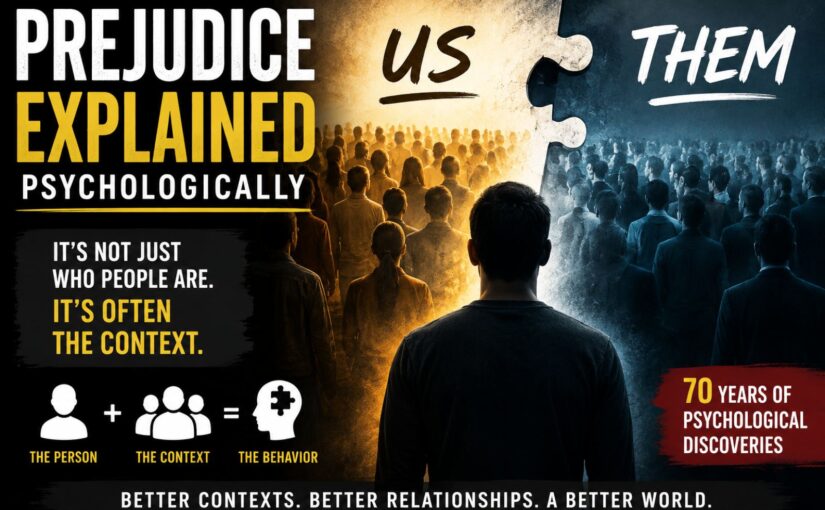
It turns out that prejudice is often not just a property of the person. It is also a product of the context.
The story begins with psychologist Kurt Lewin.
He proposed one of the simplest yet most influential ideas in psychology:
Behavior is a function of both the person and the environment.
That sounds obvious today.
But at the time, it was revolutionary.
It meant that we cannot fully understand people by looking only inside them. Every person exists within a web of relationships, culture, history, opportunities, barriers, and circumstances.
Change the context, and behavior can change.
A few decades later, another psychologist, Henri Tajfel, asked a different question.
How easily do human beings create “us” and “them”?
His famous experiments produced an uncomfortable answer.
People didn’t need centuries of hatred or deep ideological differences.
Simply dividing people into groups was often enough for them to begin favoring their own group over another.
In other words, prejudice was not just something hidden inside prejudiced individuals.
The context itself could create division.
Then psychologists Lee Ross and Richard Nisbett identified another common human tendency: the Fundamental Attribution Error.
When someone else makes a mistake, we explain it by who they are.
“They’re irresponsible.”
“They’re lazy.”
“They’re selfish.”
But when we make the very same mistake, we explain it by our circumstances.
“There was traffic.”
“I was exhausted.”
“I was under a lot of pressure.”
The same behavior.
Different explanation.
We notice the person.
But we overlook the context.
More recently, modern contextual psychology—including Acceptance and Commitment Therapy and Relational Frame Theory—has added another important insight.
Human beings survive because we use language.
We create names.
We create categories.
We create labels.
These are incredibly useful tools.
But sometimes we forget they are only tools.
Instead, we begin treating our labels as reality.
“He lied once”
becomes
“He is a liar.”
“She failed”
becomes
“She is a failure.”
“They are different from us”
becomes
“They are the enemy.”
The description becomes the person.
And that may be one of the deepest roots of prejudice.
Over the last seventy years, psychology has slowly moved in one direction.
Away from asking,
“What kind of person is this?”
and toward asking,
“What context helped produce this behavior?”
Understanding context does not remove responsibility.
It does not excuse harmful behavior.
It gives us a better chance of changing it.
Because if prejudice is simply “who people are,” then the story ends there.
But if prejudice emerges within contexts, then perhaps we can create better contexts.
Better families.
Better schools.
Better workplaces.
Better communities.
Maybe even a better country.
Perhaps the greatest lesson psychology has taught us is this:
People are more than the labels we give them.
@onelifeonlycounseling Prejudice Explained Psychologically Prejudice isn’t always about bad people. Sometimes it’s the result of how our minds naturally simplify the world. Understanding prejudice starts with understanding how the human mind works. Psychology Prejudice SocialPsychology ContextMatters CriticalThinking BehavioralScience FunctionalContextualism MentalHealth Philippines OneLifeOnly#fyp #foryou
♬ original sound – One Life Only Counseling – One Life Only Counseling