Life is about doing life.
Relationships are about doing relationships.
And love is about doing love.
Life is about doing life.
Relationships are about doing relationships.
And love is about doing love.
By Nathan Chua
We’ve often heard people say:
“I’ve learned so much from my past relationships. Now I know what to look for.”
But here’s a question worth asking.
What exactly did they learn?
Did they learn how to sustain a relationship? Or did they simply learn how to avoid another painful one?
Because breaking up doesn’t necessarily teach us how to stay together.
Sometimes, it simply teaches us how to break up better.
Think about it.
After a painful breakup, we often develop a list of things to avoid.
“I’ll never date someone like that again.”
“I won’t tolerate that kind of behavior anymore.”
“The moment I see a red flag, I’m out.”
And we call that learning from experience.
But what if some of those lessons actually make it more difficult for us to sustain our next relationship?
Let me explain.
When a relationship ends painfully, leaving can bring tremendous relief.
The arguments stop. The disappointments end. The anxiety subsides.
And naturally, we learn something from that experience.
We learn that leaving can make the pain go away.
Now, there’s nothing necessarily wrong with leaving. Sometimes, especially in harmful or abusive relationships, leaving is precisely what we need to do.
But here’s the interesting part.
What brings us relief isn’t necessarily what teaches us how to build something better.
If every disagreement reminds us of a previous painful relationship, we might become quicker to withdraw.
If we were betrayed before, we might become increasingly suspicious.
If our previous partner disappointed us, we might develop stricter expectations of the next one.
Without realizing it, we may become very good at protecting ourselves from relationships, rather than learning how to participate in them.
And there’s a difference.
You see, sustaining a relationship requires skills that breaking up doesn’t necessarily teach us.
It requires learning how to navigate differences.
How to have difficult conversations.
How to respond when our partner disappoints us.
How to recognize that the person we love will sometimes behave in ways we don’t particularly like.
And perhaps most importantly, how to distinguish between difficulties we can work through and situations we genuinely need to leave.
Unfortunately, we sometimes approach new relationships with old rules.
“If someone really loves me, they should know what I need.”
“If we argue too much, we’re probably incompatible.”
“If I feel unhappy, maybe I’m with the wrong person.”
But are these rules helping us build the relationship we want?
Or are they simply helping us avoid the pain we’ve experienced before?
Here’s something else to consider.
When we evaluate a potential partner, we often ask:
“Is this person right for me?”
But perhaps we should also ask:
“Am I learning how to become a better partner in this relationship?”
Because relationships aren’t sustained simply by finding someone who meets our expectations.
They’re also sustained by what two people learn to do together, especially when things become difficult.
Of course, not every relationship should be saved.
And staying together isn’t necessarily a measure of success.
Sometimes, ending a relationship is the most sensible and compassionate decision.
But leaving and staying require different skills.
And learning one doesn’t automatically teach us the other.
So the next time someone says they’ve learned a lot from their previous relationships, perhaps there’s another question worth asking.
Did those experiences teach you how to love better?
Or did they simply teach you how to leave sooner?
Because the real lesson from a breakup may not be about finding someone who will never disappoint us.
It may be about learning how to respond differently when disappointment inevitably comes.
And perhaps that’s where learning how to love actually begins.
Have you ever looked at your friends and wondered, “What happened to me?”
Maybe they’re earning more than you.
They have better jobs.
Bigger houses.
More impressive titles.
And you start thinking, “I’m already this old. I should have accomplished more by now.”
Our minds are very good at doing this.
They compare.
They rank.
They turn life into a scoreboard.
But here’s something I learned from Steven Hayes, one of the founders of Acceptance and Commitment Therapy.
Think about Abraham Lincoln.
Do you know how much money he had in his bank account when he died?
Probably not.
Do you know what awards or accolades he received?
Most of us don’t.
And here’s something even more interesting.
We don’t really remember Abraham Lincoln simply because he once became President of the United States.
There have been many presidents.
We remember Lincoln because of what he did while he was here.
We remember what he stood for.
We remember the choices he made when those choices mattered.
And maybe that’s something worth remembering when our minds start comparing our lives with other people’s lives.
Your job title is not your life.
Your salary is not your life.
Your awards are not your life.
Even your achievements are not your life.
They are things that happened in your life.
Your life is what you are doing with the moments you have.
So instead of asking:
“How successful am I compared with everyone else?”
Maybe we can ask a different question:
“What do I want to do with the life that’s in front of me?”
Maybe you want to be a loving parent.
A dependable friend.
Someone who shows kindness when kindness is difficult.
Someone who creates something worthwhile.
Someone who helps another human being.
Someone who keeps learning.
Someone who gets knocked down and chooses to stand up again.
Those things don’t require a prestigious title.
You can start doing them today.
Because perhaps we’ve been asking the wrong question.
It’s not:
“What have I achieved?”
It’s:
“What am I doing with the life I have?”
A meaningful life isn’t an award waiting for you at the finish line.
It’s something you do.
One choice.
One action.
One moment at a time.
And eventually, all those moments become the life you lived.
https://spotifycreators-web.app.link/e/B8x97A2uc7b
by Nathan Chua
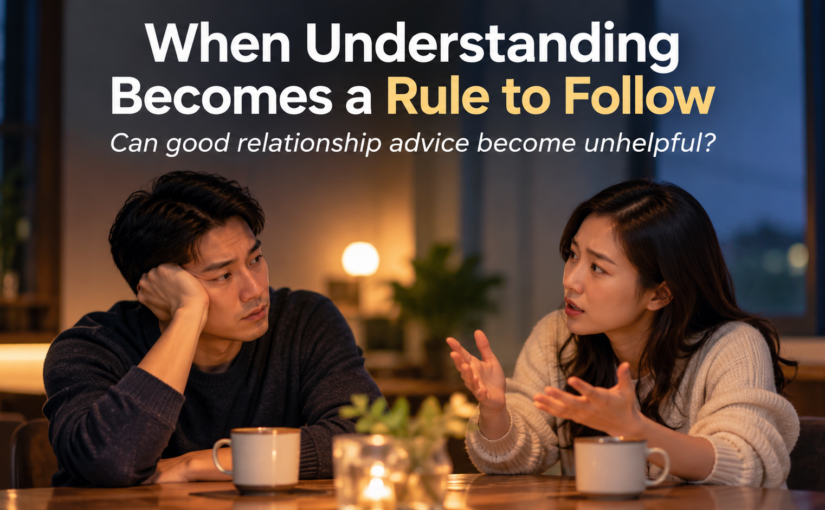
We often hear that the key to a good relationship is understanding your partner.
And of course, understanding can help.
But what if understanding itself becomes a rule that both must follow?
What if we start believing that every disagreement has to be explored, explained, processed, and fully understood before we can move on?
Imagine you’re having dinner with your partner.
The service is bad.
You want to complain. Your partner says, “Forget it. Let’s just enjoy dinner.”
Now you could spend the next twenty minutes trying to understand each other.
“Why does bad service bother you so much?”
“Why don’t you speak up when something is wrong?”
Maybe you discover that one of you is particularly sensitive to being treated unfairly. Maybe the other hates confrontation. Maybe you even understand exactly where those differences came from.
That’s useful.
But then what?
Because understanding doesn’t necessarily resolve the disagreement.
And maybe it doesn’t have to.
Perhaps the more useful question is:
What are we trying to do together right now?
We’re having dinner.
We’re on a date.
Maybe this isn’t a problem we need to solve.
One partner might say, “I know this bothers you more than it bothers me. Go ahead and speak to the manager.”
Or the other might say, “You know what? Bad service really gets to me. But tonight isn’t about fixing the restaurant. Let’s enjoy our dinner.”
Nobody has to win.
Nobody has to adopt the other person’s perspective.
And nobody has to be completely understood.
Understanding is not necessarily the goal. Understanding informs the choice.
It’s like watching a sunset together.
You say it’s orange. I say it’s red.
We could argue about it. We could investigate why we see it differently. We could even find out who’s technically correct.
But if we came there to watch the sunset together, at some point we have to stop trying to solve the sunset…
and experience it.
Maybe relationships are sometimes like that.
Not every difference needs resolution.
Not every disagreement needs deeper exploration.
And not every moment needs more communication.
Sometimes the better question isn’t:
“Do you understand me?”
It’s:
“What matters to us right now—and what would help us do that together?”
Listen on Spotify:
https://spotifycreators-web.app.link/e/WhJx0oY5M6b
@onelifeonlycounseling When Understanding Becomes a Rule to Follow: Can “You need to understand me” become a problem in a relationship? Not every disagreement needs to be resolved. Not every difference needs deeper exploration. Sometimes we already understand each other well enough. The better question may be: “What matters to us right now—and what would help us do that together?” Understanding is not necessarily the goal. Understanding informs the choice. Relationships Couples RelationshipAdvice Communication CouplesCounseling OneLifeOnly
♬ original sound – One Life Only Counseling – One Life Only Counseling
One of the hidden costs of developing a deeper understanding of ourselves and the world we create is grieving the unnecessary suffering within it. Once you see how much pain is sustained by unquestioned assumptions rather than inevitability, it’s difficult not to wonder how much suffering could have been averted had we been more willing to question the assumptions that shape our relationships, our institutions, and the way we understand and treat one another.
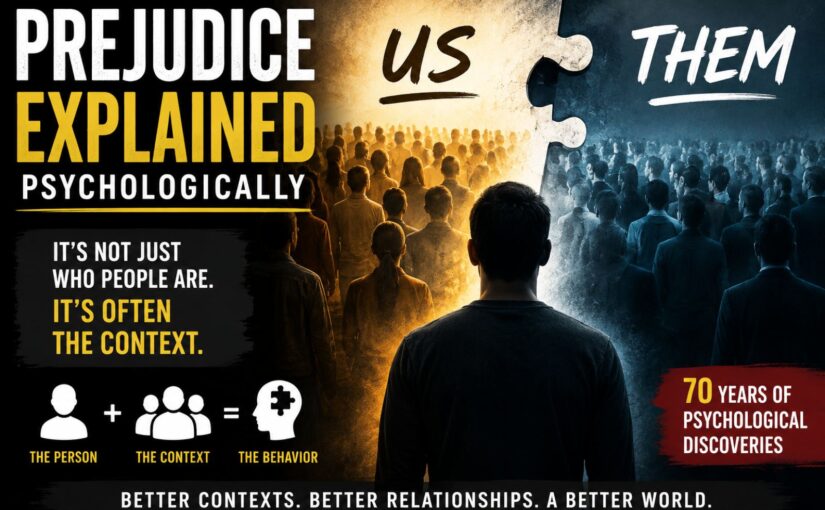
Why do ordinary people discriminate?
Why do neighbors become enemies?
Why do we so quickly divide the world into “us” and “them”?
For decades, psychology searched for the answer. At first, many believed prejudice lived inside certain kinds of people—that some individuals were simply intolerant or hateful.
But over the last seventy years, psychology has uncovered a much more surprising story.
It turns out that prejudice is often not just a property of the person. It is also a product of the context.
The story begins with psychologist Kurt Lewin.
He proposed one of the simplest yet most influential ideas in psychology:
Behavior is a function of both the person and the environment.
That sounds obvious today.
But at the time, it was revolutionary.
It meant that we cannot fully understand people by looking only inside them. Every person exists within a web of relationships, culture, history, opportunities, barriers, and circumstances.
Change the context, and behavior can change.
A few decades later, another psychologist, Henri Tajfel, asked a different question.
How easily do human beings create “us” and “them”?
His famous experiments produced an uncomfortable answer.
People didn’t need centuries of hatred or deep ideological differences.
Simply dividing people into groups was often enough for them to begin favoring their own group over another.
In other words, prejudice was not just something hidden inside prejudiced individuals.
The context itself could create division.
Then psychologists Lee Ross and Richard Nisbett identified another common human tendency: the Fundamental Attribution Error.
When someone else makes a mistake, we explain it by who they are.
“They’re irresponsible.”
“They’re lazy.”
“They’re selfish.”
But when we make the very same mistake, we explain it by our circumstances.
“There was traffic.”
“I was exhausted.”
“I was under a lot of pressure.”
The same behavior.
Different explanation.
We notice the person.
But we overlook the context.
More recently, modern contextual psychology—including Acceptance and Commitment Therapy and Relational Frame Theory—has added another important insight.
Human beings survive because we use language.
We create names.
We create categories.
We create labels.
These are incredibly useful tools.
But sometimes we forget they are only tools.
Instead, we begin treating our labels as reality.
“He lied once”
becomes
“He is a liar.”
“She failed”
becomes
“She is a failure.”
“They are different from us”
becomes
“They are the enemy.”
The description becomes the person.
And that may be one of the deepest roots of prejudice.
Over the last seventy years, psychology has slowly moved in one direction.
Away from asking,
“What kind of person is this?”
and toward asking,
“What context helped produce this behavior?”
Understanding context does not remove responsibility.
It does not excuse harmful behavior.
It gives us a better chance of changing it.
Because if prejudice is simply “who people are,” then the story ends there.
But if prejudice emerges within contexts, then perhaps we can create better contexts.
Better families.
Better schools.
Better workplaces.
Better communities.
Maybe even a better country.
Perhaps the greatest lesson psychology has taught us is this:
People are more than the labels we give them.
@onelifeonlycounseling Prejudice Explained Psychologically Prejudice isn’t always about bad people. Sometimes it’s the result of how our minds naturally simplify the world. Understanding prejudice starts with understanding how the human mind works. Psychology Prejudice SocialPsychology ContextMatters CriticalThinking BehavioralScience FunctionalContextualism MentalHealth Philippines OneLifeOnly#fyp #foryou
♬ original sound – One Life Only Counseling – One Life Only Counseling
The strongest relationships are built not on communication skills alone,
but on flexible minds.
To learn more about what it means to have a flexible mind—and how it can strengthen your relationships—visit the Love, Contextually book page.
Click here to know more about Nathan Chua’s books written under the pen name, Starfly Chua.