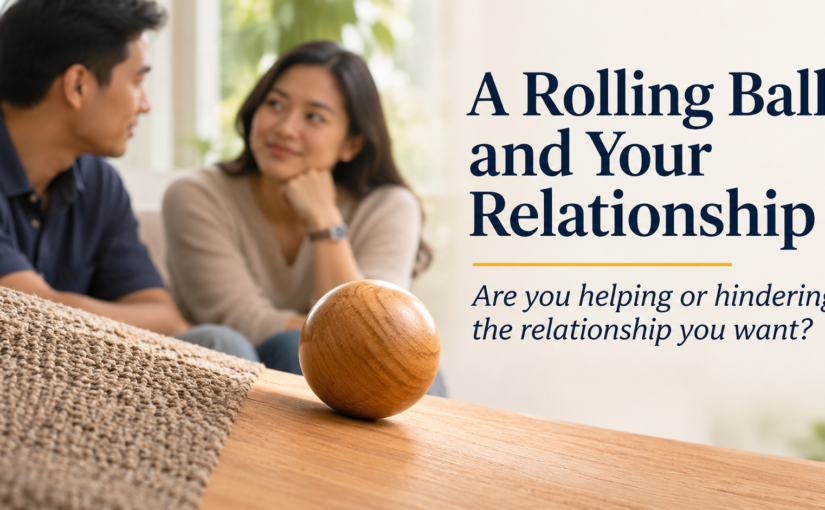
Are You Helping or Hindering the Relationship You Want?
What makes a rolling ball stop? Is it something inherent in the ball, or is it something about the conditions in which the ball is moving?
Imagine rolling the same ball across a smooth surface, a carpeted floor, and an uphill slope. The ball behaves differently depending on the conditions in which it moves.
This simple analogy, inspired by my reading of The Person and the Situation by Lee Ross and Richard Nisbett, offers us an interesting way of understanding human behavior, particularly in our intimate relationships.
Looking for Problems Within Our Partners
When our partners stop doing the things we appreciate, we often look for explanations within them.
My husband is emotionally unavailable. My wife is controlling. My partner is insensitive. My spouse is selfish.
We become so preoccupied with determining what kind of person our partner is that we may overlook the conditions under which their behavior occurs.
And perhaps one of the most important elements of those conditions is ourselves.
Instead of asking what is wrong with our partners, perhaps we can ask what makes it easier or harder for them to become the partners they aspire to be.
Becoming Each Other’s Context
Imagine a husband who wants to become more emotionally expressive. One day, he makes an effort to share his feelings with his wife, only to hear her respond:
“Now you’re telling me this? After all these years?”
Her response may be perfectly understandable given their history. She may have spent years longing for emotional intimacy with her husband.
But what effect might her response have on his subsequent attempts to open up?
Conversely, imagine a wife who wants to become less critical of her husband. She makes an effort to express her concerns gently, only to have her husband dismiss them as another instance of nagging.
Both partners may sincerely want to become better partners. Yet both may inadvertently create conditions that make it harder for the other to do so.
We are not only responding to the conditions of our relationships. We are also the conditions to which our partners respond.
Understanding Is Not Excusing
Of course, human beings are far more complex than rolling balls. We have learning histories, language, aspirations, and the capacity to reflect on our own behavior.
We can learn to act in accordance with our values even when circumstances are unfavorable.
Understanding how we influence our partners’ behavior does not mean that we are responsible for everything they do. Neither does it mean that we should tolerate abuse or mistreatment.
What it does mean is that we can examine our own contributions to the conditions in which our relationships develop.
We cannot guarantee that our partners will move in the direction we desire. But we can examine whether our behavior facilitates or obstructs those movements.
From Blame to Purpose
One of the central ideas in my approach to couples therapy is to help partners become more sensitive to the relationship between their behavior and their purposes.
Rather than spending much of our energy determining who is right and who is wrong, perhaps we can ask ourselves:
– What kind of relationship do I want to have?
– What kind of partner do I want to become?
– Does my behavior make it easier or harder for my partner to become the person they aspire to be?
– Am I providing conditions that are conducive to the relationship we both want?
We may discover that some of the very things we do to get the relationship we want are precisely the things that make it harder to achieve.
Our attempts to get closer may inadvertently create distance. Our efforts to be heard may make listening more difficult. Our insistence on getting our partners to change may create conditions that make change less likely.
The question is not simply whether our actions are justified or understandable. It is also whether they serve our purposes.
Becoming a Context in Which Love Can Grow
Perhaps one of the most meaningful expressions of love is to become a context in which another human being finds it easier to become the person they aspire to be.
This does not require us to become perfect partners. It requires us to become more sensitive to the consequences of our actions and more flexible in how we pursue what matters to us.
Before asking why your partner has stopped trying, perhaps it is worth asking what makes trying so difficult for both of you.
A meaningful and worthwhile relationship is not simply about finding the right person. It is also about creating conditions in which both people can move toward the relationship they want.
— Nathan Chua
One Life Only Counseling Services