What does it mean to be perfect?

The word perfect comes from the Latin perfectus.
It originally meant complete.
Not flawless.
Not superior.
Not better than others.
Complete.
The problem-solving mind spends much of its time convincing us that something is missing.
Yet before we were successful or unsuccessful, admired or rejected, confident or insecure, we were already human.
Perhaps perfection is not becoming someone else.
Perhaps it is living fully as the person you already are.
You are not an unfinished human waiting for permission to exist.

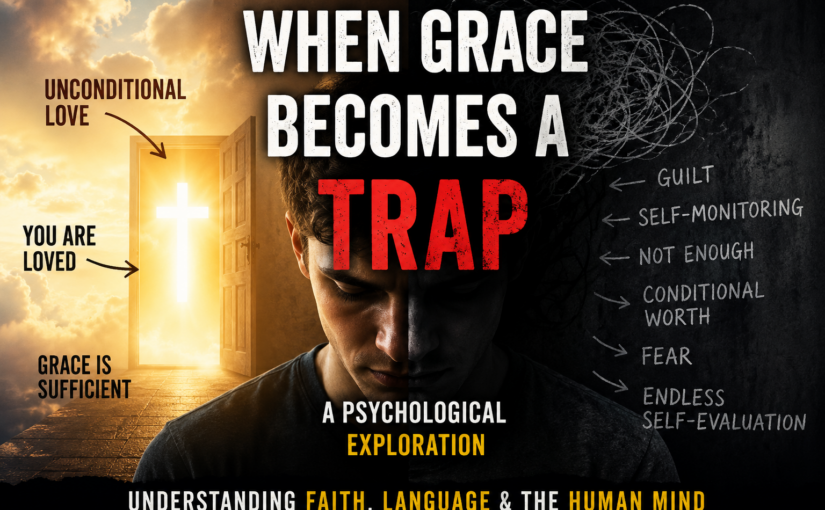
When Your Faith Becomes a Mental Trap

Have you ever listened to a sermon that says:

“You are loved unconditionally”…

but minutes later you begin wondering whether you are truly righteous enough, faithful enough, or transformed enough?

You leave inspired — but also anxious, guilty, and psychologically trapped.

This video explores how certain forms of religious language can unintentionally create chronic self-monitoring, fear, guilt, and endless spiritual self-evaluation.

This is not an attack on Christianity or faith.

It is an exploration of how language functions psychologically.

Drawing from contextual behavioral science, ACT (Acceptance and Commitment Therapy), and functional contextualism, I discuss:

rule-governed behavior
guilt as behavioral control
coherence traps
fusion with moral narratives
chronic spiritual self-monitoring
and why some people become experts at monitoring themselves spiritually instead of actually living

I also speak from personal experience as someone who once deeply preached and believed these systems myself.

The issue is not whether faith is “true” or “false.”
The issue is whether certain psychological patterns increase rigidity, fear, and suffering — or create greater flexibility, compassion, and humanity.

Many people today silently struggle with:

religious guilt
scrupulosity
fear of not being “saved enough”
compulsive self-monitoring
or the exhausting pressure to appear spiritually transformed at all times
These struggles are rarely discussed openly because they are often mistaken for spiritual weakness rather than understandable psychological processes.

My hope is that this conversation creates space for deeper reflection, honesty, compassion, and psychological freedom.
📌 Watch the full video below.
#Faith #Psychology #ACT #MentalHealth #Christianity #ReligiousTrauma #Spirituality #ContextualBehavioralScience #AcceptanceAndCommitmentTherapy #PsychologicalFlexibility #OneLifeOnlyCounseling

If you are looking for counseling or psychotherapy services in Quezon City, Manila, or elsewhere in the Philippines, you may message us at

0917 886 LIFE (5433)!

https://open.spotify.com/episode/4Jm0KWZ2aor0gKo2PDj3lj?si=c5cUF3LTScak30g9qIR-dQ

To Live Without Regret

To live without guilt is to live without mistakes.
To live without mistakes is to live without risk.
And to live without risk ultimately turns living into lifelessness.

The Rules We Live By

We all follow rules.
It’s hard to live without them.
We have rules for how to apologize, how to love, even how to make coffee.
But psychological flexibility begins when we ask:
does this rule still work in this context?
For example:
“If I’m angry, I should stay silent until I calm down.”
Sometimes that rule prevents harm.
Sometimes it quietly becomes avoidance, distance, and emotional disconnection.
And sometimes the people around us follow very different rules about anger.
One person believes anger should be controlled and hidden.
Another believes anger should be expressed immediately and directly.
So the conflict is no longer just about the thing that made you angry.
Now you begin fighting about how a person is supposed to be angry.
A good rule is not one that is obeyed no matter what.

A good rule is one that stays sensitive to context.