by Nathan Chua
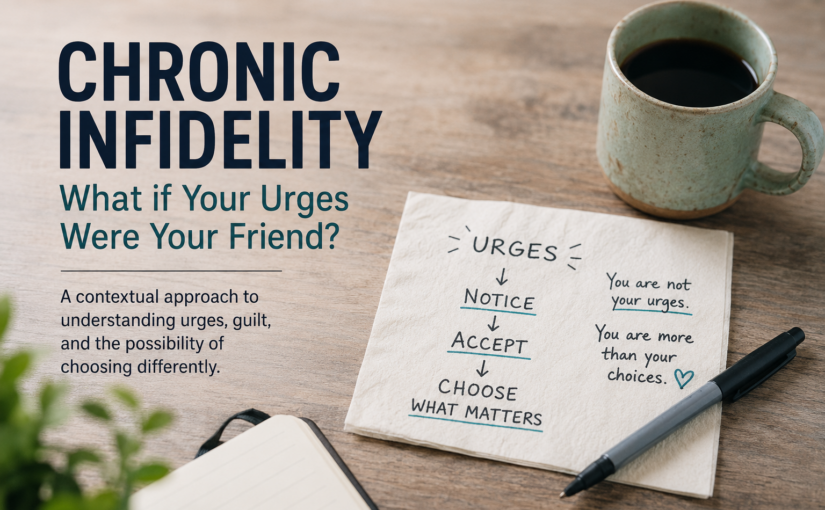
No, I’m not suggesting you follow your urges. I’m suggesting you stop treating them like an enemy that must be eliminated. Ironically, that battle is often what keeps people trapped. What if your urges could become a signal—an opportunity to choose the kind of partner you want to be instead of the person your impulses demand?
One of the most frustrating experiences in therapy is working with someone who sincerely wants to change, yet keeps repeating the same behaviour. Few examples are more painful than chronic infidelity.
Many people assume the problem is simple. If only the attraction disappeared. If only the temptation went away. If only they stopped thinking about other people, then they would finally become faithful.
Unfortunately, years of trying usually prove otherwise.
They have prayed. They have made promises. They have sworn that “this time will be different.” They have tried distracting themselves, suppressing their thoughts, avoiding attractive people, and shaming themselves after every lapse.
Yet the urges return.
Perhaps the problem is not that they have failed to eliminate their urges.
Perhaps the problem is that they have made urge elimination the goal.
The Elevator Analogy
Imagine someone with a severe fear of elevators.
Their entire life becomes organised around avoiding elevators. They climb twenty flights of stairs. They arrive exhausted for meetings. They choose hotels based on whether they have elevators. They even turn down jobs located in high-rise buildings.
For years they believe:
“Once my fear disappears, then I can use elevators.”
But exposure therapy turns this assumption upside down.
The goal is never to eliminate fear.
The goal is to help people ride the elevator while fear is present.
Ironically, when people stop making fear reduction their primary mission, fear often becomes much less powerful over time.
The fear may still visit.
But it no longer controls where they go.
The Same Principle Applies to Chronic Infidelity
Many people caught in repeated patterns of infidelity hold an invisible rule:
“I can only be a loving partner if I stop feeling attracted to other people.”
That sounds reasonable.
It is also nearly impossible.
Attraction is part of being human. Noticing another attractive person says very little about whether someone loves their partner.
The real question is not:
“Can I eliminate attraction?”
The better question is:
“Can I experience attraction without allowing it to determine my behaviour?”
Those are two completely different goals.
The Trap of Fighting the Urge
When people desperately try to eliminate an urge, something interesting happens.
The urge becomes the centre of attention.
Every attractive stranger becomes a test.
Every intrusive thought becomes evidence that something is wrong.
Every temptation feels like an emergency.
Life slowly becomes organised around managing urges.
Ironically, this often strengthens them.
The struggle itself becomes part of the problem.
Acceptance Is Not Permission
This is where many people misunderstand acceptance.
Acceptance does not mean approving of infidelity.
It does not mean giving yourself permission to cheat.
Acceptance simply means making room for uncomfortable thoughts, feelings, and bodily sensations without treating them as commands.
“I notice attraction.”
“I notice excitement.”
“I notice guilt.”
“I notice the urge to send a message.”
None of these experiences force a behaviour.
They are experiences—not instructions.
A Different Kind of Pause
When urges arise, people often experience tunnel vision.
Their attention narrows until only one thing seems to exist.
The attractive person.
The excitement.
The fantasy.
The possibility.
Therapy creates a pause.
Not a pause to force yourself to be faithful.
Not a pause to prove your self-control.
Simply a pause to notice the whole picture.
“I notice excitement.”
“I notice fear.”
“I notice guilt.”
“I notice that I care deeply about my partner.”
“I notice the kind of person I want to become.”
From that wider perspective, behaviour is no longer completely automatic.
There is no passing or failing this exercise.
The goal is simply to weaken the automatic link between urge and action.
That pause can happen before sending a message.
While chatting online.
Before agreeing to meet.
Even during a date.
At any point in the behavioural chain, awareness creates the possibility of choice.
Living According to Values, Not Urges
People often tell me,
“I’m trying not to have these urges.”
I understand why.
But perhaps there is a more helpful goal.
Instead of asking,
“How do I stop wanting this?”
Try asking,
“What kind of partner do I want to be, even while these urges are present?”
That question changes everything.
Instead of living in constant battle with your own mind, you begin living toward something that matters.
Faithfulness becomes more than the absence of temptation.
It becomes the repeated practice of choosing your values in the presence of temptation.
The Real Freedom
Freedom is not reaching the point where unwanted thoughts never appear.
Freedom is discovering that they no longer have the final say.
Just as courage is not the absence of fear but moving forward despite fear, faithfulness is not the absence of attraction but repeatedly choosing the relationship you want to build despite attraction.
The person with elevator phobia does not wait for fear to disappear before entering the elevator.
Likewise, someone struggling with chronic infidelity may not have to wait for temptation to disappear before becoming the partner they aspire to be.
Real change begins the moment we stop asking our minds for permission to live according to our values.
Recovery doesn’t begin when the urges disappear. Recovery begins the moment you stop running from them.
If you or your relationship is struggling with repeated infidelity, One Life Only Counseling Services offers evidence-based counseling online and in person. Contact us at +63 917 886 5433 (LIFE) or info@onelifeonly.net to schedule an appointment.
If you wish to book online, please click here.
For books written by Nathan Chua under the pen name Starfly Chua, click here.
@onelifeonlycounseling Chronic Infidelity: What if Your Urges Were Your Friend? What if the problem isn’t your urges? Many people trapped in repeated infidelity spend years fighting their thoughts and desires—only to feel even more trapped. A different path begins by learning to notice your urges without letting them decide your next move. Infidelity Relationships Cheating ACT AcceptanceAndCommitmentTherapy ContextualBehavioralScience Psychology MentalHealth CouplesTherapy RelationshipAdvice#fyp #foryou #counselingphilippines #onelifeonlycounseling #counseling #PsychologyVlog #ThinkDeeper
♬ original sound – One Life Only Counseling – One Life Only Counseling