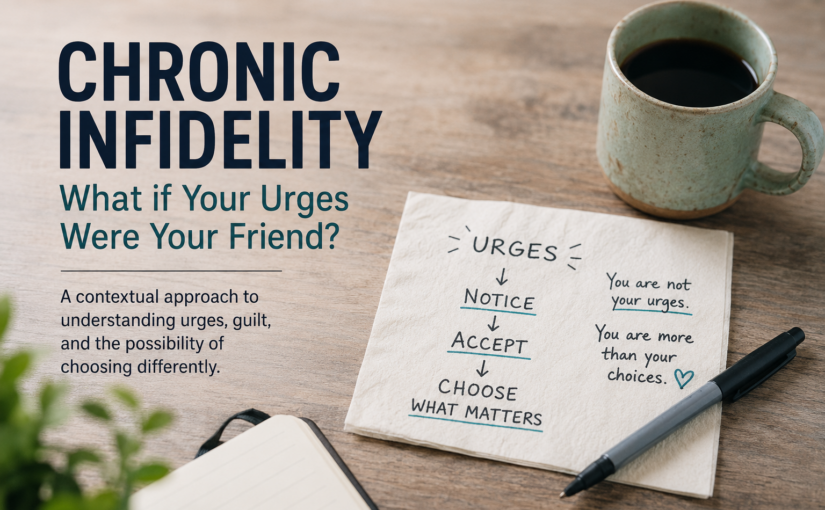
Chronic Infidelity? What if Your Urges Were Your Friend?

by Nathan Chua

No, I’m not suggesting you follow your urges. I’m suggesting you stop treating them like an enemy that must be eliminated. Ironically, that battle is often what keeps people trapped. What if your urges could become a signal—an opportunity to choose the kind of partner you want to be instead of the person your impulses demand?

One of the most frustrating experiences in therapy is working with someone who sincerely wants to change, yet keeps repeating the same behaviour. Few examples are more painful than chronic infidelity.

Many people assume the problem is simple. If only the attraction disappeared. If only the temptation went away. If only they stopped thinking about other people, then they would finally become faithful.

Unfortunately, years of trying usually prove otherwise.

They have prayed. They have made promises. They have sworn that “this time will be different.” They have tried distracting themselves, suppressing their thoughts, avoiding attractive people, and shaming themselves after every lapse.

Yet the urges return.

Perhaps the problem is not that they have failed to eliminate their urges.

Perhaps the problem is that they have made urge elimination the goal.

The Elevator Analogy

Imagine someone with a severe fear of elevators.

Their entire life becomes organised around avoiding elevators. They climb twenty flights of stairs. They arrive exhausted for meetings. They choose hotels based on whether they have elevators. They even turn down jobs located in high-rise buildings.

For years they believe:

“Once my fear disappears, then I can use elevators.”

But exposure therapy turns this assumption upside down.

The goal is never to eliminate fear.

The goal is to help people ride the elevator while fear is present.

Ironically, when people stop making fear reduction their primary mission, fear often becomes much less powerful over time.

The fear may still visit.

But it no longer controls where they go.

The Same Principle Applies to Chronic Infidelity

Many people caught in repeated patterns of infidelity hold an invisible rule:

“I can only be a loving partner if I stop feeling attracted to other people.”

That sounds reasonable.

It is also nearly impossible.

Attraction is part of being human. Noticing another attractive person says very little about whether someone loves their partner.

The real question is not:

“Can I eliminate attraction?”

The better question is:

“Can I experience attraction without allowing it to determine my behaviour?”

Those are two completely different goals.

The Trap of Fighting the Urge

When people desperately try to eliminate an urge, something interesting happens.

The urge becomes the centre of attention.

Every attractive stranger becomes a test.

Every intrusive thought becomes evidence that something is wrong.

Every temptation feels like an emergency.

Life slowly becomes organised around managing urges.

Ironically, this often strengthens them.

The struggle itself becomes part of the problem.

Acceptance Is Not Permission

This is where many people misunderstand acceptance.

Acceptance does not mean approving of infidelity.

It does not mean giving yourself permission to cheat.

Acceptance simply means making room for uncomfortable thoughts, feelings, and bodily sensations without treating them as commands.

“I notice attraction.”

“I notice excitement.”

“I notice guilt.”

“I notice the urge to send a message.”

None of these experiences force a behaviour.

They are experiences—not instructions.

A Different Kind of Pause

When urges arise, people often experience tunnel vision.

Their attention narrows until only one thing seems to exist.

The attractive person.

The excitement.

The fantasy.

The possibility.

Therapy creates a pause.

Not a pause to force yourself to be faithful.

Not a pause to prove your self-control.

Simply a pause to notice the whole picture.

“I notice excitement.”

“I notice fear.”

“I notice guilt.”

“I notice that I care deeply about my partner.”

“I notice the kind of person I want to become.”

From that wider perspective, behaviour is no longer completely automatic.

There is no passing or failing this exercise.

The goal is simply to weaken the automatic link between urge and action.

That pause can happen before sending a message.

While chatting online.

Before agreeing to meet.

Even during a date.

At any point in the behavioural chain, awareness creates the possibility of choice.

Living According to Values, Not Urges

People often tell me,

“I’m trying not to have these urges.”

I understand why.

But perhaps there is a more helpful goal.

Instead of asking,

“How do I stop wanting this?”

Try asking,

“What kind of partner do I want to be, even while these urges are present?”

That question changes everything.

Instead of living in constant battle with your own mind, you begin living toward something that matters.

Faithfulness becomes more than the absence of temptation.

It becomes the repeated practice of choosing your values in the presence of temptation.

The Real Freedom

Freedom is not reaching the point where unwanted thoughts never appear.

Freedom is discovering that they no longer have the final say.

Just as courage is not the absence of fear but moving forward despite fear, faithfulness is not the absence of attraction but repeatedly choosing the relationship you want to build despite attraction.

The person with elevator phobia does not wait for fear to disappear before entering the elevator.

Likewise, someone struggling with chronic infidelity may not have to wait for temptation to disappear before becoming the partner they aspire to be.

Real change begins the moment we stop asking our minds for permission to live according to our values.

Recovery doesn’t begin when the urges disappear. Recovery begins the moment you stop running from them.

If you or your relationship is struggling with repeated infidelity, One Life Only Counseling Services offers evidence-based counseling online and in person. Contact us at +63 917 886 5433 (LIFE) or info@onelifeonly.net to schedule an appointment.

If you wish to book online, please click here.

For books written by Nathan Chua under the pen name Starfly Chua, click here.

@onelifeonlycounseling

Chronic Infidelity: What if Your Urges Were Your Friend? What if the problem isn’t your urges? Many people trapped in repeated infidelity spend years fighting their thoughts and desires—only to feel even more trapped. A different path begins by learning to notice your urges without letting them decide your next move. Infidelity Relationships Cheating ACT AcceptanceAndCommitmentTherapy ContextualBehavioralScience Psychology MentalHealth CouplesTherapy RelationshipAdvice#fyp #foryou #counselingphilippines #onelifeonlycounseling #counseling #PsychologyVlog #ThinkDeeper

♬ original sound – One Life Only Counseling – One Life Only Counseling

Should you ask intimate details about an affair?

by Nathan Chua

One of the most common questions that couples ask on their road to recovery from an affair is whether it is helpful for a hurt partner to inquire about intimate details.  This is quite expected and an understandable reaction.  However, couples need to be sensitive to the results of such inquiries.  It is also not surprising to see the participating partner feel uncomfortable sharing sexual details about the affair.  

There are some experts who say that the best advice a therapist can give to a couple is to refrain from going into the sexual or graphic details of the affair.  Although this may sound like good advice to many and could probably work for a majority of couples, it has the potential to backfire.  The thing that I like about the work of Drs. Andrew Christensen, Brian Doss, and Neil Jacobson, is its focus on functional rather than formal rules of engagement between couples.  Formal rules usually involve teaching couples to follow a rule based on what it says alone with less consideration of the unique contexts that surround each couple.  It’s like following a rule just because.  Functional rules are more sensitive to contexts as well as the consequences that occur when they are adapted by the couple.  

A Word About Context:

When I say context, it doesn’t only mean the physical environment of the couple.  Context can involve the very thoughts, feelings, and memories that each partner has going into the relationship as well as within the relationship.  What mindfulness teaches us about this is that we learn to see things from each other’s context or perspective.  This is rather hard to see when couples have narrowed their options to survival strategies like fight, flight, or freeze!  That would take a whole set of blog posts to discuss!  So let me leave it at that.

In therapy, I allow couples to engage in their conversations about an affair with a difference.  That difference is to learn how to do them better.  How is this done when it comes to discussing sexual details?

These questions are obviously mostly going to come from the hurt partner.  Again I don’t want to give formal rules about this, so please be sensitive to what works in your relationship and what doesn’t.  If what you’re doing helps you to move on in the healing or renewing process of your relationship, then go ahead and keep it up.  However, formal rules can end up frustrating both parties.  The couple makes a turn for the worse when these questions are asked devoid of context from the injured partner.  When they turn into demands without reasons or, just because the injured partner is angry and the participating partner must pay, conversations can become fraught with anger.  At times they can become rhetorical and sarcastic.  Interrogation has become a way to make accusations.  And for most of us who have not learned what context sensitivity means, couples can go about doing what they’re doing because sometimes they do end up getting what they want.  As human beings, we have a tendency to keep doing what we’re doing even if the success rates go down on our attempts to remove difficult thoughts and feelings.  Minor, short term successes can obscure long term consequences.  And for couples who have experienced infidelity, the injured partner believes the participating partner is responsible for removing these thoughts and feelings.  This is an impossible task for anyone who’s a human being, let alone a partner who is also experiencing difficult emotions like anxiety and fear about possibly losing the relationship, and guilt about having had an affair.  The injured partner can get rewarded sporadically when the participating partner grudgingly surrenders to the demands.  Unfortunately, such enduring, surrendering, or survival moves by the participating partner more often only last for a short while before the pattern of giving in to keep the peace becomes unbearable.  Thus, an explosion of pent up feelings occurs and the couple escalates. 

The key here is for the injured partner to be more noticing of the softer emotions inside and able to enunciate them with less criticism and accusations.  Focus on asking for information and telling the partner why that is important to know.  Usually, the questions involve some kind of insecurity or a wound that informs the participating partner that such questions come from images or memories of past sexual hurts or rejections, if these are out in the open.  There could be strong feelings of insecurity about the injured partner’s attractiveness.  These types of revelations are more likely to induce compassion rather than defensiveness or withdrawal from the participating partner and allow for a more compassionate response to happen.  

So let me get back to what I mentioned earlier in this article.  In the counseling room, we are not attempting to help you end your difficult conversations.  We are there to help make better conversations, because like it or not, there will be conflicts in your relationship as your contexts change from situation to situation.  Learning the skills to make better exchanges in conflict situations can mean that these conflicts lead you to a richer closeness rather than rip you apart.    

Watch this on YouTube! Listen to this on Spotify!

What to do after an affair

by Nathan Chua

This is intended to be a first aid kit for those who are going through a difficult discovery of an affair.  Please note that this is not a substitute for seeking professional help.  Affairs are situations that would likely require trained assistance.  Some who have taken such events lightly or have let these incidents slip by, often end up having to deal with it later with loads of pent up emotions that make it even harder to recover from. 

I am not sure if I ever had a blog post that enumerates a list of do’s and don’ts when it comes to dealing with cheating in committed relationships, particularly because applying such rules can at times do more harm to an already struggling relationship.  Let me emphasize to you, my audience, that I am listing them here not because I want to give you easy answers to your situation.  It is exactly that your situations are unique that I want you to take these tips with a grain of salt.  I am showing you a list of rules that can generally apply to most cases of betrayal without having the paradoxical effect of the couple ending up fighting about the rules instead of facing the problems affecting the relationship.  

Tip 1:  Know where responsibility lies

  • It is often that the hurt partner puts the full blame of the affair on the participating partner.  Yes, that is a fact that the affair or the recourse to an affair is the sole responsibility of the participating partner.  There is no excuse for an affair even as there are major problems in the relationship.  However, the difficulties in the relationship is the responsibility of both the partners.  We all have reasons for our behavior but they are not to be considered excuses.  Providing excuses can lead to the participating partner to blame the relationship for the affair, and for the hurt partner to justify their past behaviors in the relationship.  Reasons are different from excuses or justifications for either partner.   

Tip 2:  Problem-solve in the immediate aftermath

  • You and your partner may decide to live separately for the meantime if situations at home become too difficult to handle.  This could either be because you have a tendency to escalate or are afraid of how your escalations can affect your children.
  • You may want to get yourselves checked for possible sexually transmitted diseases.  
  • Couples are free to decide if the relationship is worth keeping but making a decision in an emotionally charged state may not be in their best interest.  Delay such decisions until you have returned to calmer emotional states.
  • Withhold conversations about the affair until you are in therapy.  Early on, it may be too much of a stretch for couples to know how to handle the problem without escalating.  Remember, what we want is for couples to move forward in their relationship rather than take steps that bring them to even more hurtful conversations.  Bring these conversations to the counseling room with your therapist.

Tip 3:  What questions to ask and how for the hurt partner

  • It is understandable that the injured partner will resort to questions fraught with accusations and harsh criticisms towards the participating partner.  Focus on what you want to know and tell your partner why that is important to you.  Let your partner know that this is part of the process of moving on rather than a way of punishing your partner.  There are tendencies for the injured partner to ask rhetorical and often sarcastic questions to their partners.  It is advisable that you make factual disclosures and revelations of your underlying softer emotions of fear and anxiety towards the possibility that this could happen again. 

This will be all for now.  For part two of this post, I will be discussing what the participating partner can say or do that can help in the moving on process.  It will also involve how partners can deal with future challenges that can happen if the participating partner is still able to remain in touch with the affair partner.  Another common question is, “Is it okay for the hurt partner to confront the affair partner?”  See you in the next blog!

Watch this blogpost on YouTube!  Listen to this on Spotify!