Coping With Anger

Anger is a feeling.

It is not the problem.

Feelings are neither good nor bad, right nor wrong.

The question is not whether anger should be there.

The question is what happens when we follow it.

Can we express our anger with dignity?

Can we use it in the service of what matters?

It is never about perfection.

It is about becoming more aware of the consequences of our responses and choosing the path that works best.

When We Treat Ourselves and Others Like Things

The problem is not that we describe people.
The problem begins when our descriptions become explanations.
Personality becomes a thing.
Intelligence becomes a thing.
Diagnosis becomes a thing.
Attachment becomes a thing.
Before we know it, we stop asking what happened and start assuming we know what someone is.
We begin treating ourselves and others as things to be fixed rather than people to be understood.

Ano Ba Ang Love?

faKung ang love ay hindi pagiging bulag sa reality,
at hindi rin simpleng feeling na nawawala sa unang disappointment,
ano nga ba ito?
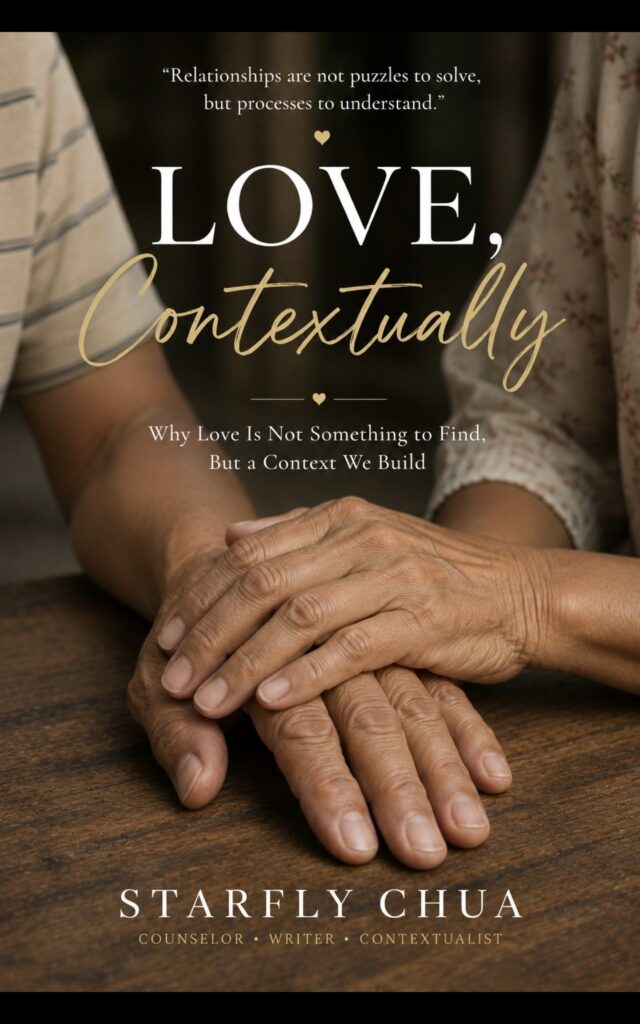
Love is a context where two people can build a meaningful life together.
Hindi ito dahilan para manatili sa takot, pananakit, o abuse.
Pero hindi rin ito isang bagay na basta na lang iniiwan dahil naiinis tayo, nadidismaya, o nahihirapan sa ating differences.
Every meaningful relationship will have moments when the distance between two people feels hard to cross.
Hindi kawalan ng mga moments na iyon ang love.
Love is creating a life where crossing that distance remains worthwhile.
Isang buhay na binubuo ng tiwala, respeto, at shared purpose.
Hindi perpektong buhay.
Hindi madaling buhay.
Pero isang buhay na maipagmamalaki nating ibahagi.
At isang buhay na may kakayahang magdagdag ng kaunting kabutihan sa mundong ating ginagalawan.

What Is Love?

If love is not blindness that ignores reality,

and not merely a feeling that disappears at the first sign of disappointment,

then what is love?

Love is a context in which two lives can be lived meaningfully together.

It is not a reason to remain where there is violence, fear, or abuse.

But neither is it something we abandon simply because we are irritated, disappointed, or confronted by our differences.

Every meaningful relationship will contain moments when the distance between two people feels difficult to cross.

Love is not the absence of those moments.

Love is the creation of a life where crossing them remains worthwhile.

A life built with enough trust, respect, and shared purpose that both people can stand within it with dignity.

Not a perfect life.

Not an effortless life.

But one rich enough to be shared with pride,

and generous enough to contribute something good to the world beyond itself.

Is Love a Feeling?

Some people stay in relationships long after they have stopped asking whether a meaningful life can be built there.
Others leave at the first sign of difficulty, assuming that the absence of excitement means love has ended.
Love requires effort.
But effort cannot make every relationship workable.
And the loss of butterflies does not mean a relationship is unworkable.
The challenge is learning the difference.

Is Love Blind?

We readily acknowledge chemistry on a first date because little is at stake.

But when the stakes become higher, we often stop asking whether a relationship is workable and start asking how to make it work at any cost.

Love requires effort.

But effort alone cannot turn every context into one where a meaningful life can be built.

Why Avoiding Toxic People Doesn’t Always Work

Most advice says: “Just avoid toxic people.”

But what if you can’t?

What if that person is your boss, your spouse, your parent, or someone you can’t simply walk away from?

This is where most advice breaks down.

And this is where people start to feel stuck, confused, or even guilty.

If this is your situation, you don’t have to figure it out alone.

👉 Book a confidential session here.

We offer counseling sessions focused on helping you respond more effectively to complex relationship situations — without pressure, judgment, or one-size-fits-all advice.

The Problem with Oversimplified Advice

Advice like “avoid toxic people” works well on social media because it’s clear, direct, and emotionally satisfying. But it can also create guilt and confusion when people find that they can’t actually follow it.

You might start asking yourself:

“What’s wrong with me?”
“Why can’t I just walk away?”
“Am I weak for staying?”

In many cases, the issue is not weakness — it’s context.

A More Workable Question

Instead of asking:

“Should I avoid this person?”

A more helpful question is:

“What is workable in this situation?”

This shifts the focus from rigid rules to practical, real-life solutions.

What You Can Do Instead

Depending on your situation, more workable options may include:

Setting clear but realistic boundaries
Limiting exposure rather than cutting off completely
Changing how you respond in difficult interactions
Building support systems outside the relationship
Gradually creating options if leaving is your long-term goal

Avoidance is sometimes the right choice — but it’s not the only choice.

A More Flexible Way to Think About Relationships

From a contextual behavioral perspective, the goal is not to follow rules perfectly, but to respond in ways that actually improve your life over time.

Some relationships require distance.
Some require boundaries.
Some require patience and strategy.

And some, eventually, may require letting go.

But the key is this:

The best choice is the one that is workable in your real-life context — not just what sounds good in theory.

Watch the Full Video

Watch the full discussion above to explore this idea in more detail and learn how to apply it to your own relationships.

If this is something you’re going through, you’re not alone.

👉👉 Book a session here to talk this through

From Participant to Contributor: A Guest Segment for a PESI ACT Training

I was recently invited by Jacob Martinez, a licensed professional counselor from Wisconsin, to contribute to an international ACT training series in collaboration with PESI.

For many years, I’ve been on the other side of these trainings—as a participant, learning from international clinicians and trying to make sense of how these ideas apply in real-world settings.

This invitation marks a meaningful shift for me: from learning within that space to contributing to it.

In this 45-minute segment, I discuss a core distinction in contextual behavioral science:

Functional coherence vs essential coherence.

In simple terms:

Essential coherence asks: “Is this true? What is this really?”
Functional coherence asks: “Does this work? What does this lead to?”

Most of us—including many clinicians—are trained to think in essential terms: labels, traits, diagnoses, and fixed explanations about “what a person is.”

ACT takes a different approach.

Instead of focusing on what thoughts or emotions are, it focuses on what they do—how they function in context, and whether they help a person move toward a meaningful and workable life.

This shift may seem subtle, but it has wide implications—not just for therapy, but for how we understand relationships, culture, and social issues.

I’m sharing this here in the hope of making these ideas more accessible, especially within the Filipino context, where moral and label-based thinking are often emphasized.

Because the real shift is not just learning new techniques.

It’s learning to see behavior differently.

▶️ Watch the full 45-minute training here:

https://spotifycreators-web.app.link/e/bZHvvPXmV1b