Solving Corruption Psychologically…Contextually! Why does corruption survive no matter who we elect… or how many new rules we create? In this video, I explain corruption through a behavioral and cultural lens — not politics. No partisanship. No personalities. Just the psychology and context behind why our system keeps producing the same problems. Here’s the truth: 🔸 Low-trust societies accumulate corruption — even without evil people. 🔸 More rules often create more bottlenecks… and more shortcuts. 🔸 Culture can block good governance even when plans are smart. 🔸 Real change begins with context — not fear, not shame, not moralizing. If you want a fresh, science-based explanation of why corruption persists in the Philippines — and what actually builds cooperation — watch this. Better People, Better Country. But better people come from better contexts.
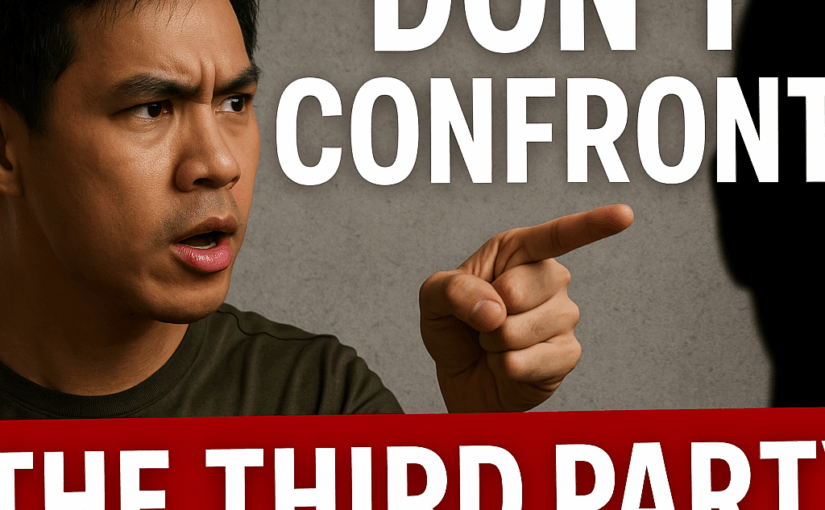
💔 Why Confronting the Third Party Doesn’t Heal Infidelity | ACT + IBCT Perspective When betrayal happens, the first impulse is often the loudest: “Harapin ko na yung third party. Para matapos na.” But in couples therapy — and in real life — this move rarely builds trust. It often creates distance, fuels defensiveness, and shifts the focus away from the only place where healing and trust can actually grow: the relationship itself. In this video, I explain: 🔹 Why confronting the third party usually backfires Through ACT and RFT principles, you’ll see how this move provides short-term relief but undermines long-term trust. 🔹 The unified-detachment question that changes everything Does this action build a bridge to trust… or drive a wedge between you and your partner? 🔹 A powerful metaphor Trying to fix a relationship by confronting the third party is like fixing your neighbor’s roof to stop your own house from leaking — it gives activity, not clarity. 🔹 What actually helps couples rebuild trust You’ll learn what Christensen et al. emphasize: Healing happens in conversations between partners, not between a partner and the third party. 🔹 A compassionate, non-moralistic view There are no absolute rules. What matters is what works to create safety, honesty, and willingness — not what feels good in the moment. ✨ For Therapists and Clients Alike Whether you’re navigating infidelity or supporting someone who is, this episode offers a grounded, functional contextual approach that avoids blame and focuses on what builds real security. 👉 Watch until the end for a reflection exercise you can use immediately. 📌 About Nathaniel (One Life Only Counseling Services) I help individuals and couples move from fear-driven reactions to values-driven actions — using ACT, RFT, and Integrative Behavioral Couple Therapy (IBCT). No labels. No DSM diagnoses. Just real processes that work. 🔔 Subscribe & Follow If this resonates, subscribe for more vlogs on ACT, RFT, IBCT, relationships, and everyday psychological flexibility.#fyp#counselingphilippines#foryou#PsychologyVlog#counseling#onelifeonlycounseling
What to do when jealousy strikes your relationship? Jealousy is one of the most painful emotions in a relationship. It can make one partner shrink their world out of fear… and push the other partner into panic, defensiveness, and exhaustion. In this video, counselor Nathan Chua (One Life Only Counseling Services) explains jealousy through a contextual behavioral lens (ACT + IBCT) — showing why jealousy narrows our world, how fear takes over, and how partners can respond from values instead of panic. You’ll learn: ❤️ What jealousy is really trying to protect ❤️ Why interrogation, control, and defensiveness make things worse ❤️ How to use the “friend experiment” to guide healthier choices ❤️ How the wrongly-accused metaphor helps partners act with dignity ❤️ Why relationships improve when love — not fear — takes the lead Remember: No relationship gets healthier by obeying fear. It gets healthier when partners act from the kind of love they want to stand for… even when fear is in the room. #OneLifeOnlyCounseling NathanielChua ACTtherapy IBCT JealousyInRelationships RelationshipAdvice ContextMatters LoveAndFear MentalHealthAwareness PsychologicalFlexibility CouplesTherapy#fyp#counselingphilippines#foryou#PsychologyVlog#counseling#onelifeonlycounseling
Jealousy is one of the most painful emotions in a relationship.
It can make one partner shrink their world out of fear…
and push the other partner into panic, defensiveness, and exhaustion.
In this video, counselor Nathan Chua (One Life Only Counseling Services) explains jealousy through a contextual behavioral lens (ACT + IBCT) — showing why jealousy narrows our world, how fear takes over, and how partners can respond from values instead of panic.
You’ll learn:
❤️ What jealousy is really trying to protect
❤️ Why interrogation, control, and defensiveness make things worse
❤️ How to use the “friend experiment” to guide healthier choices
❤️ How the wrongly-accused metaphor helps partners act with dignity
❤️ Why relationships improve when love — not fear — takes the lead
Remember:
No relationship gets healthier by obeying fear.
It gets healthier when partners act from the kind of love they want to stand for…
even when fear is in the room.
Has Psychology Lost its Soul? When a person is in pain, we rush to name it. We call it depression, trauma, narcissism. And when someone speaks about it, we ask: “Are they qualified?” Somehow, we’ve turned understanding into a privilege — guarded by titles, diagnoses, and institutional approval. But psychology, at its heart, was never meant to be a priesthood. It was meant to be a language of compassion — a way for all of us to understand what it means to be human. In this video, counselor Nathaniel Chua of One Life Only Counseling Services reflects on how modern psychology may have lost its soul — and how functional contextualism (the science behind Acceptance and Commitment Therapy) offers a way back. It’s a call to move beyond labels, diagnoses, and hallowed titles — toward a kind of psychology that belongs not to experts, but to everyone who is learning to understand themselves and others. “We don’t need more experts. We need more understanding.” – Steven C. Hayes 🎧 Watch or listen to the full reflection on One Life Only Counseling Services: www.onelifeonly.net. HasPsychologyLostItsSoul #OneLifeOnlyCounseling NathanielChua ACTtherapy IBCT FunctionalContextualism StevenHayes AcceptanceAndCommitmentTherapy ContextMatters MentalHealthAwareness TherapyPhilippines BeyondLabels HumanUnderstanding ValuesBasedLiving PsychologicalFlexibility MeaningfulPsychology#fyp#foryou#counselingphilippines#PsychologyVlog#counseling#onelifeonlycounseling
And when someone speaks about it, we ask: “Are they qualified?”
Somehow, we’ve turned understanding into a privilege — guarded by titles, diagnoses, and institutional approval.
But psychology, at its heart, was never meant to be a priesthood.
It was meant to be a language of compassion — a way for all of us to understand what it means to be human.
In this video, counselor Nathaniel Chua of One Life Only Counseling Services reflects on how modern psychology may have lost its soul — and how functional contextualism (the science behind Acceptance and Commitment Therapy) offers a way back.
It’s a call to move beyond labels, diagnoses, and hallowed titles —
toward a kind of psychology that belongs not to experts,
but to everyone who is learning to understand themselves and others.
“We don’t need more experts.
We need more understanding.” – Steven C. Hayes
🎧 Watch or listen to the full reflection on One Life Only Counseling Services: www.onelifeonly.net.
Does Love Fade Over Time? When we fall in love, everything feels effortless. Our partner brings out the best in us — we’re patient, kind, curious, alive. But as time passes, that same love can turn into frustration, distance, or even hate. So what really changes? Is it the person — or the context we’ve built together? In this video, Nathaniel Chua, counselor and founder of One Life Only Counseling Services, explores how love evolves through time from a contextual behavioral lens (ACT and IBCT). You’ll learn: 💡 Why relationships start in limerence — when our brains reward novelty and connection. 💡 How old learning histories, fears, and unmet needs begin shaping our interactions. 💡 Why partners don’t just have traits — they are contexts that bring out certain behaviors in each other. 💡 How love fades not because chemistry disappears, but because the environment that sustained it stops being nurtured. And most of all, how we can begin to rebuild that environment — through awareness, kindness, and values-based action. ❤️ Love isn’t what you feel. It’s what you keep creating together. 🎧 Listen or watch on: One Life Only Counseling Services #OneLifeOnlyCounseling NathanielChua ACTtherapy IBCT FunctionalContextualism LoveAndRelationships WhyLoveFades RelationshipHealing ContextMatters PsychologicalFlexibility TherapyPhilippines MentalHealthAwareness AcceptanceAndCommitmentTherapy ValuesBasedLiving CouplesTherapy EmotionalIntelligence Limerence #fyp#foryou#counselingphilippines#PsychologyVlog#counseling#onelifeonlycounseling
Is your partner really a narcissist — or are both of you caught in a context that rewards control over connection? 💭 Let’s shift the question from “Who’s the problem?” to “What’s the pattern we’re stuck in?” That’s where real healing starts. 🌿 NarcissistOrContext #OneLifeOnlyCounseling NathanielChua ACTtherapy IBCT RelationshipTips MentalHealthAwareness ContextualView TherapyPhilippines PsychFlexibility SelfAwareness#fyp#foryou#counselingphilippines#PsychologyVlog#counseling#onelifeonlycounseling
How to Make Wiser Choices…A Mental Health Month Exercise What do you do when your mind pulls you in two directions — between what you should do and what you want to do? In this Mental Health Month reflection, therapist Nathaniel Chua from One Life Only Counseling Services shares a simple yet powerful ACT-based exercise that helps you pause, notice old survival rules, and choose from your values instead of your fears. Through the Two Truths Practice, you’ll learn how to: ✅ Recognize the “fight, flight, freeze” rules that still shape your reactions. ✅ Make peace with both sides of yourself — the fearful and the brave. ✅ Use your inner GPS (your values) to make wiser choices in life. True mental health isn’t about erasing struggle — it’s about creating space to live meaningfully, even with it. 💬 Try the exercise: 1️⃣ Name both sides of your inner conflict. 2️⃣ Validate both — they each want something good for you. 3️⃣ Let your values guide your next small step. If this message resonates with you, don’t forget to like, share, and subscribe for more reflections that combine psychology, compassion, and everyday wisdom. #OneLifeOnlyCounseling MentalHealthMonth ACTtherapy PsychologicalFlexibility SelfAcceptance ValuesBasedLiving MindfulnessPractice InnerPeace TherapyPhilippines NathanielChua MentalHealthAwareness SelfGrowth AcceptanceAndCommitmentTherapy FunctionalContextualism#fyp#foryou#counselingphilippines#PsychologyVlog#counseling#onelifeonlycounseling
What should you do if you’ve been cheated on? Infidelity is one of the hardest challenges a couple can face. The pain is real, but it doesn’t always have to mean the end of the relationship. In this video, I share how Integrative Behavioral Couple Therapy (IBCT) helps betrayed partners face infidelity with honesty, courage, and compassion. We’ll talk about: Why acceptance is the first step to healing How to express painful emotions without escalating conflict Why tolerance is essential for both partners The complex issue of whether to ask for graphic details — and how the function of that request (trust-building, punishment, avoidance, or control) shapes healing The truth is: there are no one-size-fits-all rules. Every couple is unique. Trust isn’t rebuilt by following blanket advice, but by finding what helps your relationship move toward healing and reconnection. If you’ve been betrayed, this message is for you: even in the midst of pain, there can still be a path forward. — 📌 Subscribe for more therapy insights and relationship guidance 📌 Learn more about my counseling practice: onelifeonly.net BeenCheatedOn InfidelityRecovery RelationshipHealing MarriageHelp CouplesTherapy IBCT OvercomingInfidelity RebuildingTrust RelationshipAdvice TherapyInsights #OneLifeOnlyCounseling#fyp#foryou#counselingphilippines#counseling#PsychologyVlog#onelifeonlycounseling
What to do when you’ve cheated on your partner What do you do if you’ve cheated on your partner? Infidelity is painful, but it doesn’t always mean the end of a relationship. In this video, I share how Integrative Behavioral Couple Therapy (IBCT) helps couples face betrayal with honesty, responsibility, and compassion — turning a crisis into a chance for deeper connection. For more information, please visit www.onelifeonly.net InfidelityRecovery CheatingInRelationships MarriageHelp CouplesTherapy IBCT RelationshipHealing TherapyInsights OvercomingInfidelity RelationshipAdvice #OneLifeOnlyCounseling MarriageCounseling #fyp#foryou#counselingphilippines#counseling#onelifeonlycounseling#PsychologyVlog
What’s the best way to build confidence? Most of us are told to “think positive,” repeat affirmations like “I am strong, I am confident,” or wait until we feel ready. But does it really work? In this video, I share a different, counterintuitive approach. Drawing from my work as a counselor and insights from behavioral science, I’ll show you why confidence isn’t something you wait for or force with pep talks. Instead, it’s something you build by admitting your non-confidence — and taking action anyway. If you’ve ever struggled with self-doubt, fear, or that nagging thought that you’re “not enough,” this vlog is for you. 👉 Watch until the end for the surprising truth about where genuine confidence really comes from. — 📌 Subscribe for more counseling insights and mental health reflections 📌 Learn more about my practice: onelifeonly.net — BuildConfidence ConfidenceTips OvercomeFear Motivation TherapyInsights ACTTherapy RelationalFrameTheory SelfImprovement MindsetShift #OneLifeOnlyCounseling#counseling#counselingphilippines#PsychologyVlog#onelifeonlycounseling#counseling#counselingphilippines#fyp#foryou