In counseling, I do my best to avoid labeling my clients’ behaviors as good or bad, right or wrong. Instead, I ask a different question: In this particular situation, is this behavior helping the person move toward the aspirations they have for their lives, or is it getting in the way?
Tag: ACT Therapy
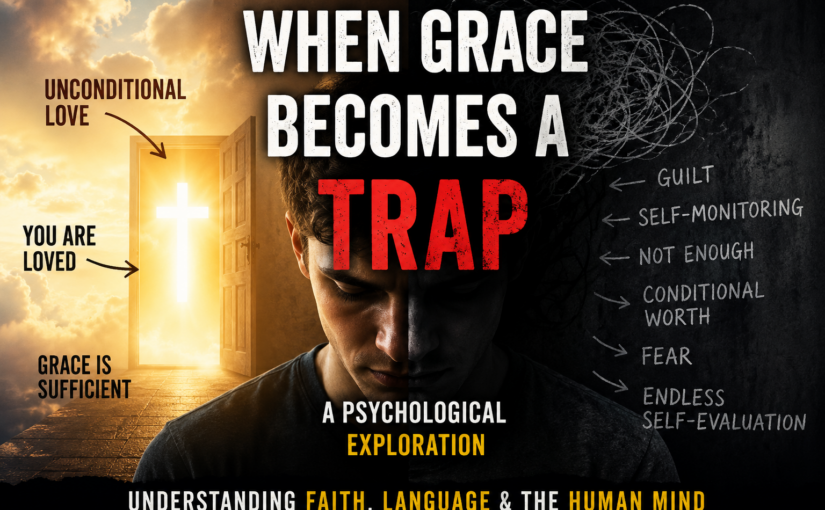
When Your Faith Becomes a Mental Trap
Have you ever listened to a sermon that says:
“You are loved unconditionally”…
but minutes later you begin wondering whether you are truly righteous enough, faithful enough, or transformed enough?
You leave inspired — but also anxious, guilty, and psychologically trapped.
This video explores how certain forms of religious language can unintentionally create chronic self-monitoring, fear, guilt, and endless spiritual self-evaluation.
This is not an attack on Christianity or faith.
It is an exploration of how language functions psychologically.
Drawing from contextual behavioral science, ACT (Acceptance and Commitment Therapy), and functional contextualism, I discuss:
rule-governed behavior
guilt as behavioral control
coherence traps
fusion with moral narratives
chronic spiritual self-monitoring
and why some people become experts at monitoring themselves spiritually instead of actually living
I also speak from personal experience as someone who once deeply preached and believed these systems myself.
The issue is not whether faith is “true” or “false.”
The issue is whether certain psychological patterns increase rigidity, fear, and suffering — or create greater flexibility, compassion, and humanity.
Many people today silently struggle with:
religious guilt
scrupulosity
fear of not being “saved enough”
compulsive self-monitoring
or the exhausting pressure to appear spiritually transformed at all times
These struggles are rarely discussed openly because they are often mistaken for spiritual weakness rather than understandable psychological processes.
My hope is that this conversation creates space for deeper reflection, honesty, compassion, and psychological freedom.
📌 Watch the full video below.
#Faith #Psychology #ACT #MentalHealth #Christianity #ReligiousTrauma #Spirituality #ContextualBehavioralScience #AcceptanceAndCommitmentTherapy #PsychologicalFlexibility #OneLifeOnlyCounseling
If you are looking for counseling or psychotherapy services in Quezon City, Manila, or elsewhere in the Philippines, you may message us at
0917 886 LIFE (5433)!
https://open.spotify.com/episode/4Jm0KWZ2aor0gKo2PDj3lj?si=c5cUF3LTScak30g9qIR-dQ
To Live Without Regret
To live without guilt is to live without mistakes.
To live without mistakes is to live without risk.
And to live without risk ultimately turns living into lifelessness.

A Life Beyond Just Feeling Good
One unintended consequence of the prevailing disease or mental disorder model is that life slowly becomes a competition over who feels the best, the happiest, the most confident, or the least distressed.
But if feeling good were the ultimate purpose of living, we would expect our final tributes and epitaphs to celebrate people mainly for how good they felt about themselves.
We know that’s rarely the case.
Most obituaries are not about who felt the happiest.
They are about what people did.
How they loved.
What they built.
Who they helped.
What they stood for.

The Rules We Live By
We all follow rules.
It’s hard to live without them.
We have rules for how to apologize, how to love, even how to make coffee.
But psychological flexibility begins when we ask:
does this rule still work in this context?
For example:
“If I’m angry, I should stay silent until I calm down.”
Sometimes that rule prevents harm.
Sometimes it quietly becomes avoidance, distance, and emotional disconnection.
And sometimes the people around us follow very different rules about anger.
One person believes anger should be controlled and hidden.
Another believes anger should be expressed immediately and directly.
So the conflict is no longer just about the thing that made you angry.
Now you begin fighting about how a person is supposed to be angry.
A good rule is not one that is obeyed no matter what.
A good rule is one that stays sensitive to context.
Better People, Better Country
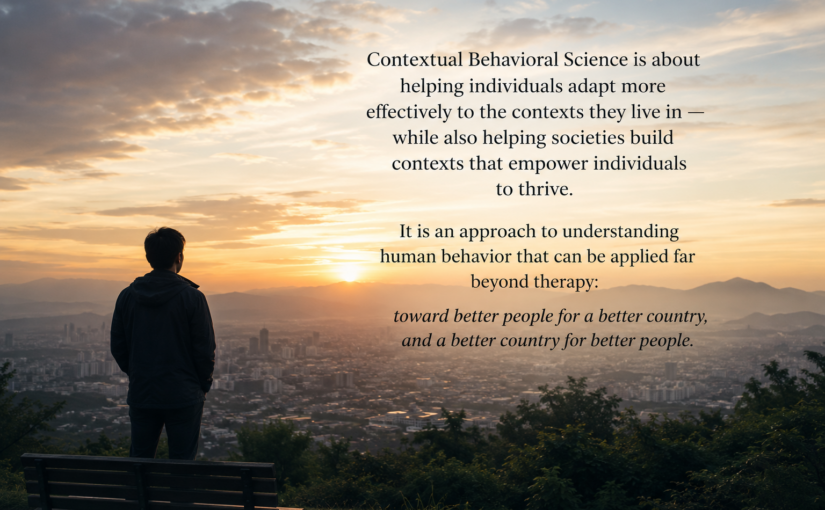
Contextual Behavioral Science is about helping individuals adapt more effectively to the contexts they live in — while also helping societies build contexts that empower individuals to thrive.
It is an approach to understanding human behavior that can be applied far beyond therapy:
toward better people for a better country,
and a better country for better people.
ACT at the Movies: Shawshank Redemption
@onelifeonlycounseling ACT at the Movie! Shawshank Redemption Welcome to ACT at the Movies. This is a series where we take some of the world’s most memorable films and look at them through the lens of Acceptance and Commitment Therapy—or ACT for short. Now, just a quick caveat: I’m not saying these movies were written with ACT in mind. But what ACT offers us is a scientific framework—a way of understanding resilience, meaning, and growth—that shows up in the stories we love. Movies capture the struggles and choices that make us human. ACT helps us see the science behind why those struggles matter, and how people find the strength to move forward. So grab your popcorn, and let’s dive in. #onelifeonlycounseling #counselingphilippines #counseling #fyp #foryou
♬ original sound – One Life Only Counseling – One Life Only Counseling
Welcome to ACT at the Movies!
This is a series where we take some of the world’s most memorable films and look at them through the lens of Acceptance and Commitment Therapy—or ACT for short.
Now, just a quick caveat: I’m not saying these movies were written with ACT in mind. But what ACT offers us is a scientific framework—a way of understanding resilience, meaning, and growth—that shows up in the stories we love.
Movies capture the struggles and choices that make us human. ACT helps us see the science behind why those struggles matter, and how people find the strength to move forward.
So grab your popcorn, and let’s dive in.
Before I begin, let me make a quick caveat. I’m not here to say that the writers, directors, or actors of The Shawshank Redemption were in any way informed by Acceptance and Commitment Therapy—or ACT. Rather, what I want to share is how ACT, as a scientific model of therapy, gives us a framework to understand something timeless: human resilience.
The Shawshank Redemption is often remembered for hope. “Hope is a good thing, maybe the best of things,” as Andy says. But when we look through the ACT lens, what we actually see are processes of psychological flexibility—the capacity to stay present, open up to difficult emotions, and move toward what matters, even in the hardest of circumstances.
- Acceptance & Willingness
Andy is wrongly imprisoned, and his suffering is immense. A purely control-based strategy—fighting, resisting, shutting down—could have consumed him. Instead, he embodies acceptance. He allows the pain of his situation to be there, while still choosing to act with dignity and purpose.
This doesn’t mean approval or passivity. Acceptance in ACT means dropping the struggle with emotions we can’t eliminate, and instead putting energy into what we can build.
- Values as Compass
Andy’s values are freedom, justice, and friendship. Those values guide him through years of confinement. His work in the library, his mentorship of Tommy, his efforts to bring dignity to the prisoners—all of these flow from what matters to him most.
ACT teaches us that when life narrows, values can open a path forward. Even in a prison cell, Andy lives by a compass bigger than his circumstances.
- Defusion from Thoughts
Red, Andy’s closest friend, often voices thoughts of despair: “Hope is a dangerous thing. It can drive a man insane.” Those are believable, sticky thoughts, especially in prison. Yet ACT invites us to notice thoughts as thoughts—not literal truths that must dictate our actions.
Andy doesn’t deny the despair, but he doesn’t fuse with it either. He chooses to hold hope lightly, and act on it, rather than be consumed by thoughts of hopelessness.
- Committed Action
The most iconic example: Andy’s years of digging through the prison wall. He doesn’t know when—or if—he will succeed. But each day, with patience and persistence, he takes committed action aligned with his values. That’s psychological flexibility in practice: consistent steps, even when outcomes are uncertain.
One of the most powerful but often overlooked parts of Andy’s story is how he responds to sexual abuse in prison. The film doesn’t sensationalize it, but it shows us enough to know that Andy suffered deeply at the hands of others.
What stands out is that he doesn’t let this experience define him. He doesn’t collapse into despair, he doesn’t wallow in self-pity, and he doesn’t passively allow the abuse to strip away his dignity. Instead, Andy keeps moving. He resists where he can, he protects his sense of self, and he continues to build toward freedom.
From an ACT perspective, this is a striking example of committed action. The pain was real, the trauma was real, but Andy chose not to let it dictate the direction of his life. He kept moving toward his values—dignity, freedom, and hope—even in the harshest of conditions.
That’s the heart of psychological flexibility: not the absence of suffering, but the courage to keep walking toward what matters, even in the darkest circumstances.
Closing Reflection
So when we look at The Shawshank Redemption through the lens of ACT, we see a scientific framework for resilience. Acceptance of pain. Defusion from despairing thoughts. Values as a compass. Committed action, step by step, toward freedom.
It’s not that Andy or Red were “ACT-informed.” But ACT helps us understand why their story resonates so deeply: it reflects universal processes of human growth and survival.
If you enjoyed this reflection, I’ll be doing more short talks on ACT and movies—exploring how science and storytelling come together to show us what resilience looks like. Thanks for watching.

Life and Driving
https://creators.spotify.com/pod/profile/nathaniel-chua/episodes/Podcast-77-Life-and-Driving-e35qfea
@onelifeonlycounseling Life and Driving For more information, please visit www.onelifeonly.net #onelifeonlycounseling #counselingphilippines #counseling #fyp #foryou
♬ original sound – One Life Only Counseling – One Life Only Counseling
Another Two Shrinks Over Drinks with Dr. Hank Robb
Erratum: B.F. Skinner did write on page 156 of his novel Walden 2 his desire for a society that does not give special honor to members of the community through the words of Frazier. Here’s part of the quote:
“We are opposed to personal competition. We don’t encourage competitive games…We never mark any member for special approbation…A triumph over another man is never a laudable act. Our decision to eliminate personal aggrandizement arose quite naturally from the fact that we were thinking about the whole group. We do not see how the group could gain from individual glory.”
Two Shrinks Over Drinks AGAIN!
In this episode for our series, Shrinks Over Drinks, I talk with Dr. Niklas Torneke, a Swedish psychiatrist who has authored three books in English and more in Swedish. Two of his books in English have been very instrumental in my journey into ACT (Acceptance and Commitment Therapy), RFT (Relational Frame Theory), and behaviorism. He is an authority when it comes to the uses of language and metaphors from an RFT perspective.
I have myself seen how his work has informed me inside the counseling room and how much it helps people see through the veneer of language.
Listen on Spotify!