By Nathan Chua | One Life Only Counseling Services
Have you ever looked at your partner and wondered why you no longer feel the same way you once did? Perhaps you used to look forward to seeing each other, enjoyed spending time together, and experienced excitement, affection, and closeness. But somewhere along the way, those feelings began to fade. You may still care about your partner, but the romantic feelings that once seemed so natural are no longer there. And so you begin to wonder: Have I fallen out of love?
In my years of counseling couples, I have encountered many who struggle with this question. One partner may say, “I care about my spouse, but I don’t feel that romantic love anymore.” For some, the absence of loving feelings becomes evidence that the relationship has run its course. But is that necessarily true? What if the disappearance of those feelings does not automatically mean the end of love? What if the context in which those feelings once flourished has gradually changed?
Love Doesn’t Exist in a Vacuum
We often think of love as something we possess. We either have it or we don’t. When we first fall in love, the feelings can be so powerful that we hardly have to think about them. We naturally want to spend time together, show affection, and do things that make our partner happy. But relationships do not remain in the same circumstances forever. There are responsibilities, financial pressures, children, careers, disagreements, disappointments, and sometimes years of unresolved conflicts. Gradually, couples may stop doing the things that once brought them closer. They talk less, spend less meaningful time together, and become increasingly preoccupied with responsibilities and problems.
Eventually, one or both partners begin to notice that something is missing. The loving feelings are no longer what they used to be. But perhaps we are asking the wrong question when we immediately conclude that love has disappeared. Instead of asking only whether we still love our partner, we might also ask what has happened to the circumstances and interactions that once nurtured those feelings.
From a contextual perspective, feelings do not exist independently of our experiences. They are influenced by what happens around us, how we interact with others, and the histories we bring into those interactions. Love is no exception.
When Love Becomes a Waiting Game
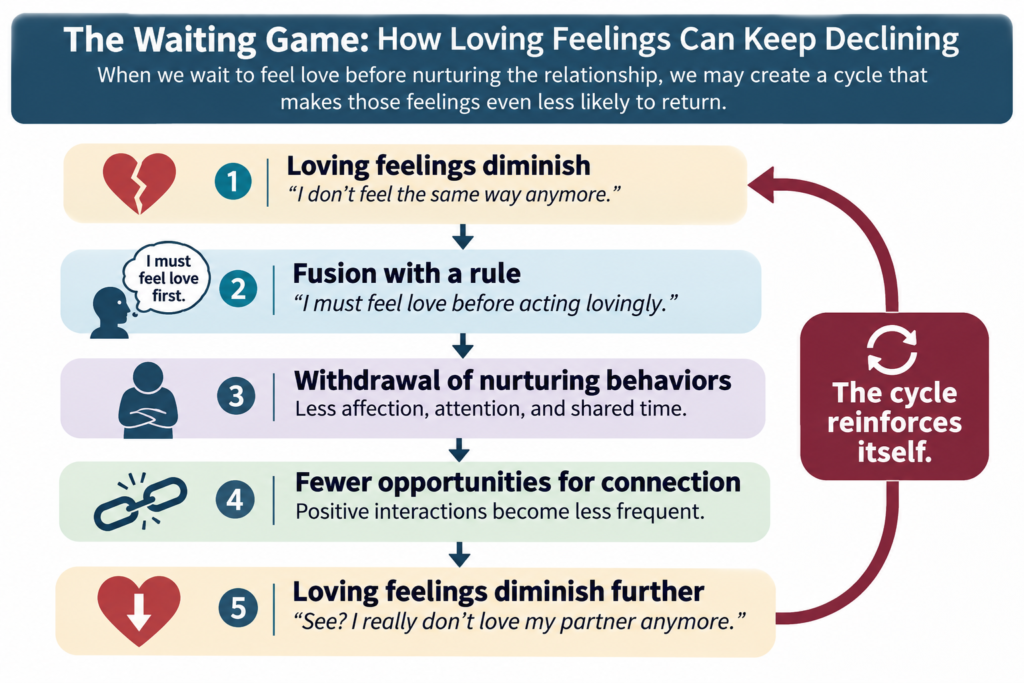
This is where couples can become caught in a particularly difficult trap. Imagine someone who tells themselves, “I don’t feel love anymore, so why should I behave lovingly?” Or perhaps, “I’ll start being affectionate again when I feel something.”
At first glance, this sounds reasonable. After all, we do not want to pretend to feel something we do not feel. But there is a potential problem with this way of thinking. What if waiting for loving feelings to return is actually contributing to their continued absence?
In Acceptance and Commitment Therapy (ACT), there is a concept called cognitive fusion. This refers to becoming so entangled with our thoughts that we begin treating them as rules we must obey, rather than as thoughts that may or may not be useful in a particular situation.
Consider the rule: “I must feel love before I can behave lovingly.”
When we become fused with this rule, we may stop doing the very things that once helped nurture our relationship. We stop initiating conversations, making time for each other, expressing appreciation, or showing small gestures of care. As these interactions become less frequent, opportunities for affection and connection may diminish as well. Eventually, we find ourselves saying, “See? I really don’t love my partner anymore.”
Without realizing it, we may have helped create the very conditions that reinforce our original conclusion.
This is how the loss of loving feelings can become a self-fulfilling prophecy. We wait for the feelings to return before changing our behavior, while our unchanged behavior may be contributing to the conditions that keep those feelings absent.
Does This Mean We Should Force Ourselves to Love?
Certainly not. I am not suggesting that people should force themselves to feel something they do not feel, pretend to be affectionate, or engage in unwanted intimacy. That would miss the point entirely.
The question I would invite someone to consider is this: If this relationship still matters to you, are there things you would be willing to do to nurture it, even when the loving feelings are not currently present?
Perhaps it means spending meaningful time together again, listening more attentively, expressing appreciation, or becoming more responsive to each other’s needs. Not because we are pretending to be in love, but because we are choosing to engage in behaviors that serve something important to us.
In ACT, this is related to committed action: choosing behaviors that are consistent with our values, even when our feelings are not necessarily cooperating. We do not have to wait for a particular emotional experience before doing something meaningful.
Of course, there is no guarantee that loving feelings will return. And the purpose of these actions should not simply be to manufacture feelings. Rather, they allow us to participate more deliberately in creating the kind of relationship we value, while remaining open to whatever feelings may follow.
Understanding the Patterns That Keep Couples Stuck
In Integrative Behavioral Couple Therapy (IBCT), we examine how partners become caught in patterns of interaction that maintain their difficulties. For example, one partner may withdraw because they no longer feel close. The other experiences this withdrawal as rejection and becomes increasingly critical or demanding. The first partner then withdraws even further. Before long, both are responding to each other in ways that make their relationship increasingly difficult.
Rather than immediately deciding who is to blame, we try to understand the pattern. What sensitivities are involved? What circumstances contribute to their difficulties? How do the partners respond to each other, and what consequences do those responses produce?
This shift in perspective can be important. Instead of viewing the problem simply as one partner’s lack of love, we begin to recognize how both partners may be participating in a pattern that makes closeness increasingly difficult.
Understanding the pattern does not automatically resolve it, but it may create opportunities for both partners to respond differently. And when their interactions begin to change, the context of their relationship may change as well.
What If the Commitment Is No Longer There?
There is, however, another important consideration. Does the person still want to remain in the relationship?
Losing loving feelings and losing commitment are not necessarily the same thing. Someone may say, “I don’t feel the way I used to, but I still want to see whether we can make this relationship work.” That is quite different from someone who has already decided that they no longer wish to continue.
Sometimes people are uncertain. They may care about their partner but no longer know whether they want to remain together. These differences matter because the goals of couples counseling should take into account what each partner wants and is willing to work toward.
For some couples, counseling may focus on improving the relationship. For others, the immediate task may be clarifying whether they wish to continue. And when separation has become the chosen direction, counseling may help the partners navigate that process more constructively.
Commitment matters, but it should not become another obligation imposed on someone. Nor should nurturing a relationship mean tolerating abuse, coercion, or threats to one’s safety.
Perhaps We Have Been Waiting for the Wrong Thing
When someone says they have fallen out of love, I do not immediately assume that the relationship is over. I become curious about what has happened. What has changed? What interactions have become less frequent? What disappointments remain unresolved? What rules might the partners be following that keep them from responding differently?
Perhaps the question is not simply, “Do I still love my partner?” Perhaps another question worth asking is, “What has happened to the context in which our love once flourished?”
And if the relationship still matters, there is another question worth considering:
“Am I waiting for my feelings to change before I do anything differently, when doing something differently might help create the conditions for those feelings to return?”
We cannot command ourselves to feel love. But we may still have choices about how we nurture relationships that matter to us.
Sometimes, the feelings we are waiting for may be influenced by the very actions we have stopped taking.
And perhaps that is something worth considering before concluding that love is gone.
Nathan Chua is a counselor at One Life Only Counseling Services in Quezon City, Philippines. His work draws from contextual behavioral approaches, including Integrative Behavioral Couple Therapy (IBCT) and Acceptance and Commitment Therapy (ACT).