I am quite sure that many of you think that all of the counseling practices being offered in the Philippines are just the same. Pretty much about common sense advice to deal with your difficulties in the secret life you and I have in our minds. You probably hear a lot of these in talk shows and see them online in your Google searches.
I must admit that from 2009 up to 2019, my practice varied only slightly from what was and is still widely available in the Philippines, that of a syndromal and symptom-reduction approach to therapy.
Since 2019 though, I have come across an approach that I believe jumps out as the most scientifically sound that I have ever experienced applying in my own life, as well as those that I have helped in the past two years or so!
In my zeal and excitement to share this with you, I am now offering a 30-minute session that is packed with enough information for you to see how this relatively new approach in the field of counseling and psychology works so well, and why it is now the most researched method in the world for the last 20 years!
What you will be shown is what Dr. Kevin Polk calls the Psychological Flexibility Point of View, which can neatly sum up this approach to therapy in just 30 minutes!
Feel free to reach out to us and book yourself a quick 30-minute appointment that we are confident will change your life’s direction! Yes, that’s all we ask! Thirty minutes and you are free to decide if you wish to continue your work with us or not.
You can be an individual, a couple, or a family. Just take 30 minutes of your time and see if this is something that will explain best why you and I struggle within our mental worlds!
Call or message me now at 0917 886 LIFE (5433)! I’d be more than excited to share my newfound knowledge with you, so you can start your journey towards creating that best version of you that you’ve always wanted!
At One Life Only Counseling Services, we work with individuals, couples, and families who are dealing with concerns such as anxiety, low mood, relationship difficulties, grief, trauma-related distress, problematic habits, life transitions, and patterns that feel difficult to change.
Our approach is grounded primarily in contextual behavioral science, particularly Acceptance and Commitment Therapy (ACT) and Integrative Behavioral Couple Therapy (IBCT).
Rather than beginning with the question:
“What disorder does this person have?”
we are more interested in asking:
“What is happening in this person’s life?”
“What is keeping this pattern going?”
“What has this behavior come to do or protect against?”
“And what might help create more workable ways of responding?”
We Look at People in Context
People do not develop problems in a vacuum.
The ways we think, feel, relate, avoid, cope, and respond are shaped over time by our histories, relationships, environments, circumstances, and the consequences of what we have learned to do.
This means that difficulties are not automatically signs that something is fundamentally wrong with you.
Often, patterns that are painful today once made sense within a particular context.
Counseling involves understanding those patterns without reducing the person to them.
You are more than a diagnosis, a test score, a symptom, or a difficult period in your life.
You are a whole person whose choices and patterns make sense in the context of your history, relationships, circumstances, and what matters to you.
Beyond Labels
Diagnoses can sometimes be useful.
They can help people describe common experiences, communicate with other professionals, access services, or identify treatment options.
But a diagnosis is not the same thing as an explanation.
Two people with the same diagnosis may have arrived there through very different histories and may need very different forms of help.
For this reason, we try not to stop at:
“What is this called?”
We also ask:
“How does this work in this particular person’s life?”
“What situations bring it out?”
“What keeps it going?”
“What changes it?”
More Than Test Scores
Psychological tests and assessments can provide useful information, but they are snapshots taken under particular conditions.
They do not capture everything a person can become.
A score cannot fully tell us how someone will respond to a different environment, a meaningful relationship, new opportunities, better support, or changing circumstances.
Assessment is therefore most useful when it helps us understand a person more clearly—not when it becomes a permanent definition of who that person is.
Counseling With a Clear Purpose
Good counseling should help you need less counseling over time.
Counseling is not intended to become an endless process of discussing the same difficulties without movement.
Our goal is to help you:
understand the patterns that keep problems going, recognize the contexts in which those patterns become stronger or weaker, develop more flexible and workable ways of responding, clarify what matters to you, strengthen your ability to make choices consistent with those values, and gradually become less dependent on counseling as your own capacity grows.
Progress does not always mean that difficult thoughts and emotions disappear.
Often, it means becoming better able to respond to them without allowing them to determine the direction of your life.
Values Without Imposition
Counseling should not be about making you live according to your counselor’s values.
Our role is not to tell you what kind of person you are supposed to become.
Instead, we help you examine what matters to you, what your current patterns are costing you, and what kinds of choices might help you move toward a life that is more workable and meaningful within your actual circumstances.
Your culture, relationships, beliefs, responsibilities, history, and constraints all matter.
There is no single template for a good life.
Relationships and Couples Counseling
In couples work, we primarily draw from Integrative Behavioral Couple Therapy (IBCT).
Rather than simply deciding who is right or wrong, IBCT looks at the patterns that develop between partners.
Many recurring conflicts are maintained not only by what each person does, but by how each partner responds to the other over time.
Couples can become trapped in cycles of criticism, withdrawal, defensiveness, pressure, resentment, or avoidance even when both genuinely want the relationship to improve.
Counseling helps make these patterns visible so that partners can respond to each other with greater awareness, flexibility, and choice.
Medication and Other Forms of Care
Counseling does not need to compete with medicine.
Medication can be helpful for some people, and psychological support can be helpful with or without medication.
The important question is not whether one approach is universally better than another.
It is whether a particular intervention is helping a particular person under their particular circumstances.
When medical or psychiatric evaluation appears appropriate, we encourage clients to consult qualified healthcare professionals.
A Science-Informed Approach
Our approach continues to evolve as the evidence evolves.
We aim to use methods that are scientifically informed, coherent with our underlying framework, and responsive to the needs and circumstances of the person in front of us.
This does not mean mechanically applying techniques because they appear in a manual.
Techniques should have a purpose.
We want to understand what a particular intervention is intended to change, why it may be useful for this person, and whether it is actually helping.
Is One Life Only a Good Fit for You?
One Life Only may be a good fit if you are looking for counseling that is:
collaborative rather than authoritarian, attentive to context rather than focused only on labels, grounded in contemporary behavioral science, interested in how problems are maintained rather than merely what they are called, flexible enough to respond to your circumstances, and oriented toward helping you become increasingly capable of navigating life without long-term dependence on counseling.
Choosing a counselor is ultimately a matter of fit.
Credentials, methods, and professional training matter, but so does what happens when two people actually sit down together.
Do you feel heard?
Can you speak honestly?
Can difficult things be discussed without being immediately judged or reduced to a label?
Does the work help you see your situation more clearly and respond to it more effectively?
Those questions matter too.
About One Life Only Counseling Services
One Life Only Counseling Services provides counseling for individuals, couples, and families using contemporary approaches informed by contextual behavioral science, particularly Acceptance and Commitment Therapy and Integrative Behavioral Couple Therapy.
Our aim is simple:
to help people understand what keeps them stuck, develop more workable ways of responding, and build lives that increasingly require less counseling—not more.
If we were trained to look at the ads we see everywhere from our mobile devices to the busy highways we go through in our regular commute, we can pretty much sum up what they’re selling us in one word. Would you like to venture a guess? That new car, that shimmering bottle of beer (that in reality is rather bitter and awful-tasting), that outfit, or even that loan that you have to pay off in a matter of a month to 20 years, are invariably supposed to make us feel good! So what in one word are they selling us? Happiness!
Having this in mind, the helping-people business has not been above the culture of the times. It is understandable that for about a century now, the field of psychology has devolved into an endeavor of classifying us into a set of symptoms or syndromes. The goal then becomes removing or lessening the four out of seven or the five out of nine signs that you are, for example, a borderline personality. This is what experts have called symptom-reduction therapies. Let’s remove your anxiety and depression so you can start moving on with your life, at least to the level of “normality.” To borrow from one of the pioneers of Acceptance and Commitment Therapy, it’s sort of like looking at how a fountain works by trying to figure out the different colors and patterns, and seeing how these can be explained.
Unfortunately, such endeavors have only left places where people have been almost literally drugged out of existence. It turns out that removing these “negative” emotions has a costly side effect: not feeling at all! There has been no science to determine that there is a germ or microbe or gene that causes mental problems. The drugs only serve to numb us–something that dead people can do better than we who are alive.
Too much anxiety? Well, here’s a drug to keep you relaxed. Too much depression, well here’s something to perk you up. It can go so bad as to make those who take these medications dependent on them. As another expert has said, it’s become so prevalent that in their country, the chemicals that are used in these antidepressants are now found in their water. Moreover, there are now drugs to treat the very side effects that such medications can create. And with trained eyes, you can sum up what these drugs are selling in one and the same word again–Happiness! The objective is to remove those feelings and thoughts first before you can start living a worthwhile life.
Fortunately, the group of people that Dr. Steven Hayes has assembled, have come up with something called process-based therapy. Dr. Kirk Strosahl who likened the way symptom reduction therapies work to explaining or addressing the phenomenon of a water fountain by the numerous colors and patterns that it makes, explains it this way: That if we were engineers studying how this fountain works, we will see that underneath it, is a simple combination of processes that a few tubes combine to do, to make it look intricate.
I have seen it in the people I have met in my work, where they come in with glassy eyes, looking enervated and lifeless. It breaks my heart to see this. In my work, I would love to see the exact opposite happening to my clients. I would love to see them bubbling with energy and enthusiasm for what life has to offer.
The culture nowadays provides for an environment where people (and that includes me) are unintentionally tricked into believing that life is about feeling good. The meaningful life has become about having the right kind of car, job, or even partner. Got this or that and you and I will be happy all the time. Well, first of all, that goal is impossible. Secondly, some of the most meaningful parts of life revolve around something we did that was hard and anxiety-causing.
I often use the following vignette to give my clients a new perspective towards life and what it is that we come to therapy for:
“If you look back at a graduation ceremony of a child, or a wedding, or any of these momentous occasions, don’t you at some point want to shed a tear? Why? Is it because raising a child and putting them through school was always happy and joyful? Is culminating a long-term relationship during a wedding all just about having fun? Or was it more like, you went through a lot of hardship and trials and somehow made it through together? The most meaningful and purposeful moments were hard, full of ups and downs, and of unpredictable and anxiety-causing moments! The tears would mean you somehow pulled through and made it! You did the hard thing, the brave thing! That’s why you come to me for counseling. Not just to be happy but always pursuing that which gives you purpose and meaning, until you breathe your last! And that’s how that wiser part of you says you were meant to live.”
I remember a person who shared with me that she had been with her therapist for several years. She felt it helped her in terms of managing her anxieties and anger issues. She went on to share that she needed her weekly sessions to get some relief from all the emotional struggles that go on during the week. This type of counseling is called supportive counseling which certainly has its place in the field. In my graduate studies, I can certainly attest to the fact that I used to do this type of work in dealing with my test cases to begin my training in listening or counseling skills. With this person who shared her experience though, the weekly sessions have become a psychological crutch, just like taking a break from her cares for at least an hour a week. *
Counseling work is more than just being supportive. The goal is more about having clients learn, as experientially as possible, skills that can be brought to their everyday lives. The counseling room becomes the lab where these skills are introduced and tested.
I don’t really mean to be simplistic here but I thought the title can help us focus on knowing what goes on inside the work I do and its ultimate goals. If we come up with something that would make it simpler and more understandable, then we would have done a better job in assisting people in appreciating what all these working sessions are for.
If you wish to change the way things are in your relationship with your partner, then you need to try different things. In ACT or Acceptance and Commitment Therapy linggo, we call that expanding behavioral repertoire. It is also referred to as flexibility skills. If you start a conversation with your spouse with a criticism or a “You” statement every time, you are more than likely to get defensiveness in return. And so on and on you go with the circular arguments that often lead you to ultimately just avoid each other or get into a massive shouting match.
Unfortunately, we are the creatures who think that we can do the same things over and over again and come up with the results we want, even if the evidence clearly shows the contrary. We like to follow rules and rule-following becomes the dominant reinforcer of our behaviors, and not the actual contingencies that show up. We can see this if we break down the process of how people get hooked to the slot machine or some form of gambling addiction. Although it is true that there is a one in a billion chance that you might hit pay dirt, the addicted person is not aware of the consequences happening as they continue this obsessive behavior.
Taken in these terms, we in this helping profession are after you getting out of your comfort zones. Comfort zones are places where we want to end up that give us the short term feel-good moments. Being able to analyze your spouse and find out what’s wrong with them, can give you that sense of accomplishment that you know something they don’t. Getting that high in front of a slot machine when you win a small pot can be intensely rewarding at the moment. However, the long term consequences eventually show up. You no longer become the spouse you want to be. The more you criticize your partner, the more they snap back. Slowly eating away at the relationship you once thought will go smoothly through the years. The more you gamble, the more you end up piling up debts and spending countless hours unable to do anything else that could have otherwise been spent more productively and meaningfully.
I’d like to borrow a phrase from a book to help you, my readers, understand how counseling works. The work is about being comfortable with the uncomfortable. Maybe it’s time you tried another approach to your spouse, even if it feels embarrassing or extremely “so not you.” Maybe you need to sit with those urges to gamble and find out what really is behind the pull towards the addiction so that you can find alternatives to spend all that energy on. To paraphrase a well-known ACT therapist, Kirk Strosahl, maybe there’s something more important here than what you feel.
If you are like the person I discussed in the first paragraph of this post, then be wary. That’s because the counseling work is making you feel comfortable! If you start to do things that are uncomfortable with the help of your counselor, then you might be on the road to being comfortable with being uncomfortable. That’s also when you know that your work with your counselor is worth all that time and energy. Maybe you’re on to trying something different that moves you towards what I regularly use in my discussions with my clients: being the person you want to be, and living the life you want to live.
*The example here is an amalgam of different cases that do not refer to any person in reality.
One of the things that our minds are really good at doing is judging. Our minds have developed this highly useful skill for the ultimate survival of our species that has very few qualities which can protect it from external threats. We don’t have large sharp teeth or claws and are said to be a species that has the longest gestation period among all creatures.
You might be curious to know how judgment can play any part in our survival, let alone the survival of a whole species. Isn’t it that we use judgment more to describe the ways we behave towards others? We are not used to using the term in light of its impact on our evolutionary history. Let’s do this little exercise to see how. If our minds didn’t know how to judge between a threat and a non-threat, we would be like the fish that get caught twice or more times by a fishing hook. Our minds are there to create rules that keep us out of harm’s way. If you see a line attached to a bait, that’s not dinner being presented to you, but you becoming somebody else’s dinner. Don’t cross the street without looking side to side. Stay indoors when your experience tells you that this is the time of the year when the weather can be harsh. This rule-following ability is what sets us apart from other species and gives us an edge of tremendous effect on who dominates the planet.
Unfortunately, this talent is double-edged. It can be useful to judge between a lion and a puppy but not when we use it to judge our internal processes. If our minds weren’t able to tell that the moving thing in front of us is a hungry lion, we could be its next prey! The mind applies the same rule to our feelings and thoughts, because the mind does what it does. Our difficult thoughts and feelings that naturally come by because of the life situations we face, are equated as bad, as in hungry lion-bad!
Couples and families often come to a judgment of their loved ones. Unfortunately, such judgments often get in the way of the loving relationships each party wishes to develop. One way of stepping out of these judgments is to consider your differences as they are and not as defects. Here’s one way to be more aware of this. Imagine if you had a loved one (either a romantic partner or a family member) who has suffered from a childhood impairment, let’s say, he or she is half-blind or has an injury that makes it difficult for them to walk at a normal pace. Would you demand that he or she be able to walk and do stuff as fast as you do? Probably not! You would most likely make adjustments to accommodate your loved one’s condition.
Given this, you and I can be more conscious of what our minds say are defects and begin to view them as conditions or differences around which we have to work. We can recognize our tendencies to see our loved ones as defective and therefore more like problems to solve rather than human beings who have learned a different way to tie a shoelace so to speak.
Another way of putting this into a clearer perspective is to notice the difference between describing a movie and judging it. A descriptive statement would be to say that the movie is an hour and 40 minutes long. While an evaluative statement would be that the movie was too long or too boring. Why don’t you try this at home? You can then experiment with a loved one that you have long judged to be defective. Just like a narrator for Nat Geo, see if you can objectively describe how your partner or child or parent behaves and say to yourself, “This is someone special who I would much rather choose to love with all his or her different behaviors that I have come to accept in the service of a truly honest and loving person that I wish to be in this and every moment.” That, my friends, is the key, not to feeling good, but to living well in spite of what your mind says are judgments to be made. It is up to you to look at those judgments and say, I choose not to run away from or struggle with my difficult experiences in dealing with this important person in my life, and to accept them above all. Be my guest and see peace arrive in your life.
Of course we do, that’s all there is to expect in married life, right? For those of us who have gotten married, I bet there’s plenty of thought of “living happily ever after,” especially in those moments when it was actually about to happen. Pretty much up to the time leading up to the wedding, everything spelled h-a-p-p-y. Pick any random year into a marriage, and we are likely to find about half of that on the brink of separation, because either one or both of the parties are bone-tired of having to suffer through the other’s insufferable ways.
We often get caught up in these all or nothing moments in our minds, where we believe that within our unhappiness, we can never have happiness. One or the other has to go. But here’s a good example to prove that this may not be necessarily so. Look back at those moments when you and your future spouse were just minutes away from exchanging vows. If I may so boldly predict, I am quite sure you had moments when thoughts like, “Am I making the biggest mistake of my life here?” were right there coming from the back of your head in the middle of your own wedding ceremony! He’s so clumsy he keeps stepping on my train! She’s turned from angel to t-rex in months! Further still, pick up any major decision you’ve made in your lifetime and tell me you never had thoughts about whether your choice was right or disastrously wrong, and I would be the first to congratulate you for being that rare master of your own mind.
Part of what can help your marriage is if you understand how your mind works that makes being married such a disappointment. We often get carried away with thoughts that we can’t have both positive and negative emotions at the same time inside us. Well, think about your dog or pet. How many times has your mind told you getting that dog is a big mistake and yet you still love him to death? So with the dog it goes, “I love him and sometimes I think getting him was such a big mistake.” There you go, both positive and negative emotions all in one situation.
Getting married to be happy is how our use of language tricks us into going to an extreme. The reality is more like getting married is meant to find purpose and meaning in your union, and many times it won’t be, just happy. Playing to win a championship game isn’t just about being happy, it is hard! Raising kids is not bound to be happy all the time, in fact it is the most challenging task for even the most notable names in history who have done seemingly harder and more exceptional deeds outside of raising a child! Why? Because the fact that it is hard and not very easy makes it challenging and fulfilling at the same time. The same is true with marriage. Your partner can sometimes be lovable and be challenging to live with. Learning how to accept this is something couples often have difficulty finding room for, because the mind suggests we can only have room for one.
Sometimes the best things in life are hard and painful, which is precisely what makes a life more purposeful and meaningful. We humans love solving problems even when it’s not always fun to do, or not always the happy thing to do. Come out of yourself and notice how your mind works; I bet you’ll see great wisdom.
You will never be like our friend Joe. He knows how to make Valentine’s day special for his wife. I clean your closet for you and you never even try! I need you to change or else I will never be happy in this relationship. I have done so much for this relationship so why can’t you do the same for me?
These are just some examples of how couples end up escalating their fights. They end up not just fighting about the issue at hand, but also the way they fight about it. In the following article I will be writing about a few common requests that couples make that usually backfire. Here is a short list of some of these ineffective petitions for change that couples use:
Did you notice how sweet Joe is to his wife? Why can’t you be more like that?
The problem with this type of request is that it immediately makes your partner defensive. Your partner, just like everyone else will then make comparisons to other people who are less thoughtful to their partners than him or herself. We all have the ability to make both upward and downward comparisons. Comparisons usually make way for even more comparisons that will defend your partner’s position and invalidate yours.
After all of the work I have done to keep this household clean, you can’t even pick up after yourself! When will you learn not to dump the dirty dishes in the sink and leave them there for hours?
The problem with this demand is that you turn your partner’s differences into defects. It may not take you much to clean up, but it can take quite a bit of effort for your partner. What may seem easy and logical for you, may not be as evident to your partner.
There are quite a few more of these, but I will now turn to ways in which you can make your requests more likely to be granted. Please note that I don’t claim certainty here. But at least these types of requests will be less likely to compound the issues by turning your fights into fights about the way you fight. You might be surprised at its simplicity.
Make simple requests for no other reasons but for the fact that such changes will make you happy! Most, if not all of us, go into a pair-bonding relationship for the simple reason that we want to make our partners happy. It gives us pleasure to know that we have done something that makes our partners smile.
In some cases though, you may find it hard to talk about these requests for change without ending up in a major altercation. In such instances, you might have to be a bit more creative. Do something different in the way you make your requests, like handwriting an open letter or sending an email.
If all else fails, there are a few things that have less to do with how your partner is, but more to do with how you are in the relationship. One is being able to accept the fact that in all relationships, there are bound to be inequalities. Your partner will be unpleasantly surprised if you suddenly demand for something that was never there in the first place. Secondly, come to terms with the fact that change is bound to happen in any relationship. In fact, keeping things as they are will take more effort than accepting that change will happen over time. To use a metaphor, keeping a car or house in its original state is much harder than accepting the fact that they will eventually break down in certain areas.
Finally, the only thing that I can guarantee will make changes in your relationship, is a change in yourself. Do what your partner has been asking for. Do it without asking anything in return. Give your partner an incentive to do what you’ve been requesting for. Be kinder, sweeter, and show your partner that you have come to accept many of the differences that he or she brings into the relationship.
Attempts to change your partner by sheer force of command usually backfires. You can only influence change not demand it to happen in order for it to happen. If you change, there is a greater likelihood that your partner will notice how much you have come to accept him or her, and thus show changes too. It’s just up to you to be more mindful of the changes you see in your partner and appreciate your partner’s efforts. As humans we all harbor aspirations of becoming the best person we want to be, most especially in this one special relationship that is like no other. Your partner is no exception.
I have a feeling you would say that this blog post may not be worth your time. Why? Because how many times have you read articles that tell you to weigh the pros and cons of being alone in this time made exclusively for couples. Well, this article will either amuse you or disappoint you. I am not here to talk about the usual good and bad of being single and alone on Valentine’s day. That battle in your mind will go on until the day you lose consciousness (well, for good, knock on wood). It will never end. It’s sort of like an old marriage joke I heard once from a clergyman, “Marriage is like flies on a screen door. Those who are out want in and those who are in want out!”
Well, that’s the mind for you! Sorry to sound trite, but your mind will always convince you that the grass is greener on the other side. It is a nonstop judgment machine!
So here’s the deal with being alone this Valentine’s day. You can either give up your search for a lover, or you can keep doing what you are doing now (rationalizing why you shouldn’t or why you should be extra picky, or why you should anyway), or you can give it a go! I know your mind will start barking off reasons for you to not even try. It’s going to be one out of a hundred chances that I get to meet someone interesting. It will be exhausting! Boring! Painful! I will just get rejected more times than I can bear.
You can either follow what your mind tells you to do or step back a little and say what is dating done in the service of? Is there a part of you that wants to be loving and caring to that one special person? If your answer is yes, notice the verbs I use here! It is about being loving and caring. It is not just about marrying the right person, or having a long term commitment. What’s the difference? The former is something you can do endlessly until the end of your last breath, while the latter are goals you make that tell you you’re partly on your way to be the former! Get it?
See if we focus on our goals, we set ourselves up for disappointment…whether we succeed or not. Why so? That doesn’t seem fair! Let’s see how goals work in our lives. Goals are mostly end points in a process of pursuing something we want out of our lives. If you fail to meet those goals, then you end up disappointed. If you succeed in achieving your goals, how long does the satisfaction last? Have you ever noticed that any new goals you achieve are instantly followed by a lack of satisfaction and an urge to pursue even more goals? (Ever wondered why some of the richest billionaires end up doing something else besides what they had been doing so well for decades?) So whether you achieve goals or not, you end up disappointed or at least unsatisfied. Remember your mind is a judgment machine!
So think of dating as part of your magic carpet ride! It will be scary at times for sure, but it will likely be worth it if you know what the activity done is in the service of. Think of a child who plays games like hide and seek! Isn’t that scary and anxiety-causing? But we still played the game for the sake of a more fun childhood! That was when we hardly knew the rules that our minds gave us! You shouldn’t feel this or that, or think this or that! At least that’s what the adults around us said! So the secret is to see your moves from a child’s eyes. This is going to be horrifying at times, but alive! Just like a movie! There will be challenging times, but that’s what makes a movie a movie worth watching, isn’t it?
So get in touch with the child in you and enjoy the ride. This is just part of your journey of being or becoming more like the loving you you’ve always wanted to be! Happy Valentine’s Day everyone! (and that includes the lonely ones!)
Since I began to sense some dissatisfaction over the counseling approaches I have been using for the first nine years of my practice, I went in earnest to find better and more modern approaches to working with couples. It didn’t take long for me to listen to a podcast from a couple of psychologists from Oxford University, raving about the efficacy of mindfulness to psychological well-being.
Most of the approaches I had tried before for couples, were rules-based. These rules made sense and they didn’t take a genius to understand how these rules can work. Unfortunately, the drawback of this approach is that couples would then tend to use such rules to bash one another.
How do I now translate the mindfulness approach to dealing with couples? Do I have my couple sit in front of me for 10 minutes and meditate? It turns out there is a way to counsel couples to become more mindful in their relationships.
Mindfulness allows couples to de-escalate fights, prevent fights, and recover more easily from their fights. Most couples end up separating because their negative interactions have become hard to tolerate. As a result, these negative exchanges can lead to a lessening of positive interactions that contribute to the couples’ opting to end the relationship.
Dr. Christensen, Doss, and Jacobson have come up with a memory aid for couples to remember. This helps couples take a more mindful approach to de-escalating fights. The mnemonic is START:
“Stop what you are doing for the moment.” Pause to notice what is going on at the moment. Notice if this is something familiar that you and your partner have gone through countless times in the past.
“Take a deep breath.” This focus on the breath and being able to breathe in and out of the body part that feels tension in this exchange, can get you off the automatic reactions that lead to escalation.
“Attend to what is going on with you emotionally in the moment.” One skill you will learn in mindfulness is to be able to identify or label the emotion that you are feeling. Couples tend to more easily show a hard emotion over a soft hidden emotion.
“Reveal your emotional state to your partner.” Once you have identified the deeper emotion, you may now be more open to tell your partner about these vulnerabilities that have remained hidden for so long.
“Take an interest in what is going on emotionally with your partner.” If you can be in touch with your feelings without defense, you can be more open to understanding your partner’s feelings as well.
I hope this short blog post will help you and your partner become more equipped when disagreements arise. Committing to act on these skills is your key to developing a better relationship.
Good counseling should help you need less counseling over time.
Counseling for Individuals, Couples, and Families
At One Life Only, we use contemporary approaches grounded in contextual behavioral science, particularly Acceptance and Commitment Therapy (ACT) and Integrative Behavioral Couple Therapy (IBCT).
Rather than simply asking “What disorder does this person have?” we ask a different question:
“What is keeping this problem going—and what can we change that will make a meaningful difference?”
This means counseling is not intended to become an endless process of talking about the same difficulties. Our goal is to help you understand the patterns keeping you stuck, develop more workable ways of responding, and eventually become less dependent on counseling—not more.
One Life Only may be a good fit if you are looking for counseling that is structured, collaborative, and grounded in contemporary behavioral science.
Our aim is to help you understand the patterns that keep problems going, develop more workable ways of responding, and build enough confidence and flexibility that counseling becomes less necessary over time.
If you are looking for counseling in the Philippines, One Life Only provides in-person counseling in Quezon City and online counseling for individuals, couples, and families throughout the Philippines. We work with concerns including depression, anxiety, trauma, relationship and family problems, insomnia, anger, infidelity, parenting difficulties, grief, addiction, procrastination, and work-related concerns.
Please text (preferred) or call:
Mobile Number: +63 917 886 5433 (LIFE)
Available also on iMessage, Viber and WhatsApp!
(The best option is to message this number through Viber or WhatsApp and we will gladly call you back or reply!)
Our office is located in Quezon City, Metro Manila, Philippines.
M Place South Triangle
8004 Mother Ignacia Avenue, Quezon City, Metro Manila, Philippines
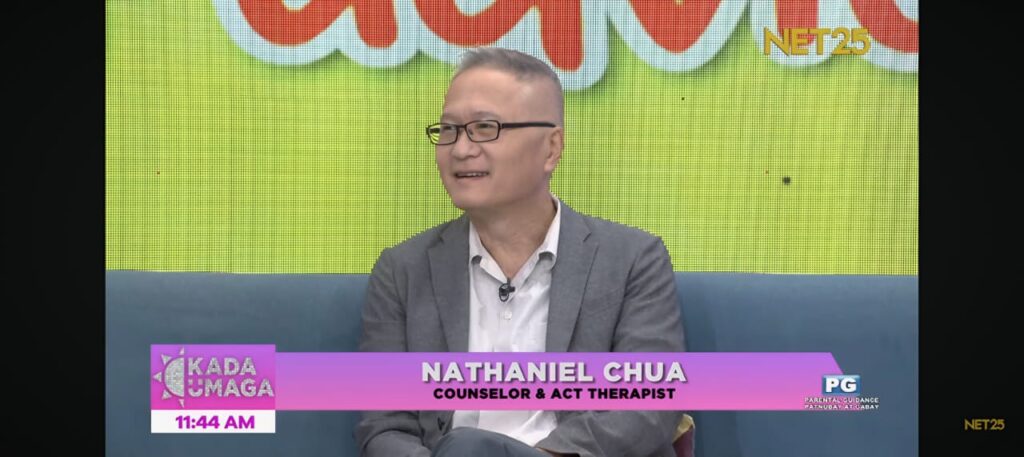
Interview with DZXL RMN News, July 2, 2026 discussing different topics related to Ai Attachment and sharing the book, Better People, Better CountryEarly morning guesting at IBC 13’s Treze Mornings with Eve Valdez and Charles Villanueva discussing Scatter Addiction, May 28, 2026Nathan Chua spoke with Pia Guanio Mago about parenting on Net 25’s Kada Umaga, June 2025
The counselor is also an author!
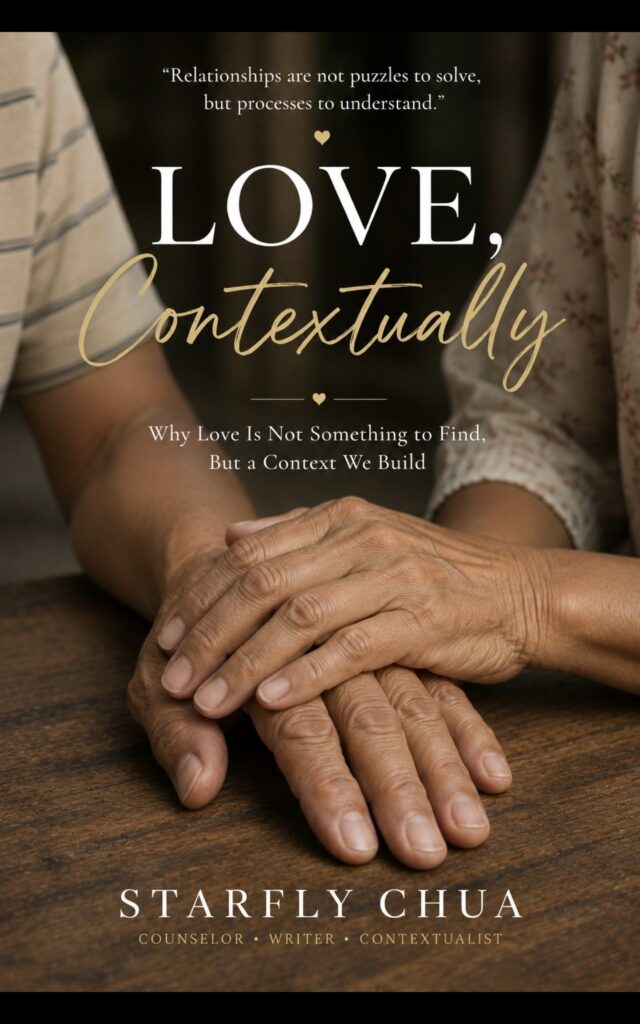
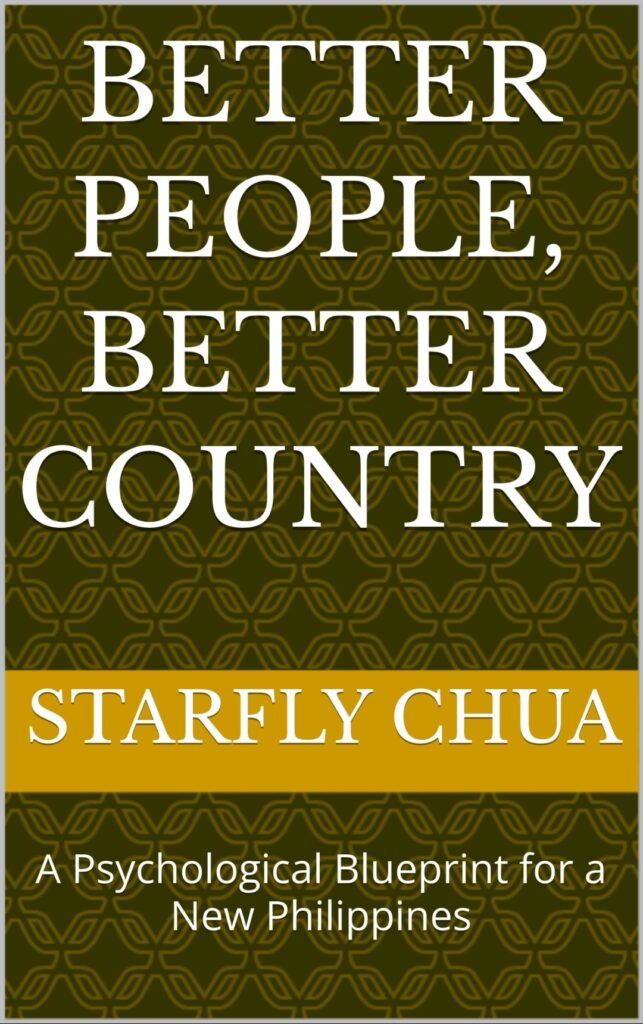
Nathaniel Chua is the author of two books!
Writing under the pen name, Starfly Chua.
New Release!
Many relationship books tell us to find the right person or master the right techniques. Love, Contextually takes a different approach. It invites readers to see love as something we continually build within the context of two changing people living through changing circumstances. Drawing from years of counseling experience and contemporary contextual behavioral science, the book offers a compassionate, practical, and refreshing way to understand conflict, deepen connection, and cultivate healthier relationships.
Better People, Better Country: A Psychological Blueprint for a New Philippines,
published under the pen name Starfly Chua. The pen name was chosen in homage to his grandfather and his ethnic Chinese roots, and reflects a preference for allowing ideas to stand on their own—without emphasis on personal visibility or status.
Here are selected endorsements from international colleagues and clinical experts:
This book is a fascinating personal exploration and cultural adaptation of contextual behavioral science applied to psychotherapy. It takes you, with great clarity and humility, from the philosophical foundations of functional contextualism all the way to its practical applications in Acceptance and Commitment Therapy. The way it addresses the challenges of psychological well-being in the Philippines makes it a particularly valuable contribution.
Dr. Matthieu Villatte, PhD, Co-author of Mastering the Clinical Conversation: Language as Intervention
Better People, Better Country offers a transformative shift in perspective, moving from rigid cultural rules that invite moral shaming toward one of contextual understanding. Both deeply personal and extensively practical, Starfly Chua provides a psychosocial blueprint for change and progress at multiple levels of human existence. This book is an invaluable resource for the people of the Philippines because it moves beyond the exhausted cycle of demanding ‘better people’ and instead provides the tools to build ‘better contexts’ — systems that naturally support prosocial values that benefit citizens and country alike.
Lou Lasprugato, MFT
Peer-Reviewed ACT Trainer
For far too long, theories of human behavior and psychology have been relegated to the therapy room, used in private, and often at the individual level. We now have advanced psychological theories that can explain and help foster change at the societal level.
Chua reaches for the same shining star that famed behavior analyst B.F. Skinner once reached for, applying cutting edge behavior change technology to the community at large—not just for the purposes of greater mental health—but for more workable societies. Chua doesn’t just reach for this star, he grasps it firmly. Laid out in this book is a set of common sense reforms that could revolutionize the Philippines and the world at an achievable cost: our own willingness.
Jacob Martinez
Practicing Counselor
Wisconsin, USA
To find out how you can get copies of his books please click here.
Nathaniel Chua is also a member of an international organization called the Association for Contextual Behavioral Science (ACBS). He once became chair of the Diversity, Equity, and Inclusion Special Interest Group (DEI-SIG) of ACBS; the first Non-North American to do so.
Nathaniel Chua has a Master’s Degree in Counseling and continues to learn more of the most cutting-edge approaches to working with the human condition.
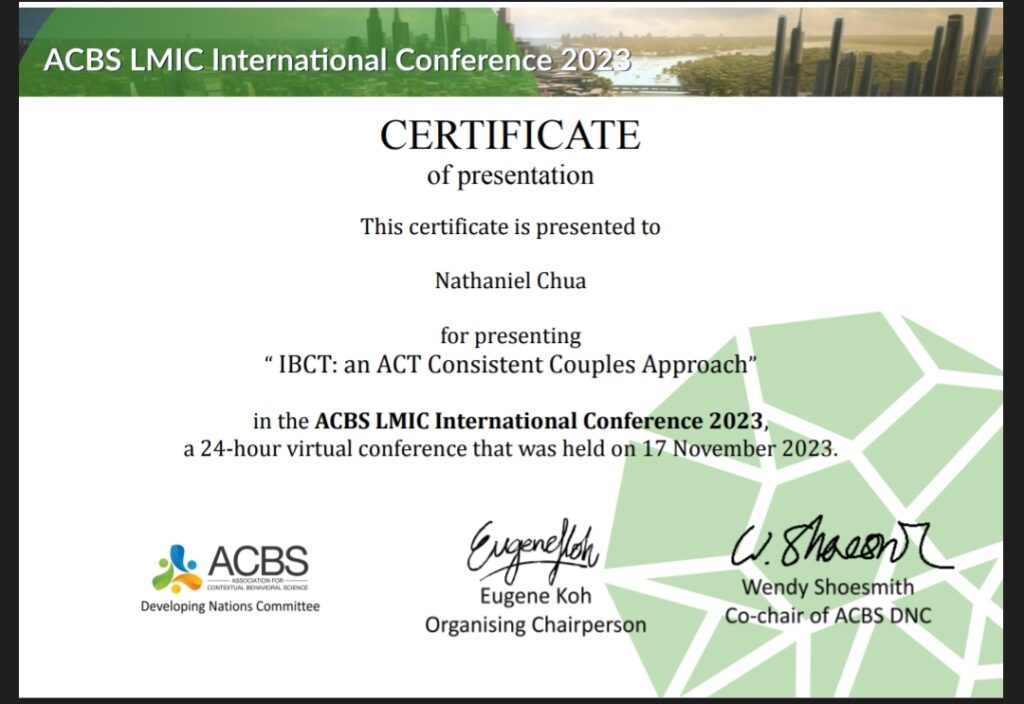
Below is Nathaniel Chua’s first virtual talk held on November 17, 2023 in front of an international group of therapists from Low or Middle Income Countries (LMIC). He is the first from the Philippines to do this:
What is One Life Only Counseling about?
We value and respect your privacy, and what you share with us is treated confidentially.
You will be respected regardless of your religion, sexual orientation, gender identity, ethnicity, economic status, lifestyle, or personal values. We are LGBTQIA+ friendly.
Your counselor will not impose personal beliefs or values on you.
We welcome people from all faith traditions—and those with no religious affiliation. Spirituality and belief can be deeply personal. For some people they are sources of strength; for others they may also be sources of difficulty or conflict.
Our role is not to tell you what you should believe. It is to understand what matters to you and help you move toward a life and relationships that are more consistent with your own values.
Our work is guided primarily by Acceptance and Commitment Therapy and Integrative Behavioral Couple Therapy.
Both approaches are grounded in functional contextualism—a scientific framework that seeks to understand behavior within the circumstances in which it occurs.
Rather than asking only whether a thought, feeling, or behavior is “good” or “bad,” we ask:
What function is this serving? What keeps this pattern going? And is it helping you move toward the kind of life or relationship you want?
What is functional contextualism?
Functional contextualism begins with a simple idea:
Behavior does not happen in a vacuum.
Every action, thought, feeling, memory, and reaction occurs within a particular context.
That context includes your history, relationships, environment, culture, learning experiences, expectations, and what is happening around you now.
Understanding that context can help us make better sense of why certain patterns continue—and what may help them change.
What we mean by behavior?
Behavior is not limited to what other people can see.
It also includes private experiences such as thinking, remembering, imagining, worrying, avoiding, planning, and interpreting what is happening around us.
Some behaviors are observable. Others happen quietly inside us.
Both matter.
What we mean by context?
Context is more than the physical place you are in.
It includes your personal history, relationships, memories, culture, present circumstances, and the people who have shaped your life—even when those people are no longer physically present.
The same person may respond very differently depending on stress, sleep, conflict, safety, expectations, past experiences, or the environment they are in.
That is why we try to understand the whole situation rather than judging behavior in isolation.
What we mean by function?
Every behavior occurs for a reason, even when that reason is not immediately obvious.
The “function” of a behavior refers to the role it plays within a person’s life.
For example, avoiding a difficult conversation may reduce anxiety in the short term, even if it creates more problems later.
Anger may sometimes protect a person from feeling vulnerable.
Withdrawal may temporarily reduce conflict while also increasing distance in a relationship.
Understanding the function of a behavior does not mean approving of it.
It means understanding what keeps it going so that more workable alternatives can become possible.
What we don’t believe or practice:
We don’t see you as “broken” or as a set of symptoms to fix. Outside of major physical damage or impairment, there’s no solid science proving that everyday behavior is caused by some permanent biological flaw. You’re not a checklist of traits scored four-out-of-seven or five-out-of-nine. You’re a complex, whole, and freely choosing individual whose actions make sense in the context of your life.
Beyond Labels
Diagnostic labels can sometimes be useful for communication, research, or access to services.
But they do not tell us everything we need to know about a person.
At One Life Only, we place greater emphasis on understanding your individual history, circumstances, patterns, values, and goals than on reducing you to a diagnostic category.
We are interested in the person behind the label.
More Than Test Scores
Psychological tests can provide useful information in some settings.
Our counseling work, however, places greater emphasis on conversation, observation, history, context, and the patterns that emerge in your actual life.
No single score can capture the full complexity of a person.
We therefore focus on understanding how you think, feel, relate, respond, and make choices within the context of your life.
Medication and Counseling
Medication can be useful and, in some cases, important.
Decisions about medication should be made with an appropriately qualified medical professional.
Our role is to focus on psychological and behavioral processes: helping you develop greater flexibility, understand difficult patterns, respond differently to thoughts and emotions, and build a life that reflects what matters to you.
When appropriate, counseling can work alongside medical care rather than being treated as an alternative to it.
A Science-Based Approach
Acceptance and Commitment Therapy has been studied across a wide range of psychological and behavioral difficulties.
ACT-based principles have also been adapted into public mental health programs designed to help people cope with stress and difficult life circumstances.
The World Health Organization has used ACT-informed material in its stress-management resources, including *Doing What Matters in Times of Stress*.
For us, the important point is not that one therapy can solve every problem.
It is that people can learn skills that help them respond more flexibly to difficult thoughts, feelings, and circumstances—and continue moving toward what matters even when life is hard.
Counseling With a Clear Purpose
Therapy should not be a random collection of techniques.
Different methods can be useful, but they should fit within a coherent understanding of the problem and the goals of counseling.
At One Life Only, the techniques we use are guided by an underlying framework.
We do not simply ask:
**“What technique should we try next?”**
We ask:
**“What is happening here, what function is it serving, and what response is most likely to help this person move toward what matters?”**
Every intervention should have a reason.
Every step should have a purpose.
And over time, good counseling should help you become increasingly able to navigate your life without needing counseling to do it for you.
Here’s a video about what makes One Life Only Counseling Services different:
May 14, 2025 Nathan Chua was one of two guest resource persons at the UST campus with third year psychology students. Topic was about bulimia and anorexia.
Recent certificate given to Nathan Chua for presenting a talk about couple’s therapy in front an international audience of therapists from Low or Middle Income Country (LMIC). He is the first and so far the only one from the Philippines to accomplish this.
Nathan Chua has appeared on mainstream media in the Philippines to discuss ACT and functional contextualism in a way that remains faithful to the underlying model.
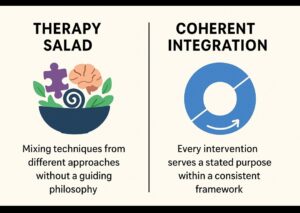
Being faithful to the model means therapy is not simply a collection of techniques chosen at random. A “therapy salad” approach can mix methods without a clear rationale, which may make counseling feel fragmented or confusing.
An integrative approach, by contrast, is guided by a unifying framework. Different methods may still be used, but they are selected with purpose and connected to a clear understanding of the client’s goals and the patterns keeping them stuck.
In other words, the question is not simply, “What technique should we use?” but “Why are we using it, and how does it fit with what we are trying to change?”
Every step we take together has a purpose, not just a mix of techniques.
Here are some of the testimonials that people have given for our work.
From a parent:
My son was diagnosed with Major Depressive Disorder. He’s been undergoing therapy each year between June to September. He’s given synthetic meds in between therapy but i am not seeing consistent progress. We needed to find a psychiatric support that can really help him.
It was a blessing indeed when i met one of the resource speaker from our community event that introduced us to sir Nathaniel.
Here’s an excerpt from my son’s long message to me …. “learning a lot through this therapy and had a ton of realizations din so i wanna say thank u so much ma…”
One life Only counselling services is truly effective and i hope it can help more people who suffers from mental health concerns.
From a partner:
Nathan is amazing! We learned so much about our relationship in just a few sessions. He also gives reading references, which helps a lot to navigate the information he provides in his session. Overall, would recommend to any couple in need of counselling.
From a husband:
Me and my wife ran into a bad patch due to outside pressure put onto our marriage. I decided to book a set of appointments with one life and I can say it help so much I wish we went years ago. We have an amazing marriage and friendship. Best thing we ever did.
Interview with Julius Babao and Christine Bersola Babao, October 25, 2023Guest resource person with Boy Abunda on his show The BottomlineJuly 2024 interview on Kapuso Mo Jessica Soho about jealousy and anger
He has also done interviews on YouTube with the developers of ACT and IBCT.
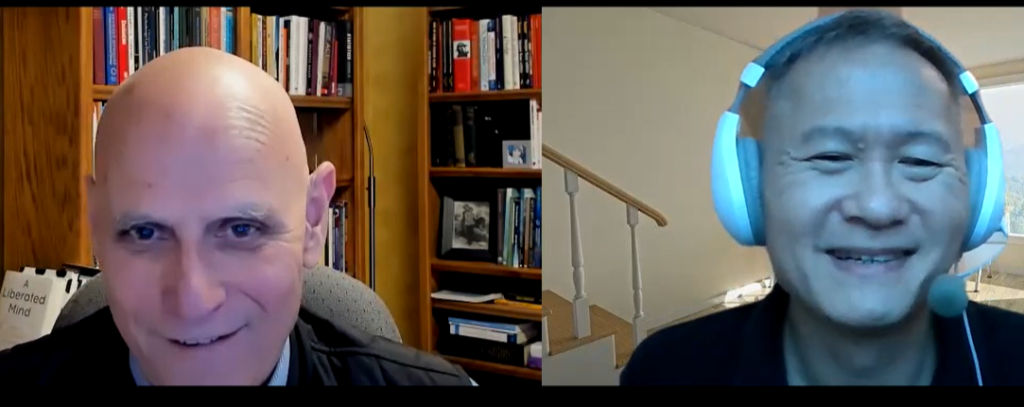
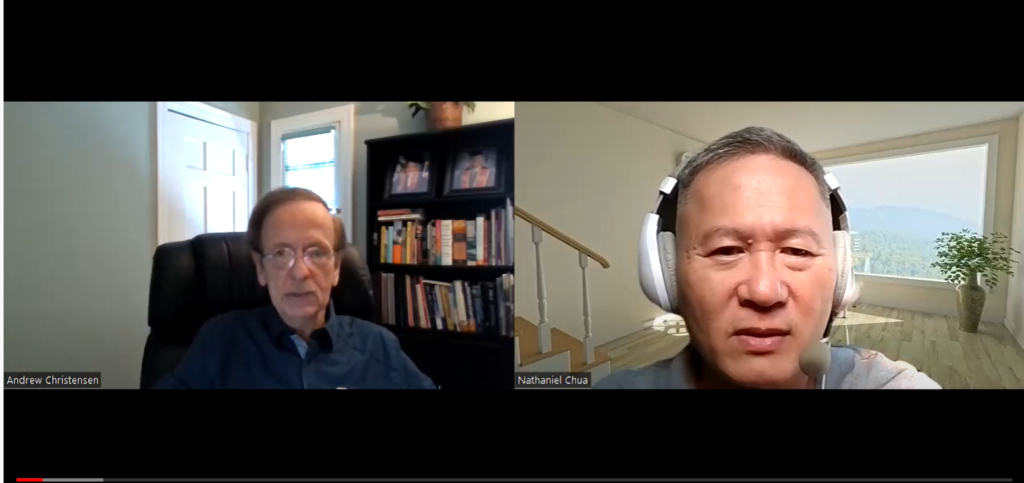
Interview with Dr. Steven C. Hayes, the developer of ACT, April 5, 2022Interview with Dr. Andrew Christensen May 14, 2022
Here is a live interview on Kada Umaga on Net 25 starting at the 25 minute mark:
Here’s a solo interview of Nathan Chua with an ACT Matrix Expert and Counselor from the United States, Jacob Martinez:
Interviews with the experts:
Here are two interviews with the two experts that have had a huge impact on my work in recent years. They are with Dr. Steven Hayes and Dr. Andrew Christensen. Here are the videos: