Many years ago, psychologist Kurt Lewin gave us one of the simplest but most powerful equations in psychology:
B = f(P, E)
Behavior is a function of the Person and the Environment.
It looks almost too obvious.
Of course our behavior is influenced by our personality, our history, our thoughts, our emotions — but also by our relationships, culture, opportunities, pressures, and the situations we find ourselves in.
And yet, despite this simple idea, we humans keep falling back into a very old habit.
We turn patterns into things.
Someone takes a personality test and says:
“I am an introvert.”
“I am an INTJ.”
“I am just not the emotional type.”
Now, there is nothing wrong with noticing patterns about ourselves. Awareness can be helpful.
The problem starts when a description becomes a prison.
“I often behave this way”
slowly turns into:
“This is who I am.”
And eventually:
“This is who I will always be.”
In some ways, personality tests can become the modern version of horoscopes. Not because they are exactly the same, but because they can serve the same psychological function.
They give us certainty.
They give us a story.
They make a complicated human being feel easier to understand.
Because uncertainty is uncomfortable.
It is much easier to say:
“He is difficult because he is a narcissist.”
“She acts that way because she is an introvert.”
“I cannot change because that is my personality.”
But contextual psychology invites us to ask a different question.
Not:
“What kind of person am I?”
But:
“What happens to me in different contexts?”
When am I quiet?
When am I confident?
When am I afraid?
When do I become the person I want to be?
Because maybe we are not fixed statues waiting to be discovered.
Maybe we are ongoing patterns constantly interacting with the world around us.
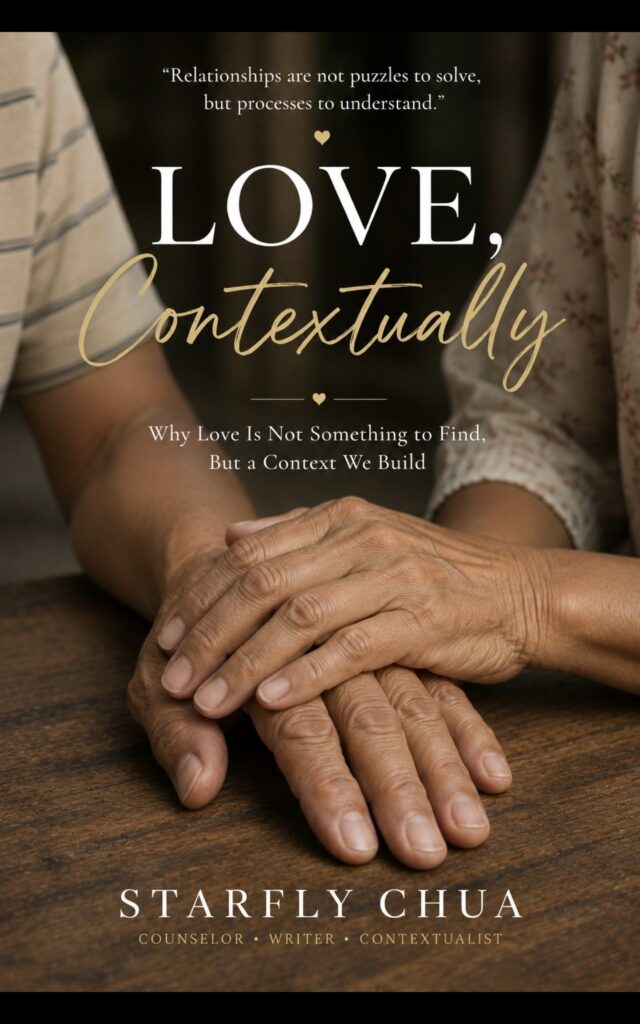
I’m happy to share my latest book, Love, Contextually.
Many relationship books focus on finding the right person or mastering the right techniques. This book takes a different path. It invites us to understand that love is not something we discover—it is something we build within the context of two changing people, facing changing circumstances.
Drawing from years of counseling and contemporary contextual behavioral science, Love, Contextually explores why couples get stuck, why conflict persists, and how understanding context can open new possibilities for connection.
Whether you’re single, dating, married, or simply curious about relationships, I hope this book offers a fresh perspective—one that replaces blame with understanding and rigid rules with flexibility.
Thank you to everyone who has supported my work. I hope this book becomes a helpful companion for meaningful conversations and healthier relationships.
Without understanding human behavior in group settings, democracy cannot succeed. And without the freedom provided by democracy, social science cannot flourish.
Inspired by Gordon W. Allport’s introduction to Kurt Lewin’s Resolving Social Conflicts (1948), reflecting on the work of Kurt Lewin and John Dewey.
This is one of the central ideas explored in the book Better People, Better Country. A thriving democracy depends not only on good laws and institutions, but also on a deeper understanding of how people think, relate, cooperate, and influence one another. If we hope to build a better country, we must first become better students of human behavior.
“Both moralism and structuralism share the same underlying mistake: they treat human behavior as if it were mechanical.
In this view: beliefs cause behavior, rules produce obedience, authority ensures order.
But human beings are not machines. They are meaning-making, context-sensitive organisms.”
— Starfly Chua *Better People, Better Country*
We often debate whether the problem is the individual or the system.
Some say we simply need better values, better discipline, and better people. Others say we simply need better laws, better policies, and better structures.
But human behavior is rarely that simple.
People and systems constantly shape each other. A better country is not created by blaming people alone or changing structures alone, but by understanding the context that influences how people behave.
When we understand context, we can design conditions where better choices become more likely.
“The unifying theme is unmistakable: the group to which an individual belongs is the ground for his perceptions, his feelings, and his actions. Most psychologists are so preoccupied with the salient features of the individual’s mental life that they are prone to forget it is the ground of the social group that gives to the individual his figured character.
Just as the bed of a stream shapes the direction and tempo of the flow of water, so does the group determine the current of an individual’s life. This interdependence of the ground and the figured flow is inescapable, intimate, dynamic, but it is also elusive.”
— Kurt Lewin, Resolving Social Conflicts: Selected Papers on Group Dynamics (1948)
In counseling, I do my best to avoid labeling my clients’ behaviors as good or bad, right or wrong. Instead, I ask a different question: In this particular situation, is this behavior helping the person move toward the aspirations they have for their lives, or is it getting in the way?