by Nathan Chua
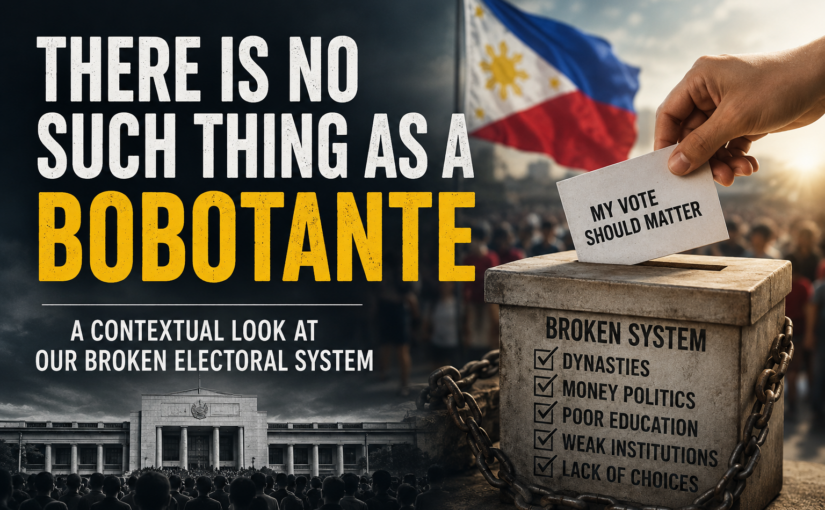
Every election season, the same word resurfaces: bobotante.
It is used to describe people who supposedly vote against their own interests. They are blamed for electing corrupt politicians, celebrities with little experience, and leaders who fail to deliver on their promises. The conclusion seems obvious: The problem is the voters.
But what if that explanation is too simple?
From a contextual perspective, the label bobotante is not an explanation at all. It is merely a description disguised as one.
Calling someone a bobotante is much like calling someone lazy, stubborn, or mentally ill. It gives us a name for a pattern of behaviour, but it tells us very little about why that behaviour occurs. The moment we attach the label, we often stop asking the more important question:
What context makes this behaviour likely?
Imagine a scientist studying why a plant keeps dying. One scientist says, “It’s a bad plant.” Another asks about the soil, sunlight, water, temperature, and pests.
Which scientist is more likely to solve the problem?
Human behaviour works much the same way.
A voter does not make decisions in a vacuum. Every vote occurs within a context shaped by poverty, education, family traditions, religious beliefs, media exposure, social media algorithms, political advertisements, peer pressure, and decades of lived experience.
Suppose a politician regularly helps a community after floods, pays hospital bills, attends funerals, and provides financial assistance when families have nowhere else to turn. During election season, many people reward that politician with their vote.
Critics may dismiss this as vote buying or ignorance.
But from the perspective of the voter, the decision may be entirely understandable. If formal institutions have repeatedly failed to provide help, why wouldn’t they support the person who actually showed up when they were in need?
This does not necessarily make the vote wise.
It makes it understandable.
Understanding behaviour is not the same as approving of it.
One of the biggest mistakes in public discourse is confusing explanation with justification. To explain why someone behaves a certain way is not to excuse that behaviour. Doctors explain diseases without approving of them. Engineers explain bridge collapses without celebrating them.
Likewise, understanding why people vote as they do is the first step toward improving our democracy.
Ironically, calling people bobotante may actually make the problem worse.
When people feel ridiculed or looked down upon, they rarely become more open to dialogue. More often, they become defensive and retreat further into the communities and political identities where they feel respected.
The insult becomes another barrier to change.
If we genuinely want better elections, perhaps we should stop asking, “Why are voters so stupid?”
Instead, we might ask:
What kind of electoral system reliably produces these outcomes?
Do our schools create a culture in which students are encouraged to think critically, question ideas, and respectfully disagree with their teachers?
Do political parties offer meaningful choices?
Does our media reward thoughtful debate or emotional outrage?
Do economic conditions leave people dependent on political patronage?
Does our campaign system favour personality over competence?
These are contextual questions.
And contextual questions lead to contextual solutions.
Take voter participation as an example. In the Philippines, repeatedly failing to vote can eventually lead to the deactivation of one’s voter registration. The intention is understandable: encourage participation and strengthen democracy.
But participation alone does not necessarily produce informed voting.
In countries such as the United States, voting is voluntary. Elections are often decided by voter enthusiasm. Candidates must convince citizens that they are worth voting for. Those who are uninterested or insufficiently informed are generally free to stay home.
The point is not that one system is inherently better than the other. The point is that electoral rules shape behaviour. If people feel compelled to participate even when they know very little about the candidates or the issues, that context may produce different outcomes than one in which voting is driven primarily by interest and engagement.
Campaign rules also create powerful contexts.
If winning an election depends heavily on television advertisements, celebrity endorsements, political dynasties, name recall, or the ability to spend enormous sums of money, we should not be surprised when wealthy, famous, or well-connected candidates enjoy a tremendous advantage. Under those conditions, election results may reflect resources and visibility as much as competence, integrity, or public service.
The same question can be asked about freedom of speech. Freedom of expression is one of the cornerstones of democracy. But does legal freedom alone guarantee a fair marketplace of ideas? During election season, the ability to communicate with millions of voters often depends on financial resources. Candidates with greater wealth can purchase more advertising, hire larger campaign teams, dominate social media, and command greater media attention. Everyone may be equally free to speak, but not everyone has an equal opportunity to be heard. If we care about democratic outcomes, we should ask not only whether speech is free, but also whether the context in which speech occurs allows competing ideas to receive a fair hearing.
Again, this is not about blaming candidates or blaming voters. It is about recognising that behaviour—including voting behaviour—is always shaped by the environment in which it occurs.
If we truly want better electoral outcomes, perhaps we should spend less time asking, “How do we fix the voters?” and more time asking, “How do we fix the system in which voters make their decisions?”
Perhaps the greatest danger of the word bobotante is that it allows the rest of us to avoid examining the system itself. If the problem is simply “stupid people,” then nothing else needs to change. We can blame individuals while ignoring the institutions, incentives, and environments that continually produce the same results.
But if behaviour is contextual, then changing the context changes the probabilities of behaviour.
That insight lies at the heart of functional contextualism.
The goal is not to find people to blame.
The goal is to build environments in which wiser decisions become more likely.
Maybe there are uninformed voters.
Maybe there are impulsive voters.
Maybe there are voters who have been manipulated.
But there is no such thing as a bobotante if by that we mean a person’s poor voting decisions can be adequately explained simply by who they are.
People vote within contexts.
If we truly care about democracy, perhaps we should spend less time insulting voters and more time improving the conditions under which they vote.
Because in the end, the quality of our elections may tell us less about the intelligence of our people than about the context we have collectively created for them.