
Tag: Psychologist Philippines
ACT Matrix for Anger
“Confidence” in a Time of Crisis!

Living with Purpose and Intent
by Nathan Chua
“Live as if you were to die tomorrow. Learn as if you were to live forever,”
Mahatma Gandhi
Have you come to a point in your life when you feel like as it says in the Bible, chasing after the wind? Have you ever felt like every day has become a pointless pursuit of comfort and tranquility? Has your life turned into an endless problem to solve? You go from fixing one problem after another. When’s the next challenge going to come? Will I be able to surmount the bigger ones down the line?
If you have, don’t worry, you’re not alone. I came from the same quagmire. Early in my career, I started believing that life was about fulfilling a role of being around to be the problem solver. Furthermore, I had learned from my history that the secret to the good life is the comfortable life. One in which I can be the great problem solver, conquering one obstacle at a time until there remain only the easier ones. I dreamt of eventually coasting along as I moved into old age.
I lived that way for the first 20 years of my working life. People around me would notice how I looked then. I often carried a tired and angry expression on my face; always on alert for the next challenge that comes my way. I was the hero who was always ready to come to the rescue.
To borrow a metaphor I saw in a YouTube video, you can view a rabbit running across from a window, but you wouldn’t know if that rabbit was going for a carrot or running away from a predator. I was like that rabbit that people saw from a window. One couldn’t tell if I was in business because I simply enjoyed doing it or if I was doing it to avoid the shame that comes if I had failed in business. For those who are new here, I spent the first 20 years of my career as a businessman. A failure in business meant I had failed my family.
You would probably understand why I often looked tired and angry. Tired because life has become a struggle and angry because I didn’t see any end in sight. Life was sending me challenge after challenge to surmount. Like the rabbit running away from a predator that eventually tires out, I was exhausted escaping from the jaws of my shaming, “Whatever happens, don’t be a failure,” thoughts.
One day I woke up and started noticing the hamster wheel I was on. It was as if I was living backwards. Like some of what I learned in psychodynamic therapy, I lived hoping to come back to the safety of my mother’s womb, wishing to get back to that fetal position of a tranquil life.
That tranquil life turns out to be a mirage. No matter how much we try to avoid it, life has its challenges and running away from the feelings and thoughts that these challenges come with, is like becoming a rabbit that spends most of its time fleeing a predator, although in my case the predator is my own worst fears.
You and I can pivot towards a life in pursuit of what truly matters to us. Rabbits run away from life-threatening circumstances. We humans though can run away from our thoughts and not just actual threats to our safety. It only takes the rabbit to notice when the noise behind the bushes was just a gust of wind to make it go and pursue food or a mate. Although it is difficult, we can start to make changes in our life directions by noticing if we are spending much of our energies running away from our unpleasant internal experiences, or if we are pursuing the qualities of being and living that matter to us.
The happy rabbit is the one that pursues nourishment and the possibility of a mate. Take it from there, are you willing to start pursuing the rich and meaningful life, even if it means that your fearful inner experiences will become more evident as you go. Maybe that’s what Gandhi meant in his words. His life was mostly about pursuing something that was good and noble, rather than about running away from the dangers his mind reminded him of. He pursued the irrational move to expose himself to the dangers of a life spent for the welfare of others, and paid the ultimate price. Nonetheless, he lived, not the tranquil life, but the meaningful one. He is the quintessential rabbit moving in the direction of what he wanted to do with his time…every single minute.

Are you a walking diagnosis?
by Nathan Chua
In my more than a decade’s work, one of the most common questions I get from people inquiring about mental health services is, “Can you give me a diagnosis?” These come in many forms. Some call already with a prior diagnosis from another practitioner, “I had been diagnosed as a borderline personality, is there anything different about the way you treat people like me?” Even as I had training from that very same school of thought, I had always had my reservations about the practice of diagnosing. I had been diagnosed once, and I know how it feels and I know that it really wasn’t helpful. It is as if knowing what people have can make them somehow more aware of their tendencies and therefore allow them to be more cognizant of their actions.
Does knowing one’s diagnosis really help? Let’s take a look at what a diagnosis really comes up to, by taking this to an absurd level of analogy. If one were diagnosed to be bipolar, would they go around eating in restaurants and meeting people and saying, “Hi, I am Nathan. I am a bipolar disordered person!” Would they introduce themselves in every situation the same way? Like would that be how you would tell someone about yourself in a group class? From this, we can notice that we all act differently depending on the situations that we are in. We act differently when we are at work and when we are at home. We act differently when we are stressed and when we are relaxed.
Based on my experience, I have seen how this happens to people who had been dealt with a veritable life sentence of being attached to a label. At times, even worse, pinned with an inaccurate one at that.
As human beings we have evolved into a group of cells and individuals that thrive and survive through cooperation. One of the scariest parts of being human is to become isolated from a group. Being creatures who survive in communities, we have yearnings to belong. In the wild, the isolated human’s fate is most probably becoming a dead human sooner than later.
Belonging is important to us. There was even a famous study in the past that showed how much humans require nurturing and caring. Babies cannot survive just being fed through a bottle. They need touching and the physical and mental stimulation that comes from a caregiver.
However in the age of social media and the rest of the modern accoutrements we enjoy, the mind has hijacked this inner yearning to belong. Our problem-solving minds are excellent in categorizing people. The way to this felt sense of belonging has turned into being special instead of being one with others who share the same doubts, fears, and inner perturbations. You and I can see this in how special people want to project themselves in their social media accounts. The way to belong is to become special! Do you notice the oxymoron here?
The other way the mind hijacks this yearning to belong is the complete opposite of the abovementioned example. Our thoughts turn us into especially vulnerable individuals that need special attention. I have bipolar disorder so you better be extra kind and loving around me.
Like traits, all these diagnoses serve more to put us in boxes of categories. Experts have seen how countries that had adapted this system of classification (or what we call our DSM, Diagnostic and Statistical Manual for Mental Disorder) get worse results. What we used to think were just the shy nerdy types in school have now turned into walking diagnoses that need special attention and worse, medication. We had forgotten an era when that shy, quiet girl in class can turn into the next world class stage performer.
So let’s get back to how I started this blog post. What do I say when asked about whether or not I can give a diagnosis? I just tell them that I don’t.

How to be OK even when everything else is not
by Nathan Chua
Multiple deadlines, challenges at home and at work, you’re about to lose your job, someone in the family has a serious ailment, pressure is coming from all sides…life happens and is coming at you like a savage beast hungry for a fight to the death! These are the times when people come to see me. The world has turned against my clients and there seems to be nothing they can do that has succeeded in changing anything. In fact, the more they try the worse the outcomes become!
It is also during these moments that our minds go on overdrive, drilling judgmental thought after judgmental thought into our consciousness. The key here is to reach a level of awareness of what is within or outside our control. If you ever wondered what it is that makes us feel that we are living ineffectual lives, it is our misdirected efforts to control that which is not subject to control.
Just be the human being that we had become through billions of years of evolution! We have an assortment of wonderful tools inside our nervous system. Turning against these evolved functions, is like working against gravity.
Ultimately, what happens to us in life is not within our control, but our responses are. The goal of psychology as a field of scientific study is to bring to bear what it is that makes us live ineffectually and then find ways to change or interrupt that process to get us moving towards a different, more effectual, and more life-enhancing direction. So it really does not matter as much what happens to us, as how we face them. How we handle ourselves in those moments is where we can bridge the gap between what we are and what we aspire to be.
The question we could keep in mind is, “Did we handle it well?” Here’s a paraphrase of Dr. Darin Cairns words reminding us that we can be okay even when everything around us tells us we’re not.
“I can’t promise you everyone’s going to like you.
I can’t promise you that people will always know you exist.
I can promise you this, if you like you at that time, if you liked how you lived it, then you’ll like that you were true to what you believed in.
That you liked how you handled yourself in terms of whatever you value, then you’re always ok.
You’re ok when you’re popular, you’re ok when you’re alone, you’re ok after a breakup, you’re ok when you’re scared to death, and you’re ok when you’re hurting.
You don’t have to stand tall but you do have to stand up. You don’t have to think that you’re better than anyone, you don’t have to have anyone praise you, but you do have to be willing to exist for you.”
So to you my friend, I can say that no matter how dire your circumstances are at this moment, take a look at yourself ahead of you by a year or so, and ask yourself, “Would your future you like how you, the present you, handled the situation?” I hope that brings you back in touch with what truly matters for you in each and every moment that comes. No matter how not okay these moments can get, you can be okay knowing you stood up for you!
Listen to the podcast version of this post on Spotify! Click here!

How language can affect your mental health
by Nathan Chua
Ah, the functions of language! Until recent years, I have never thought about how language played a role in our ability to sustain our mental health. As the theory behind this new approach that I am using is framed upon language and how we use it, I would like to introduce you to a few terms that we use in a way that can cause us to experience unnecessary depression, excess anxiety, and even attempts at suicide!
The first expression we use quite a lot in the field of counseling is the word, “healing.” I remember in the years I spent in graduate school, this word was used quite liberally. In fact, there was even a book that had, as part of its title, the words, “wounded healer.” Healing though connotes the idea that we are somehow broken and that we need to be put together like a puzzle or a broken vase in a clinical setting.
Reality though would tell us that this can be nothing more than a figure of speech that at the least, could be considered unhelpful. Because nothing inside of us is really broken. It is rather a form of learning to resort to certain strategies that provide instant relief from emotional pain that end up unproductive and futile; and thereby rendering us feeling more ineffectual and deserving of our sad fate. We are whole and complete. What we suffer when we are said to be having some psychological problems is that of being stuck in a pattern of behaviors that do not serve our best interests.
The next phrase or term I have learned to be used in unhelpful fashions is the idea that comes from stories of people who supposedly went from being dead to surviving a coma. It is often said that they see a great white light and felt immense peace! Attempts at suicide are basically logical responses to removing the difficult feelings brought on by our attempts at living what comes as meaningful to us. It is better to die, since one: it will remove the painful emotions we experience from our pursuits for meaning and purpose, and two: there will be unimaginable bliss thereafter. Unfortunately, allow me to paraphrase an expert in behavioral analysis who said in jest that there has so far been no one on record to have answered a survey from death that talks about how much better it is on that side.
The last term for this post is the word, confidence. We often combine this with the word, “feel.” This means that confidence is a feeling that we need to achieve in order to do something of significance. As Dr. Steven Hayes likes to use etymologies in his work, the word actually means having full trust or faith in Latin. We have somehow in our modern usage of the term used it to mean that it is something we feel rather than something we do. We can still put our full faith in ourselves even as we feel anxious about doing a certain task.
Remember that the best way to live is to focus on what we do rather than what we feel, because there is the possibility of redemption in the former. Our feelings are subject to change and outside of our control. If we hang our hats on them, we will find ourselves stuck in a cycle of frustration, and eventually see ourselves as broken vessels that need to be pieced together, or brought to a place where we choose to end it all permanently for temporary relief from the varied emotions we experience that come with truly living.
Do you need counseling?
One Life Only Counseling Services
Counseling for Individuals, Couples, and Families
Do you need counseling for depression, anxiety, trauma, relationship (marriage, family) problems, insomnia, anger management problems, infidelity, teen parenting issues, grief processing, addiction, procrastination, work performance, and even weight issues?
We are here to provide you with evidence-based approaches that are backed by reliable and valid scientific research!
We provide both in person and online video counseling for your convenience.
Please text (preferred) or call:
Mobile Number: +63 917 886 5433 (LIFE)
Available also on Viber and WhatsApp!
(The best option is to message this number through Viber or WhatsApp and we will gladly call you back or reply!)
Email:
Connect with us through Facebook, follow us through Spotify and YouTube.
Our offices are located in Quezon City, Metro Manila, Philippines.
CMS Clinic
2nd Floor Back to the Bible Building
135 West Avenue, Quezon City, Metro Manila, Philippines
and
M Place South Triangle
8004 Mother Ignacia Avenue, Quezon City, Metro Manila, Philippines



The counselor is also an author!
Nathaniel Chua is the author of

Better People, Better Country: A Psychological Blueprint for a New Philippines,
published under the pen name Starfly Chua.
The pen name was chosen in homage to his grandfather and his ethnic Chinese roots, and reflects a preference for allowing ideas to stand on their own—without emphasis on personal visibility or status.
Here are selected endorsements from international colleagues and clinical experts:
This book is a fascinating personal exploration and cultural adaptation of contextual behavioral science applied to psychotherapy. It takes you, with great clarity and humility, from the philosophical foundations of functional contextualism all the way to its practical applications in Acceptance and Commitment Therapy. The way it addresses the challenges of psychological well-being in the Philippines makes it a particularly valuable contribution.
Dr. Matthieu Villatte, PhD, Co-author of Mastering the Clinical Conversation: Language as Intervention
Better People, Better Country offers a transformative shift in perspective, moving from rigid cultural rules that invite moral shaming toward one of contextual understanding. Both deeply personal and extensively practical, Starfly Chua provides a psychosocial blueprint for change and progress at multiple levels of human existence. This book is an invaluable resource for the people of the Philippines because it moves beyond the exhausted cycle of demanding ‘better people’ and instead provides the tools to build ‘better contexts’ — systems that naturally support prosocial values that benefit citizens and country alike.
Lou Lasprugato, MFT
Peer-Reviewed ACT Trainer
For far too long, theories of human behavior and psychology have been relegated to the therapy room, used in private, and often at the individual level. We now have advanced psychological theories that can explain and help foster change at the societal level.
Chua reaches for the same shining star that famed behavior analyst B.F. Skinner once reached for, applying cutting edge behavior change technology to the community at large—not just for the purposes of greater mental health—but for more workable societies. Chua doesn’t just reach for this star, he grasps it firmly. Laid out in this book is a set of common sense reforms that could revolutionize the Philippines and the world at an achievable cost: our own willingness.
Jacob Martinez
Practicing Counselor
Wisconsin, USA
Nathaniel Chua is also a member of an international organization called the Association for Contextual Behavioral Science (ACBS). He once became chair of the Diversity, Equity, and Inclusion Special Interest Group (DEI-SIG) of ACBS; the first Non-North American to do so.

Nathaniel Chua has a Master’s Degree in Counseling and continues to learn more of the most cutting-edge approaches to working with the human condition.
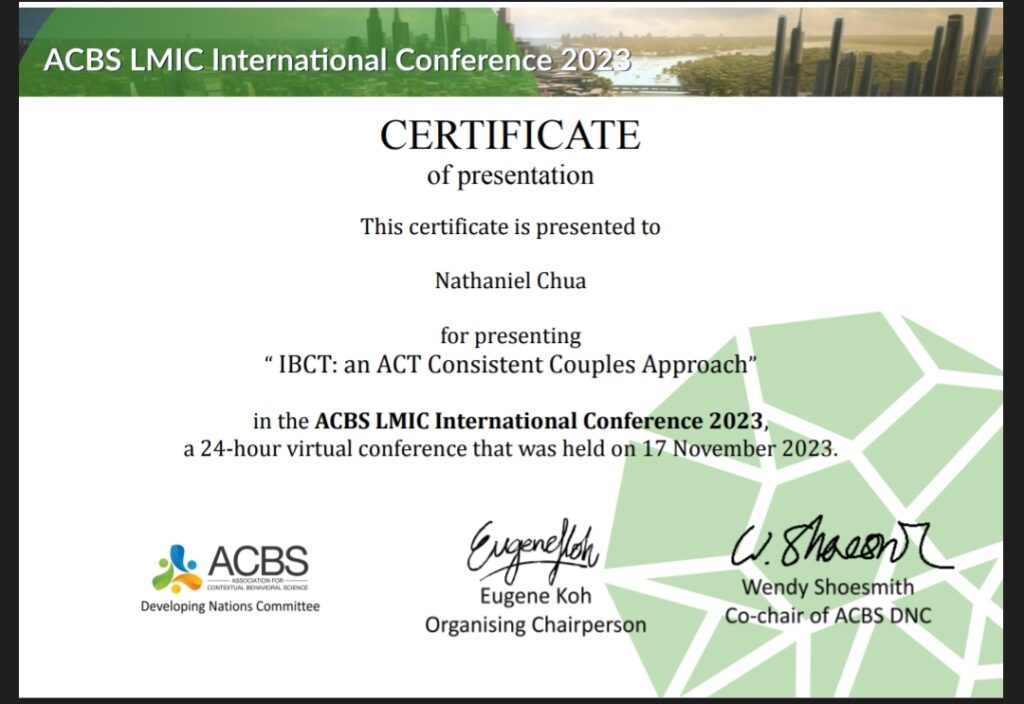
Below is Nathaniel Chua’s first virtual talk held on November 17, 2023 in front of an international group of therapists from Low or Middle Income Countries (LMIC). He is the first from the Philippines to do this:
What is One Life Only Counseling about?
- We value and respect your privacy and we keep what you share confidential.
- You will be respected regardless of your religion, gender preference, ethnicity, economic status, and even your personal lifestyle and values. We are LGBTQIA+ friendly!
- Your counselor will not impose their values and beliefs on you. We welcome people from all faith traditions—or even none at all. We understand that spirituality and belief can be deeply personal, sometimes a source of strength, and at other times a place of struggle. Our goal is not to impose but to create space where your values, practices, and questions are respected. Whatever faith tradition you belong to, you are invited to bring your whole self into the counseling process.
Nathaniel Chua, MA
Functional Contextualist Therapist
The Philippines’ ACT & IBCT Specialist
- We mainly use ACT and IBCT which are both models of therapy that are based on functional contextualism – a science-based approach that focuses on what works in your unique life context. Both approaches help individuals, couples, and families move past stuck patterns, handle difficult emotions, and build more meaningful lives and relationships.
What is functional contextualism?
Functional contextualism starts with this simple truth: behaviors don’t happen in a vacuum. Every action, every thought, every feeling occurs in your unique context — and all of them serve a purpose.
What we mean by behavior?
Behavior isn’t just what you do outwardly. It also includes inner actions like thinking, remembering, or imagining. Some behaviors can be observed; others happen quietly inside you.
What we mean by context?
Context is more than the physical space you’re in. It includes your personal history, your memories, and the people who have shaped your life — whether they’re with you now or live only in your mind.
What we mean by function or purpose?
Every behavior is influenced by what happens before and after it. The “function” is the role that behavior plays in helping you cope, adapt, or move toward something important to you.
What we don’t believe or practice:
We don’t see you as “broken” or as a set of symptoms to fix. Outside of major physical damage or impairment, there’s no solid science proving that everyday behavior is caused by some permanent biological flaw.
You’re not a checklist of traits scored four-out-of-seven or five-out-of-nine. You’re a complex, whole, and freely choosing individual whose actions make sense in the context of your life.
Beyond Diagnostic Labels
We don’t use DSM diagnoses because your life is more than a checklist of symptoms. Real change begins with understanding your whole story, not fitting you into a category.
Medication as a Last Resort
While medication can sometimes be necessary, it’s never the first step we recommend. We focus on approaches that build lasting strength, skills, and choice – empowering you without unnecessary dependence.
You’re More Than a Number
We don’t use psychometric testing, because no score can capture who you are. We choose to listen, explore, and work with you through open, genuine conversations that honor your unique journey.
An Approach That is Recognized by the WHO!
The approach we use is also one that is endorsed by the World Health Organization as an effective psychological tool for coping with any kind of life crises! It can be described as a kind of psychological vaccine that has been found to be effective in improving and promoting mental resilience in the face of many, if not all kinds of life challenges.
Here’s a paraphrase from Dr. Steven C. Hayes in my interview with him on April 5th, 2022:
“Here’s what the World Health Organization, the best public health and scientific group in the world says about this protocol, this extensively tested protocol is helpful for anyone who is stressed, for any reason, in any circumstance.”
Since being established in 2009, it was in 2019 that we have been very excited to offer this type of a radically different approach to therapy that is not just about relieving symptoms, but also about helping people towards creating lives imbued with meaning and purpose.
Here’s a video about what makes One Life Only Counseling Services different:
You can read the written version of this video through this link: https://www.onelifeonly.net/about/what-makes-one-life-only-counseling-services-different/
Here is a recent interview for an article on Philstar Life featuring Nathaniel Chua and a legal practitioner about marital sexual consent:
https://philstarlife.com/news-and-views/928796-consent-rape-marriage-explainer

Nathan Chua is probably one of the very few therapists in the Philippines who’s been on mainstream media to talk about ACT and functional contextualism in a way that stays faithful to the model.
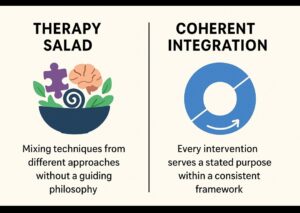
Being faithful to the model means therapy isn’t about throwing techniques together like ingredients in a salad. The “therapy salad” approach mixes bits and pieces without coherence, often leaving clients confused. An integrative approach, on the other hand, is guided by a unifying framework – methods are chosen and blended with purpose, creating a clear, consistent direction that serves client’s goals.
In other words, therapy isn’t about randomly mixing different techniques. That can feel confusing, like tossing ingredients together without a recipe. An integrative approach means everything fits together with a clear purpose – so the tools and methods used actually connect and support your journey.
Here are some of the testimonials that people have given for our work.
From a parent:
My son was diagnosed with Major Depressive Disorder. He’s been undergoing therapy each year between June to September. He’s given synthetic meds in between therapy but i am not seeing consistent progress.
We needed to find a psychiatric support that can really help him.
It was a blessing indeed when i met one of the resource speaker from our community event that introduced us to sir Nathaniel.
Here’s an excerpt from my son’s long message to me …. “learning a lot through this therapy and had a ton of realizations din so i wanna say thank u so much ma…”
One life Only counselling services is truly effective and i hope it can help more people who suffers from mental health concerns.
From a partner:
Nathan is amazing! We learned so much about our relationship in just a few sessions. He also gives reading references, which helps a lot to navigate the information he provides in his session. Overall, would recommend to any couple in need of counselling.
From a husband:
Me and my wife ran into a bad patch due to outside pressure put onto our marriage.
I decided to book a set of appointments with one life and I can say it help so much I wish we went years ago. We have an amazing marriage and friendship.
Best thing we ever did.
Please click the link below for more:
https://share.google/RV5f9DYNVeURSGIJ8


He has also done interviews on YouTube with the developers of ACT and IBCT.
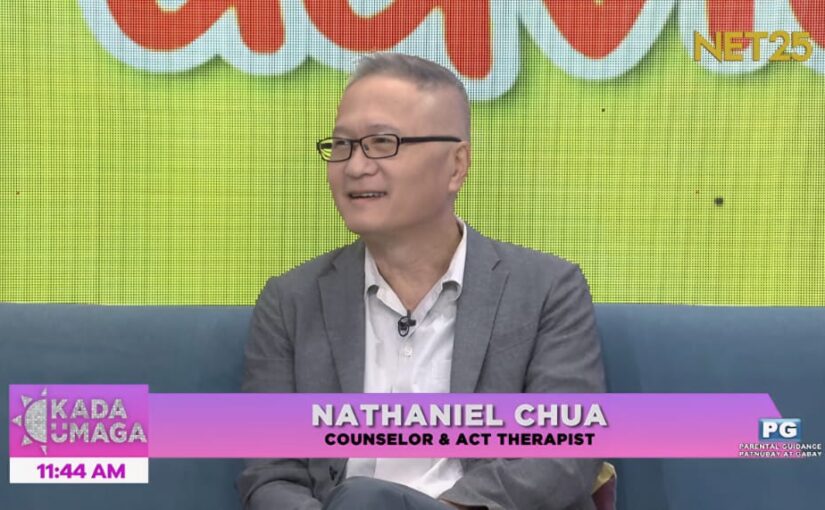
Here is a live interview on Kada Umaga on Net 25 starting at the 25 minute mark:
Here’s a solo interview of Nathan Chua with an ACT Matrix Expert and Counselor from the United States, Jacob Martinez:
Interviews with the experts:
Here are two interviews with the two experts that have had a huge impact on my work in recent years. They are with Dr. Steven Hayes and Dr. Andrew Christensen. Here are the videos:

Making Your New Year’s Resolution Work
by Nathan Chua
I think even without a new year to celebrate, many of us have often made certain commitments that we hope to accomplish beginning at a certain time. Well, looking back, how many of those commitments have we fulfilled? What is it that keeps us from getting from point A to point B?
One way we end up not doing what we resolve to do has to do with reasons. Our logical minds have evolved to find cause and effect relations. This is an important function because in order to solve problems in our environment, we need to know what causes something to happen. For instance, relevant to today’s issues, our minds needed to find out what causes the spread of the coronavirus in order for us to keep infections down and manage the extent of the pandemic. The scientists needed to know how the virus causes life-threatening pneumonia, for them to find ways to counteract the process of fatal illness developing in people.
The only drawback to this mental capacity is when the rule becomes inflexible. They are applied across other domains when they don’t really put us on a path to where we want to be. For example, we say, “I have to eat chocolate if I am sad.” The rule here is sadness should be removed by eating unhealthy snacks. However, we can reverse this statement and say, “I should not eat chocolate to stop me from feeling sad, because in the end, the lack of control of my behavior makes me even sadder and therefore the urge becomes stronger.”
Now if reasons really have so much power over us, wouldn’t we be all following the reasons why we should not be eating chocolate when we feel sad? The answer is no matter what the reasons our minds come up with, we still can opt to act one way or the other. This only means that no matter how much we try to give ourselves reasons to do stuff, we can always make a decision that complies or doesn’t comply with the behavior we want to either stop or begin doing more of.
This means reasons are just thoughts that our minds come up with for us to make logical decisions. Unfortunately, what may sound logical may not be what’s good for us. Now, you might be thinking, what then do I do about this? Well, one way to do it is to first notice your thoughts as thoughts. They are not you. Your mind is just a part of you and your bodily functions.
One way to practice this ability to keep your thoughts separate from you, is to give your mind a name. Thank him or her for the suggestion. You’re not bad for having those thoughts, it’s just part of your minds’ functioning. It is nothing more than a reason-manufacturing tool.
You can also add in one more step. You can notice what sticking to your diet is in the service of. Maybe you’d like to become more attractive so you can start having more opportunities to find a date. It could be that you’d love to see your kids grow old enough to see them go through different life stages. Whatever your motivations are, it is best to come up with ideas that give you intrinsic motivation, rather than those that make you think that you are a bad or lousy person if you don’t follow your resolutions. The latter only spirals into the negative feedback loop of emotions.
And finally, keep in mind that whatever life-enhancing habits we want to create, it takes time and patience. Your road will not be a straight line. Every time you fail at your commitments, you can always pick yourself up and keep going towards a direction you want. We are creatures who want to create habits that work for our lives. If we suffer an injury to our leg, we still want to stand up and walk again, don’t we? And yes, you and I will fall to the ground as we rehab, but we pick ourselves up and keep going, with pain and all. Because walking matters, just like living does too!

When Anger Strikes
by Nathan Chua
Anger was a familiar foe to me. As a child, I saw how anger in the family was able to get the giants at home what they wanted from myself and others. And so I learned that albeit unpleasant and unbecoming, anger can be a means to a good end. Anger for me was never an end in itself. People should understand the reason for my short temper, so I thought. Yet, there would probably be very few occasions when I would realize that my angry behavior served me in good stead as I pursued the good ends.
Much of what ails us with anger is not about the feeling itself, but rather the coping style that most of us use as we feel this difficult emotion. You see, my biggest problem with my anger was precisely what I had just indicated in the opening sentence of this blogpost. Anger had become a familiar foe, when all it was, was a part of my nervous system telling me that I just experienced frustration or disappointment or anxiety.
For as long as anger remained my enemy, then it would continue to stand in the way of me becoming the person I wanted to be. Back in my days as a businessman, anger got in the way of my acting in a manner that was most faithful to my deepest aspirations for my life. My inner yearnings to help the people around me made me passionate about keeping the business healthy and viable. Mistakes at work meant a step backwards and threatened to move the company away from this goal. My mind dutifully and persistently told me that the solution to avoiding mistakes, is to exert control over the people working for the business with my anger. Unfortunately, gaining full control over other people is like keeping ocean water from being salty.
The logical solution was to intimidate people into feeling motivated every day. What’s worse is that my mind has learned this dictum to try and try the same thing over and over again until I succeed. Put in another more familiar way, my mind told me to do the same thing over and over again and expect a different result.
Here are some tips for you my readers on what to do when anger pays you a visit:
- Welcome your old friend and breathe into the feelings and body sensations that arrive with your anger.
- Notice it and observe it in your body. Observe what it is egging you to do. Notice it with a beginner’s mind.
- Remind yourself that this is but part of a journey, a hero’s journey if you will, and you just encountered something that is getting in the way of the valued outcomes you want at this very moment.
- Give yourself some compassion as you suffer through these obstacles and difficult feelings.
- Remember what it is that you wish to stand for in your life.
- Notice the thoughts as thoughts and not as commands that will make you go in a different direction if you’re not aware. Remember the actions your mind will dictate can move you away from the valued outcomes you had imagined.
We all have seen the unfortunate results of harsh behaviors in our midst. We have also seen how it affects our sense of purpose and meaning as we go through the daily challenges of life and relationships. Anger is neither bad nor good. It’s just a feeling that we all can contain within us. It is a part of us. Not wanting it is akin to saying that you want your tongue to taste only food that is pleasant. Unfortunately, our tongues and other senses come in a package. We will feel both ends of the spectrum of emotions.
And if you are like me, your anger might have something to offer you. For many years, my anger had been telling me that I did care about the business, because its viability meant the well-being of the people involved. This realization has helped me see what was behind my frustrations and disappointments. I cared and I still do to this day. May we experience the benefits of accepting life for all the bitter-sweet experiences it presents. As an old ACT saying goes, “We care where we hurt and we hurt where we care.”