Tag: Grief Counseling
Going Inside Your Grieving: Video!

Going Inside Your Grieving
by Nathan Chua
If there is one facet of our internal lives that can be quite a puzzle to many, it could be grieving. This is a part of life that can be difficult to understand. It’s one of life’s mysteries. Many faiths have come about in order to explain the reality of our own finitude. In therapy, there are millions out there seeking help for this process that has so often been misunderstood. Frequently, much of the struggles come from how the grieving process is supposed to happen. Here are some examples of the puzzlement in question form: There must be something wrong with me for not “grieving” the loss as much as others I know. Why can’t I get rid of the guilt so easily just as everyone around me has been advising me to do? Of course, there is also that most common difficulty of all, why can’t I seem to get over it as quickly as some of the people I know? Will this pain last forever?
Some of the misconceptions about grieving is that all of us have to go through a series of stages in order to qualify our process as “normal grief.” As with many other areas in life, we tend to compare ourselves with the people we share moments with. As a consequence of this inevitable mental process of comparing, it is understandable that we would feel guilt whether we go through the stages more or less quickly than others. Or if we have reached complete acceptance or not, which is what most construe to be the final stage of grieving.
Another misconception about grieving is that it involves just one feeling, which is what is expected, sadness. Many can question themselves if they don’t feel as much sadness as expected. Grieving involves multiple emotions and not just sadness. Depending on your relationship with the person you had lost, you can feel anything from a longing for the departed one or a sense of relief that the person is no longer there. And of course, everything in between. It is not a sign of being abnormal for you to think that the loss provided some relief from the past abuses that a close member of the family had brought. Feelings are not there for us to command. You and I can’t just will ourselves to feel a certain way. However our problem-solving, comfort-seeking, overeager and logical minds believe that to be true. Our minds are very good tools for eliminating discomfort. But our feelings are not an inconvenience or like mosquitoes that we can just kill off with a slap of our hands. Our feelings tell us that we have lost someone we cared for very deeply, or on the other extreme, someone who might have caused much pain in our life,
Another thing our minds do is comparing. One thing that we fail to do when we focus on comparisons as we rush ourselves out of the process, or when we rant about the what if’s, is what I indicated in the title of this article. In ACT or Acceptance and Commitment Therapy, we frequently help move people to look inside their pain just as we do for our own. Within our pain, there could be a gift that we don’t see. The gift of really loving and caring for another. I often ask my grieving clients to shift their perspective by imagining someone who comes to them with a similar loss and says that the experience is of no consequence to them emotionally. Would you be more or less worried about this person?
And what do I mean about going inside our grief? As I had indicated earlier in this piece, it is learning more about what is behind the pain. This is part of our humanity. The pain is part of what makes us deeply love and care while a person walks among us.
Finally, there is probably something about the departed one that you treasure most. Something that this loved one has taught you through their life, Here’s one exercise you can do. Write down all the wonderful things you experienced and learned from this person, and imagine this person sitting there beside you and you were reading this out loud to them. What do you think this person would feel or say about what you just wrote or read for them? And then ask yourself another important question. Must this be that person’s legacy? If your answer is yes, then what can you do to honor that?
And then look through what you have done in the past weeks, months or days, do these things that you do reflect a sense of honoring the life of this person who meant so much to you? If not, then maybe it’s time to do something else that will. You may end up doing something that involves either getting out of the pain, or carrying your pain with you while you live out a life worthy of your loved one’s legacy.

When we grieve…
by Nathan Chua
Nothing can be more heartrending than to see someone in my office having to deal with the loss of a dear one. Not only is there pain in seeing the empty spaces at home, but also the empty hours that go by without a familiar companion. Some even have to deal with the images of seeing the loved one’s struggle for that one last breath.
How does one cope with such a cruel reality that life introduces us to, the moment we lose that childhood innocence? What does grieving involve? How do we move on when all we have are memories of something that will never happen again? Why is it so hard to find relief?
Some of the unnecessary suffering we experience in the course of grieving involves our own struggle against the feelings that come with a loss. When we suppress our feelings that come with such an evocative event, we end up with an unwinnable struggle. A common misconception is that grief is a feeling that we should try to get over with. We feel especially unfit when we are not able to do so just at the time when others around us have. Attached to this idea is the effort to appear unperturbed by the pain we carry. Grief is not a feeling but a process that involves different feelings. There will be guilt, hurt, sadness, anger, and many more that come along with the process.
A common experience is the advice that we get from well-meaning people around us who try hard to cheer us up. Our minds will quickly relate this to some kind of internal defect having been left behind by the group that has moved on with their feelings. We reject parts of us that tell us that we have lost someone we cared for. You and I are not robots or computers that can be programmed to shut down certain thoughts and feelings with the flick of a switch. This is what I often end up observing in my clients. It is quite understandable since there is so much pressure to conform with the expectations; especially of those they hold in high regard.
If we run away from our difficult feelings then we don’t really learn much about who we are or what we hold to be important in our relationships. Grieving now turns into a struggle with our own thoughts, feelings, and memories. We overlook the reason behind our pain. That reason is important because we cared enough to hurt over what we have lost. Dr. Steven Hayes had this to say, “The things that bring us pain, also enrich our lives. When we cry at the loss of a friend, we’re enriching our lives, we’re not diminishing our lives.”
One of the processes that can help us get through with more resilience, purpose, and meaning in the midst of such a crushing event is to remember why this person meant so much to us. Maybe they were kind and loving. Maybe they never had a bad thing to say about others. Maybe they were thoughtful and caring, gentle and soft-spoken. Whatever it is that they left in your memory only tells you one thing. That those same qualities of being they lived, are pretty much the same in you. Live it! Bring their lives into yours and experience for yourself what some experts call a place in time, “where the magic happens.”
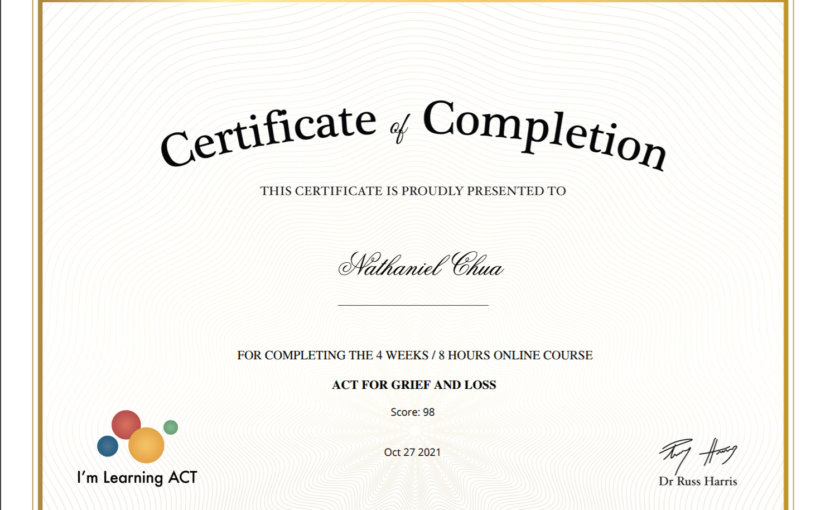
Grief Counseling Module with Russ Harris
Nathan just finished another training module with renowned author and ACT therapist from Australia, Dr. Russ Harris!
What Makes One Life Only Counseling Different?
One Life Only Counseling Services
Good counseling should help you need less counseling over time.
Counseling for Individuals, Couples, and Families
At One Life Only, we use contemporary approaches grounded in contextual behavioral science, particularly Acceptance and Commitment Therapy (ACT) and Integrative Behavioral Couple Therapy (IBCT).
Rather than simply asking “What disorder does this person have?” we ask a different question:
“What is keeping this problem going—and what can we change that will make a meaningful difference?”
This means counseling is not intended to become an endless process of talking about the same difficulties. Our goal is to help you understand the patterns keeping you stuck, develop more workable ways of responding, and eventually become less dependent on counseling—not more.
One Life Only may be a good fit if you are looking for counseling that is structured, collaborative, and grounded in contemporary behavioral science.
Our aim is to help you understand the patterns that keep problems going, develop more workable ways of responding, and build enough confidence and flexibility that counseling becomes less necessary over time.
If you are looking for counseling in the Philippines, One Life Only provides in-person counseling in Quezon City and online counseling for individuals, couples, and families throughout the Philippines. We work with concerns including depression, anxiety, trauma, relationship and family problems, insomnia, anger, infidelity, parenting difficulties, grief, addiction, procrastination, and work-related concerns.
Please text (preferred) or call:
Mobile Number: +63 917 886 5433 (LIFE)
Available also on iMessage, Viber and WhatsApp!
(The best option is to message this number through Viber or WhatsApp and we will gladly call you back or reply!)
Email:
Connect with us through Facebook, follow us through Spotify and YouTube.
Our office is located in Quezon City, Metro Manila, Philippines.
M Place South Triangle
8004 Mother Ignacia Avenue, Quezon City, Metro Manila, Philippines



The counselor is also an author!
Nathaniel Chua is the author of two books!
Writing under the pen name, Starfly Chua.
New Release!
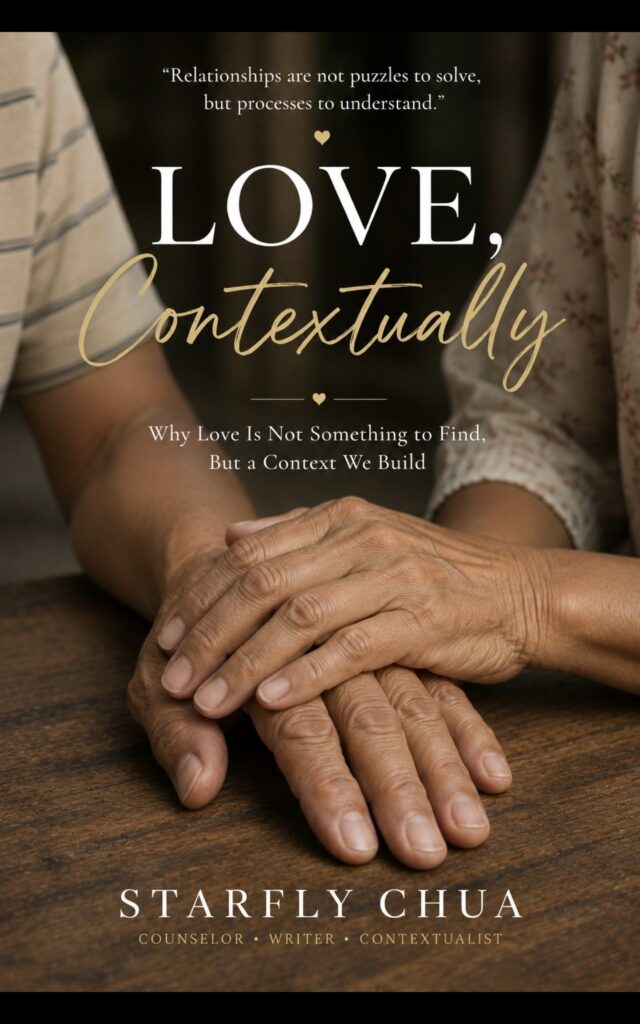
Many relationship books tell us to find the right person or master the right techniques. Love, Contextually takes a different approach. It invites readers to see love as something we continually build within the context of two changing people living through changing circumstances. Drawing from years of counseling experience and contemporary contextual behavioral science, the book offers a compassionate, practical, and refreshing way to understand conflict, deepen connection, and cultivate healthier relationships.

Better People, Better Country: A Psychological Blueprint for a New Philippines,
published under the pen name Starfly Chua.
The pen name was chosen in homage to his grandfather and his ethnic Chinese roots, and reflects a preference for allowing ideas to stand on their own—without emphasis on personal visibility or status.
Here are selected endorsements from international colleagues and clinical experts:
This book is a fascinating personal exploration and cultural adaptation of contextual behavioral science applied to psychotherapy. It takes you, with great clarity and humility, from the philosophical foundations of functional contextualism all the way to its practical applications in Acceptance and Commitment Therapy. The way it addresses the challenges of psychological well-being in the Philippines makes it a particularly valuable contribution.
Dr. Matthieu Villatte, PhD, Co-author of Mastering the Clinical Conversation: Language as Intervention
Better People, Better Country offers a transformative shift in perspective, moving from rigid cultural rules that invite moral shaming toward one of contextual understanding. Both deeply personal and extensively practical, Starfly Chua provides a psychosocial blueprint for change and progress at multiple levels of human existence. This book is an invaluable resource for the people of the Philippines because it moves beyond the exhausted cycle of demanding ‘better people’ and instead provides the tools to build ‘better contexts’ — systems that naturally support prosocial values that benefit citizens and country alike.
Lou Lasprugato, MFT
Peer-Reviewed ACT Trainer
For far too long, theories of human behavior and psychology have been relegated to the therapy room, used in private, and often at the individual level. We now have advanced psychological theories that can explain and help foster change at the societal level.
Chua reaches for the same shining star that famed behavior analyst B.F. Skinner once reached for, applying cutting edge behavior change technology to the community at large—not just for the purposes of greater mental health—but for more workable societies. Chua doesn’t just reach for this star, he grasps it firmly. Laid out in this book is a set of common sense reforms that could revolutionize the Philippines and the world at an achievable cost: our own willingness.
Jacob Martinez
Practicing Counselor
Wisconsin, USA
To find out how you can get copies of his books please click here.
Nathaniel Chua is also a member of an international organization called the Association for Contextual Behavioral Science (ACBS). He once became chair of the Diversity, Equity, and Inclusion Special Interest Group (DEI-SIG) of ACBS; the first Non-North American to do so.

Nathaniel Chua has a Master’s Degree in Counseling and continues to learn more of the most cutting-edge approaches to working with the human condition.
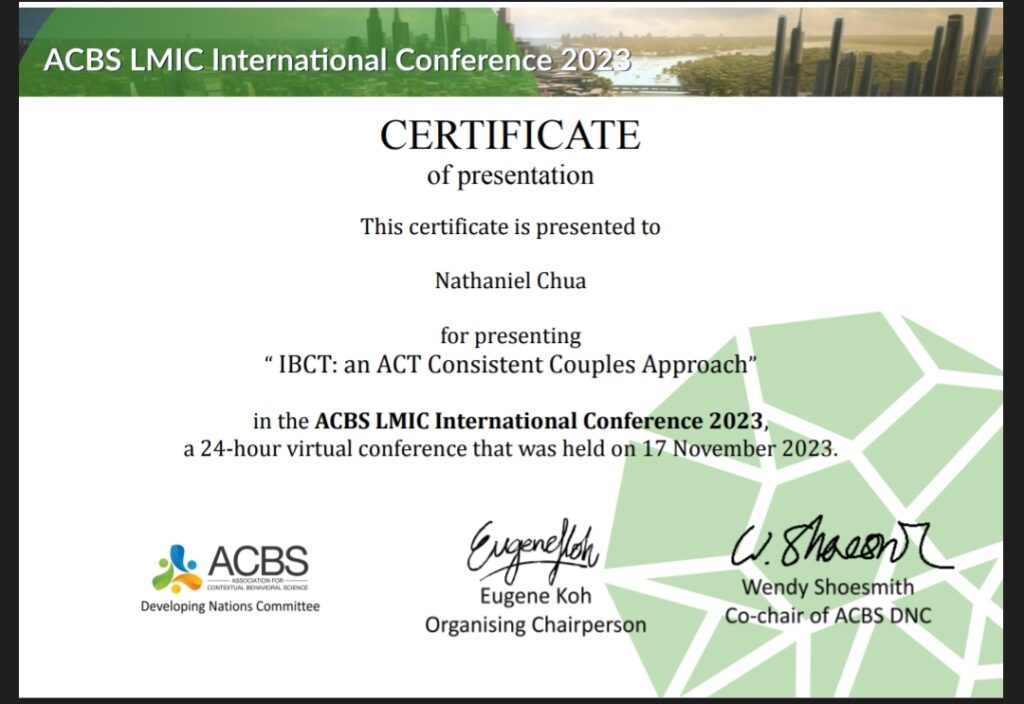
Below is Nathaniel Chua’s first virtual talk held on November 17, 2023 in front of an international group of therapists from Low or Middle Income Countries (LMIC). He is the first from the Philippines to do this:
What is One Life Only Counseling about?
We value and respect your privacy, and what you share with us is treated confidentially.
You will be respected regardless of your religion, sexual orientation, gender identity, ethnicity, economic status, lifestyle, or personal values. We are LGBTQIA+ friendly.
Your counselor will not impose personal beliefs or values on you.
We welcome people from all faith traditions—and those with no religious affiliation. Spirituality and belief can be deeply personal. For some people they are sources of strength; for others they may also be sources of difficulty or conflict.
Our role is not to tell you what you should believe. It is to understand what matters to you and help you move toward a life and relationships that are more consistent with your own values.
Nathaniel Chua, MA
Functional Contextualist Therapist
ACT & IBCT Specialist
Our work is guided primarily by Acceptance and Commitment Therapy and Integrative Behavioral Couple Therapy.
Both approaches are grounded in functional contextualism—a scientific framework that seeks to understand behavior within the circumstances in which it occurs.
Rather than asking only whether a thought, feeling, or behavior is “good” or “bad,” we ask:
What function is this serving?
What keeps this pattern going?
And is it helping you move toward the kind of life or relationship you want?
What is functional contextualism?
Functional contextualism begins with a simple idea:
Behavior does not happen in a vacuum.
Every action, thought, feeling, memory, and reaction occurs within a particular context.
That context includes your history, relationships, environment, culture, learning experiences, expectations, and what is happening around you now.
Understanding that context can help us make better sense of why certain patterns continue—and what may help them change.
What we mean by behavior?
Behavior is not limited to what other people can see.
It also includes private experiences such as thinking, remembering, imagining, worrying, avoiding, planning, and interpreting what is happening around us.
Some behaviors are observable. Others happen quietly inside us.
Both matter.
What we mean by context?
Context is more than the physical place you are in.
It includes your personal history, relationships, memories, culture, present circumstances, and the people who have shaped your life—even when those people are no longer physically present.
The same person may respond very differently depending on stress, sleep, conflict, safety, expectations, past experiences, or the environment they are in.
That is why we try to understand the whole situation rather than judging behavior in isolation.
What we mean by function?
Every behavior occurs for a reason, even when that reason is not immediately obvious.
The “function” of a behavior refers to the role it plays within a person’s life.
For example, avoiding a difficult conversation may reduce anxiety in the short term, even if it creates more problems later.
Anger may sometimes protect a person from feeling vulnerable.
Withdrawal may temporarily reduce conflict while also increasing distance in a relationship.
Understanding the function of a behavior does not mean approving of it.
It means understanding what keeps it going so that more workable alternatives can become possible.
What we don’t believe or practice:
We don’t see you as “broken” or as a set of symptoms to fix. Outside of major physical damage or impairment, there’s no solid science proving that everyday behavior is caused by some permanent biological flaw.
You’re not a checklist of traits scored four-out-of-seven or five-out-of-nine. You’re a complex, whole, and freely choosing individual whose actions make sense in the context of your life.
Beyond Labels
Diagnostic labels can sometimes be useful for communication, research, or access to services.
But they do not tell us everything we need to know about a person.
At One Life Only, we place greater emphasis on understanding your individual history, circumstances, patterns, values, and goals than on reducing you to a diagnostic category.
We are interested in the person behind the label.
More Than Test Scores
Psychological tests can provide useful information in some settings.
Our counseling work, however, places greater emphasis on conversation, observation, history, context, and the patterns that emerge in your actual life.
No single score can capture the full complexity of a person.
We therefore focus on understanding how you think, feel, relate, respond, and make choices within the context of your life.
Medication and Counseling
Medication can be useful and, in some cases, important.
Decisions about medication should be made with an appropriately qualified medical professional.
Our role is to focus on psychological and behavioral processes: helping you develop greater flexibility, understand difficult patterns, respond differently to thoughts and emotions, and build a life that reflects what matters to you.
When appropriate, counseling can work alongside medical care rather than being treated as an alternative to it.
A Science-Based Approach
Acceptance and Commitment Therapy has been studied across a wide range of psychological and behavioral difficulties.
ACT-based principles have also been adapted into public mental health programs designed to help people cope with stress and difficult life circumstances.
The World Health Organization has used ACT-informed material in its stress-management resources, including *Doing What Matters in Times of Stress*.
For us, the important point is not that one therapy can solve every problem.
It is that people can learn skills that help them respond more flexibly to difficult thoughts, feelings, and circumstances—and continue moving toward what matters even when life is hard.
Counseling With a Clear Purpose
Therapy should not be a random collection of techniques.
Different methods can be useful, but they should fit within a coherent understanding of the problem and the goals of counseling.
At One Life Only, the techniques we use are guided by an underlying framework.
We do not simply ask:
**“What technique should we try next?”**
We ask:
**“What is happening here, what function is it serving, and what response is most likely to help this person move toward what matters?”**
Every intervention should have a reason.
Every step should have a purpose.
And over time, good counseling should help you become increasingly able to navigate your life without needing counseling to do it for you.
Here’s a video about what makes One Life Only Counseling Services different:

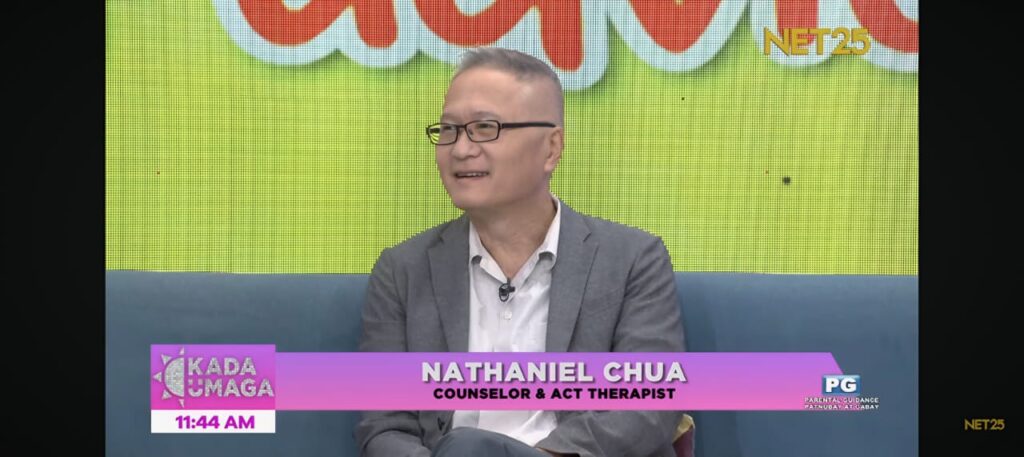
Nathan Chua has appeared on mainstream media in the Philippines to discuss ACT and functional contextualism in a way that remains faithful to the underlying model.
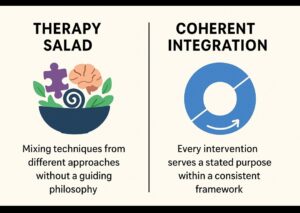
Being faithful to the model means therapy is not simply a collection of techniques chosen at random. A “therapy salad” approach can mix methods without a clear rationale, which may make counseling feel fragmented or confusing.
An integrative approach, by contrast, is guided by a unifying framework. Different methods may still be used, but they are selected with purpose and connected to a clear understanding of the client’s goals and the patterns keeping them stuck.
In other words, the question is not simply, “What technique should we use?” but “Why are we using it, and how does it fit with what we are trying to change?”
Here are some of the testimonials that people have given for our work.
From a parent:
My son was diagnosed with Major Depressive Disorder. He’s been undergoing therapy each year between June to September. He’s given synthetic meds in between therapy but i am not seeing consistent progress.
We needed to find a psychiatric support that can really help him.
It was a blessing indeed when i met one of the resource speaker from our community event that introduced us to sir Nathaniel.
Here’s an excerpt from my son’s long message to me …. “learning a lot through this therapy and had a ton of realizations din so i wanna say thank u so much ma…”
One life Only counselling services is truly effective and i hope it can help more people who suffers from mental health concerns.
From a partner:
Nathan is amazing! We learned so much about our relationship in just a few sessions. He also gives reading references, which helps a lot to navigate the information he provides in his session. Overall, would recommend to any couple in need of counselling.
From a husband:
Me and my wife ran into a bad patch due to outside pressure put onto our marriage.
I decided to book a set of appointments with one life and I can say it help so much I wish we went years ago. We have an amazing marriage and friendship.
Best thing we ever did.
Please click the link below for more:
https://share.google/RV5f9DYNVeURSGIJ8



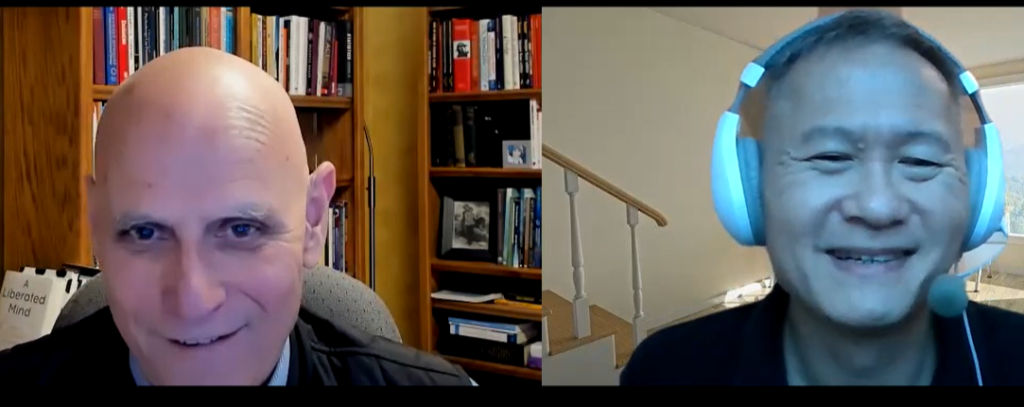
He has also done interviews on YouTube with the developers of ACT and IBCT.
Here is a live interview on Kada Umaga on Net 25 starting at the 25 minute mark:
Here’s a solo interview of Nathan Chua with an ACT Matrix Expert and Counselor from the United States, Jacob Martinez:
Interviews with the experts:
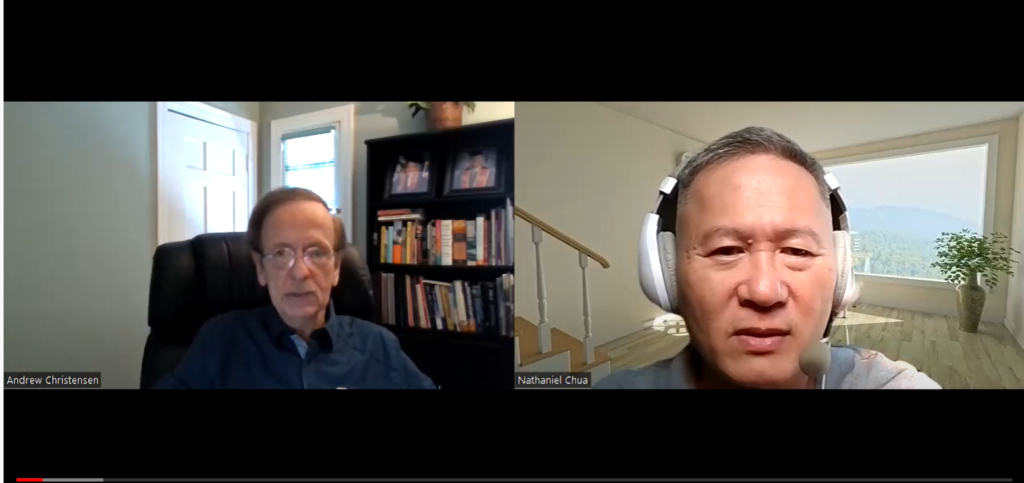
Here are two interviews with the two experts that have had a huge impact on my work in recent years. They are with Dr. Steven Hayes and Dr. Andrew Christensen. Here are the videos: