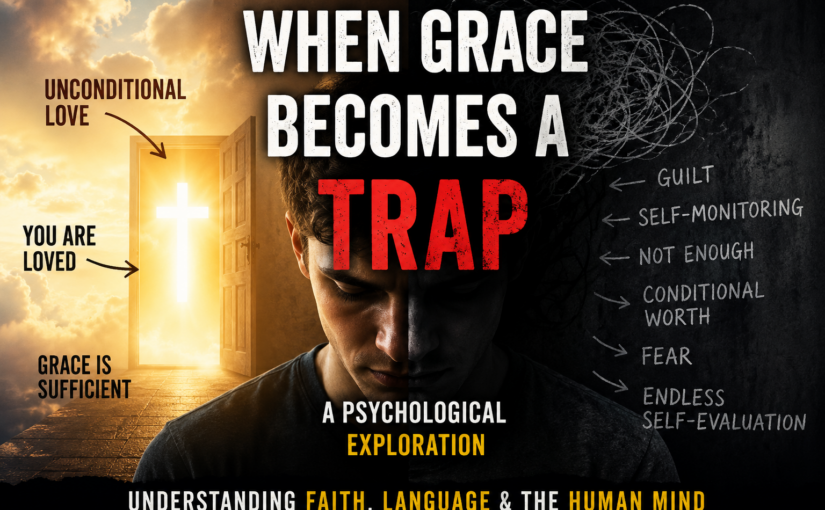
but minutes later you begin wondering whether you are truly righteous enough, faithful enough, or transformed enough?
You leave inspired — but also anxious, guilty, and psychologically trapped.
This video explores how certain forms of religious language can unintentionally create chronic self-monitoring, fear, guilt, and endless spiritual self-evaluation.
This is not an attack on Christianity or faith.
It is an exploration of how language functions psychologically.
Drawing from contextual behavioral science, ACT (Acceptance and Commitment Therapy), and functional contextualism, I discuss:
rule-governed behavior
guilt as behavioral control
coherence traps
fusion with moral narratives
chronic spiritual self-monitoring
and why some people become experts at monitoring themselves spiritually instead of actually living
I also speak from personal experience as someone who once deeply preached and believed these systems myself.
The issue is not whether faith is “true” or “false.”
The issue is whether certain psychological patterns increase rigidity, fear, and suffering — or create greater flexibility, compassion, and humanity.
Many people today silently struggle with:
religious guilt
scrupulosity
fear of not being “saved enough”
compulsive self-monitoring
or the exhausting pressure to appear spiritually transformed at all times
These struggles are rarely discussed openly because they are often mistaken for spiritual weakness rather than understandable psychological processes.
My hope is that this conversation creates space for deeper reflection, honesty, compassion, and psychological freedom.
📌 Watch the full video below.
One of the fastest ways to destroy a relationship?
Using threats to get what you want.
Bakit kapag tinatakot mo ang partner mo… mas lalo siyang lumalayo?
“Pag umalis ka sa akin, hindi mo na makikita anak mo.”
“Mag-iiskandalo ako.”
“Subukan mo lang, tingnan mo gagawin ko.”
These sound powerful.
Pero in reality…
👉 ito yung mga bagay na mas sumisira sa relationship.
Kasi when you use threats:
Oo, minsan susunod siya
👉 pero dahil sa takot, hindi dahil sa pagmamahal
And over time…
👉 the relationship becomes about escape, not connection
From a behavioral perspective:
👉 Pressure changes how the relationship feels.
Instead of:
safety
trust
It becomes:
tension
control
walking on eggshells
And here’s the painful part:
👉 The more you try to control someone…
👉 the more they start wanting to get away
This doesn’t mean:
❌ “Wag ka na magsalita”
❌ “Hayaan mo na lang lahat”
It means:
👉 How you influence matters more than how strong your words are.
Because in the long run:
👉 Fear can force behavior
👉 But it cannot build a relationship
If this pattern feels familiar in your relationship,
there are ways to shift it without losing yourself.
Feel free to message me.
“Hi, this is Nathan again. Today I want to answer a simple but important question: How does humor actually help couples? I’ll be sharing from the lens of Integrative Behavioral Couple Therapy, or IBCT.”
“One of IBCT’s goals is what we call unified detachment. Instead of blaming each other, couples step back and look at the problem together — like scientists observing a pattern.
Humor is one of the best ways to do this. When couples laugh at how predictable their fights are, the problem becomes something they face together, not something that divides them.
For example, instead of saying, ‘You’re always late, you don’t care about me,’ one partner might joke, ‘If lateness were an Olympic sport, you’d win gold.’
That moment of laughter changes the energy. Suddenly, it’s not me versus you — it’s us versus this quirky pattern.”
“Second, humor reduces defensiveness. Couples can get stuck in cycles of criticism and withdrawal. A light, well-timed comment can soften the tone and break the cycle before it escalates.
It’s like putting a pin in a balloon before it bursts. Humor diffuses the tension so the conversation can continue in a gentler way.”
“Third, humor helps with acceptance. In IBCT, we encourage couples to not just push for change, but to also accept differences with warmth.
For example, instead of demanding, ‘Stop worrying so much,’ a partner might smile and say, ‘If worrying burned calories, you’d be the fittest person alive.’
That’s not an insult — it’s a playful way of saying, ‘This is how you are sometimes, and I see it with love.’
Humor makes quirks feel more tolerable, more human.”
“And lastly, humor strengthens intimacy. Shared laughter creates bonding. It reminds couples, ‘Hey, we’re in this together.’
In IBCT terms, it turns recurring struggles into part of their unique story, not proof that they’re incompatible. That sense of togetherness makes it easier to work on change later, because the bond feels strong.”
“So, to summarize, from an IBCT perspective, humor helps couples by:
1. Helping them see problems as ours, not yours.
2. Reducing defensiveness.
3. Opening the door to acceptance.
4. Strengthening intimacy and bonding.
Of course, the key is that humor must be gentle and shared — laughing with, not laughing at. Used wisely, humor is one of the most powerful tools to bring couples closer together.
Thanks for watching. If you found this helpful, feel free to share it with someone who could use a little lightness in their relationship.”
I am writing this not to advocate for any external form of ritual bonding for couples. I have lately ended up telling my clients that neither am I a priest nor a pastor. I am not here to judge what their lives are and what they’re supposed to do or not. I am duty bound to respect anyone who comes to see me for their important questions about their lives. So it doesn’t matter if you’re monogamous or polyamorous, straight or non-straight, what ends up mattering in our work is if you are living your life according to your best hopes for your short existence.
Now let’s get on with the topic at hand. How many times have you ended up being in a long(er) term relationship with someone who turns out to be totally different from your own images of what a pair bond is supposed to be? Have you ever heard of people who have jumped from one abusive relationship to another? Here are some tips about knowing if you have someone worth considering in front of you:
Be Mindful, Not Blind:
It is understandable that you may have a shortlist of what you want to look for in a partner. This certainly provides greater probability of success than just random choice. Unfortunately, predicting how you and another human being will do in a close relationship is something that the shortlist will never be able to guarantee. What I am saying here is that people are unique and can hardly be summarized in a short checklist. No matter how long this list will be, not one person can match everything that you want.
Getting to know someone is pretty much like learning how to ride a bike, swim, or even walk! There is no instruction manual good enough or long enough to tell you how to do these activities. And so it is with relationships! You won’t really get to know a person thoroughly by just comparing them to a checklist of qualities. Why? Because all behavior happens in context. It’s easy to think about a person’s behavioral choices in a vacuum. We usually do not appreciate the contexts in which these behaviors happen and blindly follow rules that end up with well, blind choices. Your potential mate may be nice in a date, but what are they like in traffic or stressful situations?
There are certainly good reasons why we should trust our minds when it comes to fending off a virus or an infection. But trusting our logical minds to fend off the difficult feelings, thoughts, and memories that we experience in relationships, is a route towards possibly worse outcomes. I often use an example of how our problem-solving minds are an absolute gift. Mosquitoes are some of the worst threats to our health. Without our problem-solving minds, we would not learn to slap them dead on our arms or invent a lotion to repel them. We are quick to apply the same kind of problem-solving skill to our feelings and thoughts. The bad news is there is no slap strong enough to keep your feelings away, nor is there an off lotion version that works to remove our unpleasant internal experiences. If there was, please tell me. Unless it’s some sort of drug or substance that sedates you, then feel free to reach me so I can take these substances myself. I don’t think living a life numbed out or sedated is what I bargained for.
Why is this worth mentioning? Well, in a relationship your logical, sensical mind will tell you that your partner should never arouse any difficult feelings. So, good luck with that if you aren’t mindful enough to notice the rule inside your head. Relationships come with feelings. In fact, you wouldn’t be in a relationship if it meant you were just going to be half awake all the time. You’re there to feel something moving and purposeful. You’re not there for a stale lifeless existence! So be mindful of what you see in your partner in different situations. See if you share the same hopes and cherished values.
Keep in Touch with your Feelings:
As you spend time with a person, you would probably get a sense of what it feels like to be in their company. Do you feel a sense of loneliness? Maybe you are with someone who is preoccupied with themselves; they hardly hear what you have to contribute. Do you feel incensed or angered that this person can’t make a commitment to arrive on time or do as they promise to do? Maybe this person is lacking in empathy and consideration.
If you are one of those who jump from one abusive relationship to another, then maybe it’s time for you to step back and listen to your feelings. Maybe you are so tunnel-visioned into thinking what story your mind is creating about your long term relationship. Maybe it’s time to wake up and check your feelings when you are with this person.
I remember a story of the character of Lt. Dan in the movie Forrest Gump. He, like all of us, created a story of his fate after the Vietnam war. He wanted to die in war just like his war hero ancestors. Just as you and I know, sometimes life happens however. In his case, Gump happened…to save him from his inevitable passing as a war hero. Unable to reconcile his experience with the story his mind wanted to create, he lived his life purposefully wasting his time fighting the memory or thoughts of an opportunity lost with the amputated legs serving as a constant reminder of a missed opportunity to fulfill his mind’s vision of a destiny. In the end, he realized that he can still be the hero unto himself; the one who harbored a hope of living his life without his amputated legs but with much purpose as just Dan, the man, who may not be the war hero he dreamt of becoming, but a person of worth nonetheless.
Just as Lt. Dan started to let go of his grand story of what he wants about his life, maybe you also can hold these love stories lightly, and see if this person is worth your time and love.
I remember some of the most fun I had back in my school days, was when we had to do role plays. Not just any other role play, but actually create a skit as a medium to learn. There’s also very little pressure as these were done in front of a class only and not a major production wherein a whole auditorium of students were there to watch.
My Louis Vuitton Story:
I once entered an LV store in Metro Manila, and scoured through some of the merchandise. As I was doing that, I noticed the attentiveness of the sales people as there were hardly any people around who were shopping. I looked at some items that I thought were very impressive and their price tags. As I was on my way out, I said, “I love your products but I can’t afford any of them!”
Walking around with plastic buckets:
Have you ever had a time when you and your friends went out and knew that you were all going to do something rather unconventional and at times downright embarrassing? Of course, always in the spirit of good clean fun. Well, I am one of those who has gone out with a group of my high school male friends wearing clothes that should only belong to the home, carrying plastic buckets and brooms, and going inside a mall to deposit the stuff we had at the front of the department store where people usually leave their shopping items.
Ordering a siopao at Mcdo:
When I am in a fast food restaurant, I sometimes order something obviously unserious at the counter. For what reason? Nothing just for fun! As the heading for this paragraph tells you, I have in the past ordered the Jollibee Chicken Joy at a McDonald’s restaurant!
Which leads me to how I got to think about writing something like this for all of you. When I did those I did not know anything about contextual behavioral science. About a couple of weeks ago, I found an online audio resource created by Steven Hayes, the developer of ACT (Acceptance and Commitment Therapy) and RFT (Relational Frame Theory). He shared one of the ways we can pop that bubble or illusion that says we do what we think, by doing exactly what I had been doing sporadically since oh, high school? I hadn’t realized doing these crazy things weren’t just fun, they were also about letting go of some of the rules that we tend to sell our lives to! What I was doing was letting go of the rules that shackled me from pursuing what would be psychologically risky, but at the same time liberating. I can choose to be how I want to be at any given moment!
This article reminds me of my father. He was a good but also misunderstood man. Believe me, I was one of those who did. He had always been a businessman who inherited a family business. Through decades of working in the business, he could not manage to make a sizable profit. He found himself mired in debt until the day he passed. There was one skill that we, his kids, thought that could have made him a world-class cartoonist. We saw some of his drawings of caricatures of his friends with a pen! His every line had a precision that he didn’t need a pencil to make his initial sketch. Awesome talent that was never discovered nor shared with more people because he thought he couldn’t.
Are you living with can’ts, shoulds, musts in your life? Yeah they sure feel safe, but do they make you feel alive? Doing what your mind tells you you can’t, is a part of the exercise towards breaking that bubble. That bubble that says you can’t get out of that family business that is so comfortably limiting. That bubble that says you can’t do this or that. Don’t get me wrong, it is not my intention to tell you that anyone can be anything. We all do have limits. The question is, have you tested the limits and seen how liberating it can be on that side where your mind says no, you can’t. And maybe you can just, by doing these silly things for nothing, be you, and no one else but you!
Just like probably most of you, I have had questions about whether counseling is worth the effort and the risks involved. Common reasons would be:
The stigma attached to seeking assistance from a mental health practitioner,
Talking to a stranger about very private information is scary,
Counselor might not be as good as you would expect,
it could even worsen your situation.
I have also asked some of the experts in my field that I know. Why would risking talking to a stranger be worth it when these problems would soon go away anyway?
Here are some examples of what I mean:
Well, I haven’t had anxious feelings lately because my partner and I haven’t had anything to fight about.
I haven’t had any trouble with my addictions, I just stayed away from the places that tempted me to indulge and besides I’ve recently had a religious epiphany!
Yes, it was tough for a while but the memory of my departed loved one has not been as present as it had been, after a year of grieving and also keeping myself busy with work and my kids really helped.
I didn’t have to have those tough moments at work, I just asked for a transfer to another department to avoid that boss I couldn’t work with.
Hey, we were close but drifted apart because we had a disagreement. It is what it is. I’ll live.
Well, here’s a metaphor that I would like to share with you to sort of provide my answer to these objections about counseling. If someone you know got rich because of a process of growing a business and learning from mistakes, compared to someone you know that got rich because that person inherited a large sum of money, then you and I can say that both achieved the same outcome. But the processes were different.
The point here is that there are places and moments where and when you can stay away from the hard stuff that comes with life, but where are you going to go where the thought of the substance, trauma, or abuse or failure or loss, doesn’t go?
Counseling is an invitation to you to join in a process, a journey, through the direction you thought you were capable of taking if only those nasty experiences weren’t there for the ride. And maybe they won’t stop riding along with you. So the work is about how it is that you can bring those painful experiences with you as you stay the course.
And I would bet that that course was established by that younger version of you before you came across this thing between your ears that continues to remind you of past pains, continues to judge, and to compare and stop you from being that innocent you, who just wanted to see and be seen, to love and be loved, to accept and be accepted. In a way it’s sort of a journey towards regaining our innocence. There is a term for that innocence throughout humankind’s history: the ancients called it spirituality and in contextual behavioral science, we call it you-as-context.
Let me end with a quote from Dr. Steven C. Hayes, the instigator of ACT or Acceptance and Commitment Therapy, that can partly explain what it means when we lose our innocence and regain that spiritual sense of ourselves:
“Language has been said to have produced a “loss of innocence” in humankind. The story of Adam and Eve is perhaps a reflection of this thought. Spirituality is said by some to reestablish a kind of “experienced innocence.” Like the Zen koan that asks “does a dog have Buddha-nature?” We find that we cannot really go back, but that spirituality (you-as-context) offers one possible solution to the dilemma. Through a second type of contingency-shaped behavior, it may weaken automatic rule-control and allow the direct contingencies themselves to take more control. As one Eastern monk puts it “When I am hungry, I eat; When I am tired, I sleep.”
Having a long term relationship primarily involves two things. Can you guess what they are? The answer could be as simple as acceptance and change. Just like the lines in the Serenity Prayer by Reinhold Niebuhr, a big part of the work I do in individual, couple, and family sessions can actually come to just these two options as people face challenges in their relationships with themselves and their significant others.
I often ask a few questions to my couples once they get to the feedback session, “If you’ve seen a few of those silver or golden anniversary celebrations, what do you notice is usually part of the ceremony? Do you see the couple face each other and say something about their relationship? What do you often see included in their speeches for one another?” After a few guesses and not hearing what I expect them to say, I would add that couples usually talk about the funnier parts of their history together. In fact, couples call each other by their pet names which, especially in Filipino culture, could be endearingly funny. So the answer to the question is humor.
Why is humor important? Because humor signifies a level of acceptance that couples have for each other, knowing that certain things are difficult for them or their partners to change. It also involves a greater awareness of their benign albeit hidden intentions. If one is messier than the other, the neater partner usually only sees a lazy and defensive partner. But once the messier partner feels accepted while the neater partner sees how much the former is trying their best to keep up with the neatness, the human compassionate side starts to kick in. Because like it or not, your partner will probably forget the way you want the stuff on the kitchen counter to be arranged. In other words, it’s not going to be perfect most of the time.
Acceptance:
Let’s first talk about acceptance and why it could be your road to change. Please note though that acceptance is never something that we can demand from each other nor from ourselves. Here’s a quote from Dr. Andrew Christensen et.al.:
“Change is the brother of acceptance, but it is the younger brother. When acceptance comes first, it paves the way for change,” Christensen, Doss, and Jacobson.
It is understandable for couples to come to therapy thinking that they’re there to follow certain rules about how to change their partners or how to change the way they communicate with one another. Anyway, isn’t this the reason why they came to see a trained counselor in the first place? Well, if you find your counselor providing simple solutions to many of your communication problems, then maybe that’s a sign you might have to go elsewhere. Why? Because those very same simple solutions are probably nothing new to what you are already doing. If psychology was done this way then there is no need for its study. All we would need is some good old common sense. For example, simple solutions like making plans for a partner to pick up their socks when they remove their shoes and put them in the hamper. Couples who agree to these types of interventions usually end up fighting about the rules learned in counseling. It can also breed resentment in the partner who is not sided with by the counselor. Moreover, these are new rules to again fight about. Well, one of you is not following the agreement which means another demand and another source of frustration.
It is through acceptance that what we see in our partners as defects turn into the differences they were between you from the very start. Humor is a big part of this process of accepting that your partner will not be your clone. It is also through acceptance that we humans feel moved to change. When others accept us in all our uniqueness, we find the space to feel compassion when we sense that our partner is accepting us even if we snore too loud at night, or cleaning up after us even when they had a long day at work. That compassion is what can trigger more lasting change. It is self-motivated and not coming from an outside expert who probably doesn’t know the full context of your relationship.
Change:
“If we want things to stay as they are, things will have to change.”
― Giuseppe Tomasi di Lampedusa
The change we are looking for, is a change from within. If you go to a counselor and feel like he or she is taking either side of the equation, then that means your counselor is not doing anything that you and your partner haven’t already tried. Your counselor is just adding another voice to either side of the argument. You go home with a full set of rules that are hard to remember in flight and hard to maintain as old habits are difficult to eradicate. In other words, we slip into our old patterns just like all humans do.
Deliberate change can be done in order to avert cumulative annoyance. When I say deliberate it means that the change is coming from a more mindful partner who is capable of seeing the world behind your partner’s eyes. Knowing your partner’s sensitivities and unique history of past relationships with family, friends, ex-romantic partners and many more is your template to doing things more slowly in the face of challenging situations. In fact, if there is indeed a rule that universally applies to any relationship struggling or otherwise, it is simply to slow down and become more mindful or aware of your differences, sensitivities, context, and ways of communicating.
So slow it down and try to get a wider perspective in the heat of the moment. Remember what you wanted to be when you first said yes to the relationship. Can you say yes to the full package and continue to persevere towards your best aspirations you have for yourself in the context of a long term relationship? You can’t slice your partner in half because they come in one package. You only have to remember what you cared about deeply as you jumped into this relationship. Maybe that holds the key and having a good sense of humor about your differences can be one of those endearing things about your partner.
No, you’re not. You are called by a name, and I don’t think your parents or guardians would name you, “Depressed!” Yes, this is kind of a play on words, but it can also serve as a reminder to you that your depression doesn’t define you. I have met a good number of clients who have come to me saying that they have been diagnosed with major depression and subsequently medicated for something they are supposed to have that causes the depression…some sort of brain disease. It no longer surprises me when clients come to me and say that they had a chat with their provider for 15 minutes and voila, they are labeled as being stricken by something that is called major depressive disorder or MDD! Sad to say you’re broken and you need some fixin’!
These conclusions are made in the service of a manual that says someone has a problem with depression when it lasts for a couple of weeks or more, plus a few other criteria listed. Most people who get such a diagnosis often end up feeling like they have very little control over their choices regarding how they want to spend their time. Much of their time from thereon will be focused entirely on getting rid of this depression. They begin to adjust their lives and expectations about their lives and their relationships around a diagnosis. People have to be careful about my feelings. They shouldn’t say anything that can trigger my depression or sense of self-worth. All of a sudden a mask is worn throughout their remaining existence.
A few words about our sadness:
I have recently shared this thought experiment about our sad feelings. It speaks about how understandable our negative feelings are. If you were in a funeral wake to visit the friends and loved ones of the departed, wouldn’t you be surprised if anyone came in without at least a tinge of sadness in their face? If you lost someone you cared for, would you think you’re abnormal for feeling sad? Wouldn’t you once in a while even after years following the death of a loved one, still feel a sadness that comes with a reminder of the person who once meant so much to you? Wouldn’t that be about just being a person who has feelings? And yet we have a system or a culture that says you only have a couple of weeks to get over your sadness.
The loop:
I remember an expert sharing that depression as we interpret it today, is not about the presence of sadness, but the unwillingness to feel sadness. The loop happens when you and I try to get rid of our feelings of sadness. This can come in many different forms. We may try to distract ourselves, opt out of activities we enjoy, ruminate about the guilt and the what ifs, and some of us even take substances. The sad news is unless you have a major brain injury or you are close to that age when you get hit by Alzheimer’s, you will experience sadness sooner or later. No amount of avoiding can help you on your way to being unable to feel. Take it from me, there are times I wake up feeling sad for no particular reason at all. That’s just the case about feelings. They visit us once in a while and they come and go of their own accord.
In short, the loop kind of looks like this, you don’t only feel sad, but also feel sad that you are sad.
It’s not what you are, it’s something you have:
You are not a walking depression. You can just observe. Take a full day without any medication and see if you will feel sad 24 hours non stop. Chances are you will find that your sadness only visits you in spurts. And when it is a longer spurt, chances are you are trying to suppress it. The problem with that strategy is that the more you try to forget about your sadness, the more you remember. Because trying to forget something only reminds you of what you have to forget!
The meaning behind the sadness:
Finally, this article won’t be complete without some kind of redemption. If our sadness were meaningless then I would be first to recommend that all of us should find ways to escape it. For example, if you were being physically or verbally abused by a partner or a guardian, this is needless pain that all of us can and should avoid. But the kind of sadness I speak about here does stand for something. Our sadness means we have lost something or someone of great value to us. We have sad feelings for a reason. We are sad for the loss of a loved one because…we loved them! If our sadness stood for something as life-changing and powerful as love, then why should we be ashamed of it?
I remember an author and psychologist mention that we have tears come out of our eyes because they were meant to be seen. I often say this to my clients, your tears today tell me something about you that any form of running away from or medicating your way out of your sadness cannot. They tell me something about you that makes me feel connected to you. You’re just as human as I am.
So next time you lose someone or something that matters to you, take a moment and look at the other side of the coin. This moment is precious because your sad feelings tell you you have lost someone precious. And for you to feel the pain of the loss, is the essence of why it is both difficult and a privilege to be part of the human species.
“…for better, for worse, for richer, for poorer, in sickness and in health, to love and to cherish…”
This is for all the June brides and grooms out there!
When we hear this vow at wedding ceremonies, some of us can’t help but sense the daunting task ahead for the couple. However, what’s lost in these words involves one of the main reasons why couples don’t end up fulfilling these promises: context or changes in the couple’s contexts. Many marriages end not in particularly distressing times. I don’t have the data on this, but just by my experience in working with couples, the best of times do not shield a relationship from conflicts that may lead to separation or an unhappy co-existence.
Some changes in context come in the form of challenges to their dreams of what constitutes a happy marriage, or the rules that they thought would be followed faithfully. For better, for worse, for richer, for poorer, in sickness and in health, all describe a context wherein couples commit to standing their ground and being with each other in the most trying times. These are changes in context that are descriptive of major crises that heighten the solemnity of the event. Perhaps few couples realize that the moments when there are no crises can also set their course. Maybe an in-law is coming for an unwanted visit, a child is having trouble at school, a car breaks down and a daily routine drive is disrupted. Mundane as they seem, couples who are different, will want to handle these situations differently. Ergo, we hear one of the most perplexing yet tragic complaints from couples. Their fights seem to come from nowhere. Trivial matters become issues that make or break the relationship.
We all operate differently depending on the context. I know I write better when I am in a secluded, well-lit, and quiet place. You may work better when you hear white noise from your favorite mini-component stereo system. Can you imagine how a young couple sharing a small space has to deal with the potential conflict in the context of important deadlines? In other words, there is a confluence of stressful events.
Let’s take another example of a young professional who came to like a partner who was highly responsible and hardworking as they were dating. The eventual boyfriend who she ends up marrying, was very prompt on their dates but could only devote one night a week for a date. She liked that about him as her previous boyfriend was usually just hanging around her, sleeping on the couch and occasionally, shooting drugs. In the dating context, this new guy was an oasis. That context however, changes when they begin to chart their course as a married couple. All of a sudden, that once a week date feels like a concession. The boyfriend and now husband is not addicted to drugs but addicted to work! It’s now the couch surfing boyfriend that’s the oasis. Well, at least he was present most of the time. Another example is a partner you married or committed to because he was very close and loving to his family. I remember some sayings that mothers would usually advise their daughters that however their boyfriends treat their mothers, is the way they can expect to be treated as wives. In fact, your boyfriend was so close to his mom and family, he wanted you to all live in one place. You know where this is going.
So here’s my tip for all of you June brides (or grooms) out there. Be aware that any positive quality about anything, which includes your fiance (fiancee), has a flipside not a darkside. Take social media for instance. They have a flipside depending on usage. Your partner’s most likable qualities have a flipside depending on where you are in your matrimonial odyssey together. To put it simply, not all qualities are likable in all contexts. The trick is to be aware of this and see how you can handle your differences effectively. Remember that wedding vow represents not just your contexts in crises situations, but also your everyday ones. So be more conscious of your everyday wedding vows to avert self-inflicted crises.